
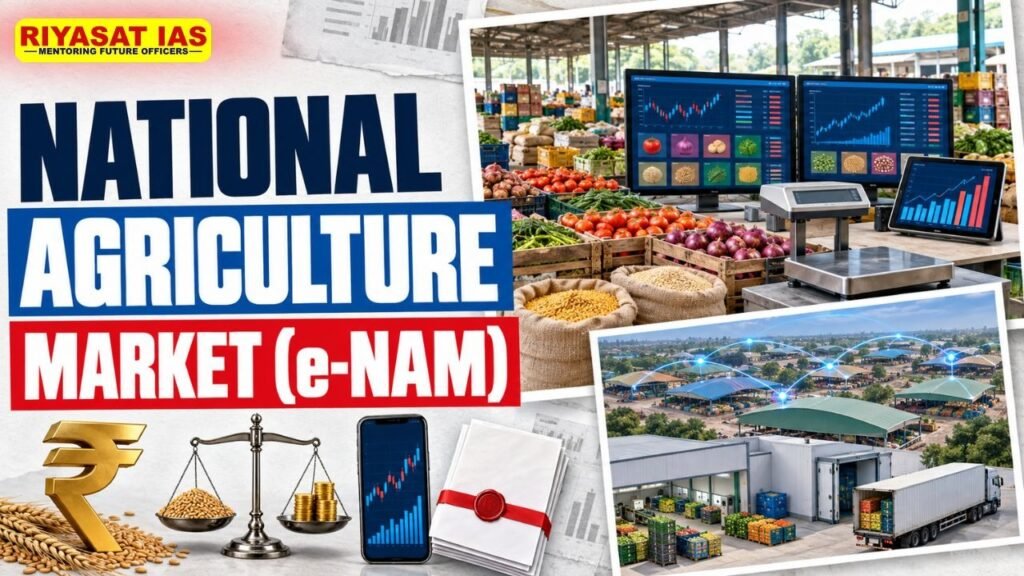
Indian farmers, over decades, have been reliant on their local wholesale markets (mandis). This system led to limited buyer competition, opaque pricing and multiple middlemen. The National Agriculture Market (e-NAM) was launched to disrupt this status quo.
Run by the Small Farmers’ Agribusiness Consortium (SFAC) as a fully centrally funded initiative, and operated by the Ministry of Agriculture and Farmers’ Welfare, e-NAM is the “one nation, one market” approach to Indian agriculture. Farmers could now bypass the tussle of multiple buyers and sellers, and directly trade with buyers across the country via an integrated digital platform.
Key Features
- Online Trading: Buyers and sellers could participate in online trading and avoid traditional mandis altogether.
- Mandi Integration: In a bid to integrate disparate local mandis across the country and offer a more competitive price discovery mechanism for farmers, the software makes a wide range of buyers and sellers accessible to each other.
- Transparent Price Discovery: Dashboards tracking live arrivals of produce and current market rates allow for live electronic bidding.
- Scientific Quality Testing & Grading: To ensure farmers are paid for the exact quality of their produce, crops are subjected to systematic assaying and grading.
- Assaying using AI: AI-powered assaying is now used to grade crops.
- Platform of Platforms (PoP): Launched in 2022, the PoP ecosystem connects farmers to third party logistics, warehousing, trade finance and other advisory services.
- Trading Based on Warehouses: Farmers do not have to sell their crops immediately after harvest. Using electronic Negotiable Warehouse Receipts (e-NWRs), farmers can store their produce in virtual warehouses and trade electronically.
- Direct Payments: Using direct online payments, farmers avoid delays in receiving payments due to disputes over the scale of produce. This leaves a clear digital trail of payments.
- Farmer-friendly Mobile Tools: In addition to mandi bidding and price discovery tools, farmers can also use the application’s Farmer Producer Organization (FPO) module to facilitate their trading. This FPO module was critical in facilitating trading during the COVID-19 lockdowns when the mandis were shut.
Importance
- Price Discovery: The open bidding mechanism based on nationwide price arrivals ensures farmers get the right price for their produce.
- Fewer Intermediaries: While not doing away with middlemen altogether, e-NAM cuts down the number of intermediaries dramatically, leaving only 2-3 per mandi on average.
- Paperless and Reliable Transactions: Virtual bazaars and online payment systems ensure minimal paperwork and faster, more trustworthy transactions.
- Cropping Decisions: By providing farmers with up-to-date price data, they can make informed cropping decisions based on demand in the market.



Milestones and Impact
Since inter-state trading began in 2019, agricultural trade has seen a steady rise. As of March 2026, the software has achieved several scale benchmarks:
- More than 1.80 crore farmers and 2.73 lakh traders are registered on the portal.
- 4,724 Farmer Producer Organizations (FPOs) have been integrated into the digital trading system.
- 1,656 mandis have been integrated across 23 States and 4 Union Territories.
- A cumulative trade volume of 13.25 crore metric tonnes has been recorded between 2016 and March 2026.
- A total trade value of ₹4.84 lakh crore has been recorded between 2016 and March 2026.
- 247 commodities are covered under mobile-based price information services through the e-NAM app.
Ground Realities and Challenges
While e-NAM is poised to revolutionize how Indian farmers trade, the digital trading system still faces several challenges:
Digital Divides: Internet penetration in rural areas continues to be a problem, with teledensity in rural areas at only ~60.92% (as of early 2021) compared to more than 143% in urban areas. This can disrupt live bidding on the portal.
Lack of Hardware: Mandis still lack the digital infrastructure and automated weighing scales and assaying equipment needed to participate in digital trading.
Illiteracy and Risk Aversion: Navigating mobile applications and digital wallets is not intuitive to many people, many of whom have been conditioned to rely on manual systems. Many farmers and commission agents are also risk-averse and would prefer the established, if laborious, manual system.
Fragmented Regulations: Indian agriculture is a state subject, and different states have different APMC regulations. Additionally, inter-state tax and licensing laws add to the transaction costs for long-distance trading.
Limited Commodities: The trading portal only covers a fraction of commodities. There is a need for greater digitalization of perishable and local crops.
Need for Vigilance against cartels: Digital trading systems require greater vigilance against manipulation of prices and bidding.
Way Forward:
Making e-NAM the default mode of trading in India requires addressing some of these challenges:
Internet Infrastructure and Mandi Hardware: Building rural internet infrastructure is crucial, as is outfitting mandis with the necessary digital and weighing infrastructure.
Ground-level Training: Farmers and FPOs need to be trained on navigating the portal, tracking prices and verifying direct digital payments.
Harmonizing Agricultural Laws: Encouraging states to harmonize APMC laws and mutual recognition of trader licenses will reduce transaction costs for inter-state trade.
Cold Chain and Logistics Infrastructure: Building cold chain and logistics infrastructure will complement digital trading systems by ensuring perishable goods reach distant buyers.
FAQs
What is e-NAM?
e-NAM is a pan-India electronic trading portal that connects existing APMC mandis to create a unified national market for agricultural commodities.
Who operates the portal and who funds e-NAM?
The portal is 100% centrally funded and run by the Small Farmers’ Agribusiness Consortium (SFAC) under the Ministry of Agriculture and Farmers’ Welfare.
Does e-NAM do away with all middlemen?
No, while e-NAM reduces the number of intermediaries drastically, it does not seek to eliminate them entirely.
What is the “Platform of Platforms” (PoP)?
The PoP feature, launched in 2022, allows access to a wide range of third-party logistics, warehousing, fintech and crop advisory services.
What are e-NWRs?
e-NWR stands for electronic Negotiable Warehouse Receipts. These are digital receipts given to farmers who store their produce in approved warehouses.
How many mandis and farmers are on the platform?
As of March 2026, 1,656 mandis across 23 States and 4 Union Territories and more than 1.80 crore farmers are on the platform.
Preparing for UPSC? Get personalised guidance.
Join our UPSC Mentorship Programme for structured preparation, answer-writing guidance, current-affairs support, regular evaluation and personalised feedback.


 Ravi Raaz
 Hassan Khan
 Shadab Ali