
A public servant works in a society where people differ in religion, language, caste, ideology, lifestyle and economic position. They also approach the state with conflicting demands. In such an environment, administrative ability alone is not enough. The official must have the patience to engage with difference and the commitment to continue serving even when the work is difficult, unnoticed or personally inconvenient.
This is where tolerance and dedication to public service become important. Tolerance prevents public power from becoming arrogant or prejudiced. Dedication prevents administration from becoming indifferent or mechanical. One protects citizens from the misuse of authority; the other protects them from neglect.
Understanding Tolerance
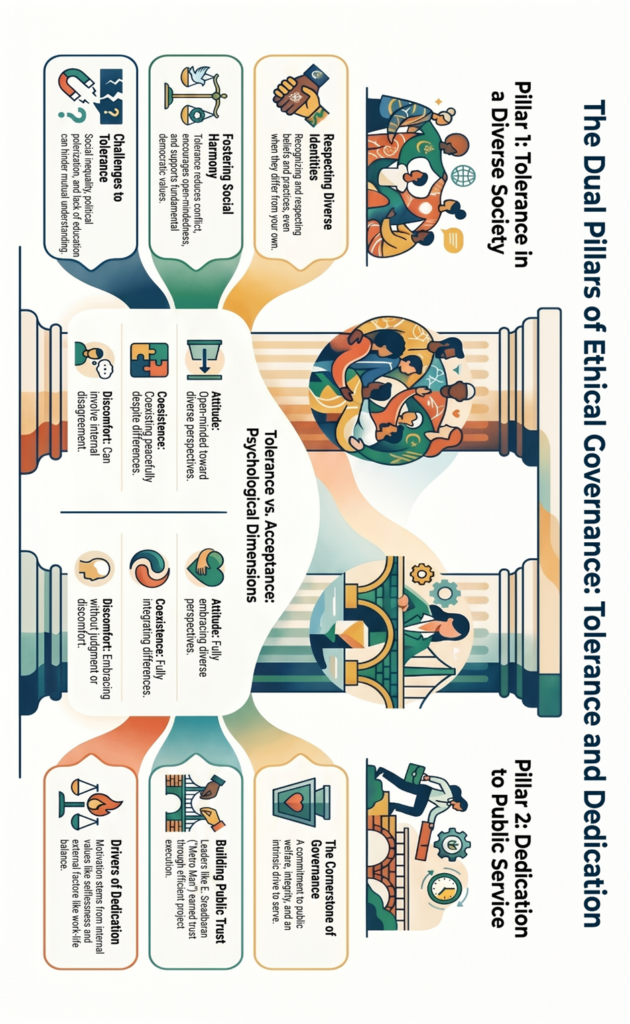
Tolerance is the willingness to respect the dignity and lawful freedom of people whose beliefs, identities or opinions differ from one’s own. It does not require agreement. A civil servant may strongly disagree with a citizen, colleague or public group and still listen fairly, apply the law impartially and communicate without hostility.
Tolerance in administration has three dimensions:
- Personal tolerance: Control over one’s prejudices, irritation and emotional reactions.
- Social tolerance: Respect for diversity in religion, language, culture, ideology and ways of life.
- Institutional tolerance: Creating administrative space for consultation, criticism, peaceful protest and reasoned disagreement.
Thus, tolerance is not merely “putting up with” other people. At its best, it is the disciplined exercise of power in the presence of disagreement.
Understanding Dedication to Public Service
Dedication to public service is a sustained commitment to the welfare of citizens and the constitutional purpose of one’s office. A dedicated official does not treat public duty as a set of files to be disposed of. Such an official tries to understand whether government action is actually solving the citizen’s problem.
Dedication includes:
- Sense of purpose: Recognising that public office exists to serve citizens, especially those who lack influence.
- Perseverance: Continuing to work despite difficult terrain, limited resources, criticism or repeated setbacks.
- Competence: Improving one’s knowledge and skills instead of relying only on good intentions.
- Responsiveness: Acting in time, because delayed relief, pension, medicine or justice may become meaningless.
- Ownership: Accepting responsibility for results rather than shifting every problem to another department.
- Integrity of means: Pursuing public welfare within the Constitution, law and due process.
Dedication may demand extra effort, but it does not mean blind obedience, reckless self-sacrifice or breaking rules for publicity.
Their Constitutional and Administrative Foundation
Tolerance and dedication are not optional qualities added to administration for moral decoration. They arise from India’s constitutional design.
The Preamble promises liberty of thought, expression, belief, faith and worship, along with equality and fraternity. Articles 14 and 15 reject arbitrary and discriminatory state action. Article 19 protects important freedoms, while Articles 21 and 25 safeguard dignity and freedom of conscience within constitutional limits. A public servant who humiliates a citizen for holding a different view may formally occupy a constitutional office but acts against its spirit.
Dedication is similarly reflected in the expectation of devotion to duty under the civil-service conduct framework. Rule 3 of the Central Civil Services (Conduct) Rules requires government servants to maintain integrity and devotion to duty. Modern capacity-building initiatives such as Mission Karmayogi also emphasise the movement from rule-based functioning towards role-based, competent and citizen-centric service.
The two values therefore connect everyday administration with constitutional morality: citizens must be respected in their differences and served with seriousness.
Why These Values Matter in Public Administration
1. Administration of a Diverse Society
Uniform rules often operate in socially diverse settings. An official implementing a welfare scheme may encounter different languages, customs, family structures and local beliefs. Tolerance helps the officer adapt communication and procedure without compromising the law.
For example, arranging multilingual assistance at a relief camp is not preferential treatment. It enables equal access for people who would otherwise remain excluded.
2. Handling Criticism and Dissent
Citizens have the right to question government decisions. A tolerant officer distinguishes between criticism of the administration and a personal attack. Instead of treating every protest as disloyalty, the officer examines whether it reveals a genuine policy failure.
At the same time, dedication requires more than patiently hearing grievances. It requires recording them, examining the facts and communicating a reasoned decision.
3. Protection of Vulnerable Citizens
The poor, migrants, persons with disabilities, elderly people and members of marginalised communities may find administrative systems difficult to navigate. Dedication motivates the official to remove avoidable barriers. Tolerance ensures that the official does not judge citizens by accent, dress, occupation, education or social identity.
4. Law-and-Order Administration
Tolerance is especially important when the state uses coercive power. Police and district authorities must differentiate between peaceful disagreement and actual violence. A lawful protest cannot be handled as though it were a riot; equally, violence cannot be excused in the name of tolerance.
The correct response is proportionate, evidence-based and respectful of due process.
5. Continuity during Crisis
Floods, epidemics, elections and industrial accidents frequently require officials to work under pressure. Dedication keeps essential services functioning. Tolerance helps officials remain calm with frightened, angry or confused citizens instead of reacting defensively.
6. Ethical Leadership within Government
A tolerant senior permits subordinates to express disagreement without fear. A dedicated senior does not merely demand results but removes obstacles, shares responsibility and protects officials who give honest advice. This improves both the quality of decisions and the moral climate of the organisation.
Tolerance Is Not the Same as Indifference
Tolerance is frequently misunderstood as silence, weakness or acceptance of everything. This is incorrect.
| Tolerance means | Tolerance does not mean |
| Respecting the person despite disagreement | Agreeing with every opinion |
| Protecting lawful speech and peaceful dissent | Allowing threats, violence or incitement |
| Examining competing claims impartially | Avoiding a decision to please everyone |
| Using proportionate authority | Surrendering the state’s lawful responsibility |
| Correcting prejudice in oneself and institutions | Treating injustice as merely another viewpoint |



An administrator should be tolerant towards people, identities and lawful opinions, but firm against corruption, discrimination, violence and deliberate harm. Even such firmness must be exercised through law rather than anger or collective punishment.
Dedication Is Not Blind Obedience
Dedication can also be distorted. An officer may claim dedication while obeying an unlawful order, bypassing safeguards or pursuing targets at any human cost. Such conduct displays loyalty to an individual or an outcome, not dedication to public service.
| Genuine dedication | Distorted dedication |
| Loyalty to the Constitution and public interest | Personal loyalty to a political or administrative superior |
| Consistent and competent performance | Dramatic activity undertaken mainly for publicity |
| Extra effort within lawful authority | Rule-breaking in the name of speed |
| Courage to give honest advice | Obedience even when an order is illegal or harmful |
| Sustainable commitment to duty | Chronic overwork that destroys judgement and health |
| Building capable institutions | Making citizens dependent on one “heroic” officer |
The most dedicated public servant is not necessarily the one who remains in the office for the longest hours. It is the one who uses public time, authority and resources responsibly and leaves the institution more capable than before.
The Relationship between Tolerance and Dedication
These values correct each other’s possible excesses.
- Tolerance without dedication may become passive sympathy. The officer listens politely but does nothing.
- Dedication without tolerance may become paternalism. The officer works hard but assumes that citizens need not be heard because the administration already knows what is best for them.
- When combined, tolerance produces inclusive understanding and dedication converts that understanding into action.
This relationship can be applied through a simple ethical test:
| Administrative situation | Tolerance asks | Dedication asks | Ethical outcome |
| Public protest | Have all lawful viewpoints been heard? | Have the grievances been examined and answered? | Dialogue followed by a reasoned and lawful decision |
| Welfare delivery | Am I carrying any bias against the applicant? | Have I ensured that the benefit actually reaches the eligible person? | Dignified and effective service |
| Crisis response | Is force or restriction genuinely necessary and proportionate? | Am I maintaining essential services despite difficulty? | Firm but humane crisis management |
| Disagreement within a team | Can juniors speak honestly without retaliation? | Will I take responsibility for the final decision and its implementation? | Better advice and accountable leadership |
| Use of technology | Does the system exclude any language, disability or social group? | Am I monitoring outcomes instead of assuming that digitisation has solved the problem? | Inclusive digital governance |
Contemporary Administrative Relevance
Inclusive Elections
Election administration demonstrates how dedication can be institutional rather than merely heroic. Polling personnel serve in remote and difficult locations so that geographical isolation does not become political exclusion. During the 2024 General Election, home-voting arrangements for eligible senior citizens and persons with disabilities further reflected the effort to bring the electoral process closer to citizens who might otherwise face serious barriers.
The ethical lesson is that equal citizenship sometimes requires the administration to make additional effort for those facing unequal circumstances.
Mission Karmayogi
Mission Karmayogi seeks to develop a competent, citizen-responsive and future-ready civil service through continuous capacity building. Its emphasis on role-based competencies is relevant to dedication because public commitment must be supported by professional ability. A sincere but unskilled officer can still cause serious harm.
It also has a connection with tolerance. Behavioural competencies such as active listening, empathy, communication and citizen orientation help officials engage respectfully with people whose experiences differ from their own.
Digital Administration
Online services can reduce delay and discretion, but they can also exclude citizens lacking internet access, digital literacy or compatible identity records. A dedicated officer does not merely announce that a portal is functioning. A tolerant and citizen-sensitive administration keeps assisted and offline channels available, studies exclusion errors and modifies the system when evidence shows that vulnerable groups are being left behind.
Challenges in Practising These Values
- Social and political polarisation: Officials may face pressure to view every issue through an ideological or communal lens.
- Stereotypes and unconscious bias: Decisions may be influenced by caste, gender, language, disability, occupation or economic status without the officer recognising it.
- Online misinformation: Viral claims create pressure for immediate action before facts have been verified.
- Political and hierarchical pressure: An official may be pushed to silence lawful criticism or favour a politically influential group.
- Work overload and compassion fatigue: Continuous exposure to public distress may gradually produce impatience and emotional detachment.
- Frequent transfers and limited resources: Officers may lose motivation when reforms are interrupted or when institutional support is weak.
- Target-driven administration: Excessive focus on numerical achievement can make officials ignore dignity, consent and quality of service.
- Fear of appearing weak: Consultation and restraint are sometimes wrongly interpreted as indecision, encouraging unnecessarily coercive responses.
A Practical Framework for Civil Servants
Before acting in a difficult situation, an officer may use the following two tests.
The LISTEN Test for Tolerance
- L — Look beyond the label: Do not reduce a person to caste, religion, political identity or social-media description.
- I — Inquire into facts: Verify the grievance and the surrounding circumstances.
- S — Separate disagreement from illegality: An unpopular opinion is not automatically unlawful.
- T — Treat comparable cases equally: Avoid selective permission, punishment or access.
- E — Explain the decision: Give reasons in language the affected person can understand.
- N — Note and review: Record the decision and remain willing to correct it if new evidence emerges.
The SERVE Test for Dedication
- S — See the citizen impact: Examine who will benefit, who may suffer and who may be excluded.
- E — Establish the public duty: Identify the legal responsibility and constitutional purpose of the office.
- R — Respond competently and in time: Good intention cannot compensate for avoidable delay or poor preparation.
- V — Verify the outcome: Check whether the service actually reached the intended citizen.
- E — Endure without ego: Persist through difficulty, accept criticism and give credit to the team.
These tests convert broad ethical values into administrative habits.
Measures to Strengthen Tolerance and Dedication
- Ethics and capacity-building programmes should use realistic field situations involving dissent, discrimination, conflicting rights and pressure from superiors.
- Public offices should institutionalise hearings, multilingual communication, accessible services and reasoned orders. Respect should not depend solely on the personality of an individual officer.
- Diverse teams and regular field exposure can help officials understand communities beyond their own social background.
- Honest internal dissent should be protected. A subordinate who raises a lawful concern should not be treated as disloyal.
- Performance appraisal should examine service quality, grievance resolution and citizen outcomes, not merely the number of files disposed of or targets reported.
- Officers working in high-stress roles should receive reasonable rest, counselling and organisational support. Burnout weakens empathy, patience and judgement.
- Technology should be audited for exclusion, language barriers and discriminatory outcomes. Human assistance must remain available where necessary.
- Senior officers must model respectful behaviour. An organisation rarely becomes more tolerant or dedicated than the leadership it observes.
Practice Questions
Question 1
“Tolerance in public administration is not passive acceptance; it is the disciplined use of power in the presence of disagreement.” Explain with suitable examples. (10 marks, 150 words)
Question 2
Dedication to public service loses its ethical value when it turns into blind obedience or disregard for lawful procedure. Critically examine. (10 marks, 150 words)
Question 3
Tolerance protects citizens from administrative arrogance, while dedication protects them from administrative apathy. Discuss the complementary role of these values in citizen-centric governance. (10 marks, 150 words)
These are original practice questions framed in the style of UPSC General Studies Paper IV. They are not presented as verbatim previous-year questions.
Case Study
Situation
You are the Municipal Commissioner of a city facing a sharp rise in dengue cases during the monsoon. Sanitation workers begin a peaceful strike, alleging that wages have been delayed for two months and that they are being sent to clean hazardous drains without adequate protective equipment.
The strike disrupts waste collection. Residents are angry, hospitals warn of worsening public-health risks and social media users begin describing the workers as irresponsible. The political executive directs you to remove the protesting workers immediately, initiate mass disciplinary action and hire temporary labour. Union representatives state that they will restore essential services if the administration gives them a written and time-bound response.
Stakeholders
- Sanitation workers and their families
- Residents, particularly children, elderly people and low-income settlements exposed to disease
- Hospital staff and public-health teams
- Municipal administration and elected representatives
- Temporary workers who may be engaged for emergency duties
- The wider public, which depends on uninterrupted sanitation services
Ethical Issues
- Respect for peaceful dissent versus the need to protect public health.
- Dignity and occupational safety of sanitation workers.
- Dedication to uninterrupted essential services.
- Pressure to use authority for a quick but potentially unjust solution.
- Fiscal and administrative constraints behind delayed wages.
- Risk of prejudice against workers whose contribution often remains socially invisible.
- Need for proportionate disciplinary action and procedural fairness.
Possible Courses of Action
Immediately dismissing or suspending the workers may appear decisive and could temporarily satisfy public anger. However, it may violate due process, intensify the strike, ignore genuine safety concerns and damage long-term trust.
Accepting every demand without verification may end the protest quickly, but it would be fiscally irresponsible and could bypass lawful administrative procedure.
Taking no action until the strike ends would avoid confrontation but would amount to neglect of public health and failure of leadership.
The ethically preferable course is a time-bound settlement combined with an emergency continuity plan.
Recommended Action
- I would meet worker representatives immediately and verify the wage and safety complaints through the finance, health and sanitation departments.
- Pending dues that are legally payable should be released on priority. If full payment cannot be made at once, the administration should issue a written schedule approved by the competent authority rather than make an informal promise.
- Basic protective equipment, vaccination or health support, and safe-work protocols should be arranged before workers are sent into hazardous drains. No worker should be compelled to undertake prohibited or unsafe manual cleaning.
- I would negotiate a minimum-service arrangement for hospitals, waterlogged areas, markets and neighbourhoods reporting dengue clusters while discussions continue.
- Emergency teams may be deployed transparently for essential sanitation, but temporary labour should receive the same necessary safety protection. The arrangement should not be used to punish lawful collective action.
- Peaceful protesters should not face retaliation. Any violence, intimidation, deliberate sabotage or refusal to perform an agreed emergency service should be examined individually and dealt with through due process rather than mass punishment.
- Residents should receive a factual public update explaining the health measures, temporary waste-collection plan and expected resolution timeline. Communication should avoid blaming or humiliating the workers.
- After normal services resume, I would establish a system for timely wage monitoring, regular issue of safety equipment, worker grievance hearings and joint review of high-risk sanitation work.
Ethical Justification
This approach combines tolerance with dedication. Tolerance requires listening to the workers and respecting peaceful protest even when it creates administrative inconvenience. Dedication requires maintaining essential sanitation services and resolving the underlying problem rather than waiting for the controversy to disappear.
The response is neither weak nor punitive. It is firm about public health, fair towards workers and focused on a sustainable institutional solution.
Conclusion
Tolerance and dedication give public service both humanity and direction. Tolerance reminds the state that disagreement does not diminish a citizen’s dignity. Dedication reminds the official that authority has little value unless it improves people’s lives. Together, they produce an administration that can listen without becoming passive, act without becoming authoritarian and persist without losing either legality or compassion.




 Ravi Raaz
 Hassan Khan
 Shadab Ali