
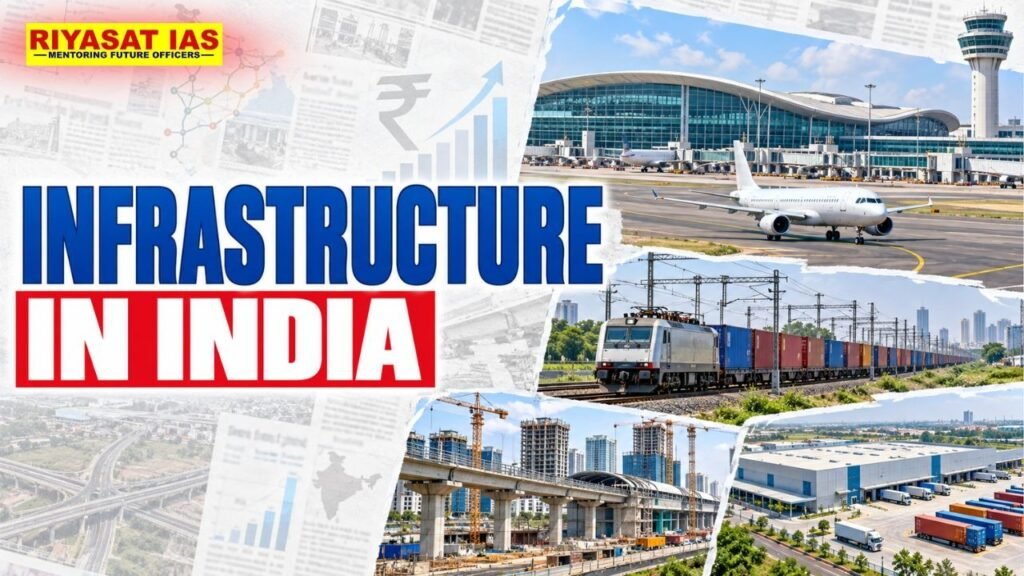
Infrastructure is a critical engine for economic and social development. It encompasses physical and digital assets that facilitate the movement of people, goods, services and information – such as transport networks, power grids, digital identity systems and payment platforms.
- Over the last decade, India has focussed on rapidly developing infrastructure through schemes such as the National Infrastructure Pipeline (NIP), PM Gati Shakti, Bharatmala, Sagarmala and the development of Digital Public Infrastructure (DPI) to enhance connectivity, logistics and the overall business environment.
- In this article we look at different aspects of infrastructure – with some highlights on recent developments in transport and logistics, urban and social infrastructure as well as digital public infrastructure.
Types of Infrastructure in India
Infrastructure can be broadly classified into:
- Physical Infrastructure – transport and logistics
- Urban Infrastructure – water, sanitation, mobility and urban services
- Digital Infrastructure – digital connectivity, digital identity and digital public infrastructure
- Social Infrastructure – health, education and housing
Physical Infrastructure: Transport and Logistics
- Physical infrastructure encompasses transport networks that enable the efficient movement of people, goods and services.
- Major initiatives such as the NIP, PM Gati Shakti, Bharatmala Pariyojana, Sagarmala and the National Monetisation Pipeline (NMP) have enhanced multimodal connectivity as well as logistics.
Roads and Highways
- Under Bharatmala, India’s National Highway network grew from 91,287 km in 2014 to 1,46,572 km as of March 2026 while access-controlled expressways and high-speed corridors grew from 93 km to 2,636 km.
- With the PM Gati Shakti National Master Plan, highways have been integrated with railways, ports, airports and logistics parks through a GIS-based platform; and under NMP 2.0, highways account for 26% of total monetisation of assets which has helped in funding new projects.
Railways
- India has 164 Vande Bharat trains as of December 2025 while 46,900 km of railway lines have been electrified since 2014.
- The East and West Dedicated Freight Corridors are over 96% complete.
Aviation
- The UDAN Scheme has supported operation of 95 regional airports benefiting 1,68,00,000 passengers as of July 2026 while operational airports have grown from 74 in 2014 to 165 as of July 2026.
- With the DigiYatra initiative, 38 airports have been covered enabling more than 10,00,00,000 seamless journeys.
Ports and Inland Waterways
- Turnaround time of major ports went down from 94 hours in 2014 to 48.8 hours in 2025–26 while cargo handling capacity has gone up from 873 MMTPA to 1,728 MMTPA in the same period.
- Under the Sagarmala Programme, inland waterway cargo has increased by 710% while national waterways have gone up from 5 in 2014 to 111 in 2026, of which 32 are operational.
Infrastructure Planning and Industrial Connectivity
- The National Infrastructure Pipeline (NIP) covers around 13,000 projects across 33 sectors with an estimated investment of ₹185 lakh crore according to the source.
- Around 20% of NIP projects have been completed while nearly 45% are currently being implemented.
- Other important initiatives for industrial infrastructure, planning and connectivity include:
- PRAGATI has reviewed 382 projects worth more than ₹85 lakh crore and addressed 2,958 issues.
- India Industrial Land Bank has mapped more than 4,220 industrial parks while there are 272 industrial parks currently operational under the Plug-and-play scheme.
- BHAVYA, approved in March 2026, proposes to develop 100 new plug-and-play industrial parks while the BHAVYA Rasayan Scheme, approved in July 2026, has an outlay of ₹3,030 crore.
- PM MITRA Parks proposes to establish 7 parks to support the manufacturing ecosystem.



Bridges, Tunnels and Metro Infrastructure
- Significant infrastructure projects have helped improve connectivity in inaccessible and remote areas.
- For example, the Chenab Bridge, being the world’s highest rail arch bridge, enhances connectivity between Jammu and Srinagar.
- Other important projects include the Anji Khad Bridge, Pamban Bridge, Z-Morh/Sonamarg Tunnel, Sudarshan Setu and the Atal Tunnel.
- India’s metro network has grown from 248 km in 2014 to over 1,155 km in 2026 with metro connectivity increasing from 5 to 26 cities and daily passenger volume crossing 1.15 crore.
- The Kolkata Metro has launched India’s first underwater metro tunnel in 2024 while Kochi has become the first city to launch the Water Metro system.
Urban Infrastructure in India
- Urban infrastructure aims at creating livable and economically vibrant cities through enhanced water, sanitation and mobility as well as improved governance mechanisms.
- The AMRUT 2.0 programme has sanctioned projects worth around ₹2.79 lakh crore since 2015 with focus on water security and sewerage.
- It has provided 2.03 crore tap water connections and 1.50 crore sewer connections while reducing carbon emissions by nearly 46 lakh tonnes annually.
- The Smart Cities Mission has completed 7,790 projects (accounting for 95%) worth ₹1,56,257 crore as of March 2026 with all 100 Smart Cities having AI and IoT-enabled Integrated Command and Control Centres.
- The SWAMIH Fund, launched in 2019, had delivered more than 63,000 homes, benefiting around 2.52 lakh residents as of June 2026.
Digital Public Infrastructure in India
- Digital Public Infrastructure (DPI) is an emerging area with potential to support economic and social development.
- The JAM Trinity (Jan Dhan, Aadhaar and Mobile) has enhanced digital connectivity, financial inclusion and delivery of public services.
Digital Connectivity
- BharatNet has connected nearly 2.18 lakh Gram Panchayats (about 97%) with more than 7 lakh km of optical fibre.
- India has 106.58 crore broadband subscribers while 5G has covered 99.9% of districts through 4.74 lakh towers.
Digital Identity and Digital Economy
- More than 144 crore Aadhaar numbers have been generated while Aadhaar has enabled 2,707 crore authentications during 2024–25.
- UPI processed 21.7 billion transactions worth ₹28.33 lakh crore in January 2026 while ONDC has onboarded more than 1.16 lakh retail sellers.
- DigiLocker has 67.63 crore users while platforms such as UMANG and PFMS have enhanced digital governance and public services.
Digital Health and Emerging Technologies
- eSanjeevani has provided teleconsultation service to 45.42 crore patients.
- The India Semiconductor Mission has sanctioned 12 semiconductor projects worth ₹1.64 lakh crore while ISM 2.0 focuses on strengthening indigenous capabilities in semiconductors.
- IndiaAI Mission, with an outlay of ₹10,371.92 crore, has scaled national AI computing capacity to over 45,000 GPUs.
Social Infrastructure in India
- Social infrastructure mainly consists of physical and institutional facilities that cater to human development and social service needs, including health, education and housing.
- The Pradhan Mantri Ayushman Bharat Health Infrastructure Mission (PM-ABHIM), launched in October 25, 2021, has an outlay of ₹64,180 crore for FY2021–22 to FY2025–26.
- It provides for 17,788 building-less Sub-Centres as Ayushman Arogya Mandirs and 11,024 Urban AAMs, particularly in slums and slum-like settlements.
- It also provides for 35,000 critical-care beds across 600 districts and referral facilities in 125 districts.
- The PM Schools for Rising India (PM SHRI), launched on September 5, 2022, with an outlay of about ₹27,360 crore for 2022–23 to 2026–27, proposes to upskill selected government schools to become model institutions in consonance with the National Education Policy 2020, including facilities such as smart classrooms, laboratories, libraries, sports and vocational education.
- Samagra Shiksha envisages school/teacher development, digital and inclusive education and learning outcomes.
- At the higher-education level, PM-USHA supersedes RUSA to focus on access, equity, quality and employability in State higher-education institutions.
- The PMAY-U, launched in 2015 and expanded through PMAY-U 2.0 in September 2024, proposes to provide affordable pucca houses to eligible urban households.
- As of August 12, 2026, 99.25 lakh houses have been completed while around 96% of PMAY-U 2.0 houses have been allocated to women.
- The PMAY-G, launched in 2016, provides ₹1.20 lakh in plains and ₹1.30 lakh in hilly/difficult areas towards financial assistance for rural housing with convergence with MGNREGS and the Swachh Bharat Mission.
- PMAY-G 2.0 proposes to increase the projected long-term housing requirement to about 4.95 crore houses by 2029.
Importance of Infrastructure for India’s Economy
- Infrastructure is the backbone of economic and social development. It facilitates production, trade and connectivity while enabling enhanced quality of life, inclusion and sustainability.
- It has a multiplier impact on growth, industrial production and consumption.
Economic Growth
- Infrastructure investment has a multiplier impact on GDP, industrial output and consumption.
- Public infrastructure capital expenditure has grown from ₹2 lakh crore in FY2014–15 to ₹12.2 lakh crore in BE 2026–27.
Employment Generation
- Infrastructure in the areas of roads, railways, housing, ports and energy creates direct and indirect employment.
- The sector’s share of total workers has grown from 12.1% in 2020–21 to 13.0% in 2022–23 (source: Periodic Labour Force Survey figures cited in the source).
Crowding-In of Private Investment
- Public investment can crowd-in private investors, which is important for deepening capital markets.
- India accounts for more than 90% of the South Asia Private Participation in Infrastructure (PPI) investments.
Trade and Export Competitiveness
- Modern roads, railways, Dedicated Freight Corridors, ports and logistics infrastructure can reduce logistics costs and help improve export competitiveness.
Financial Inclusion
- Digital infrastructure based on the JAM Trinity and DPI has enabled Direct Benefit Transfers worth ₹49.09 lakh crore, reducing leakages in delivery of public services.
Balanced Regional Development
- Improved regional connectivity can enhance integration of remote and backward regions with major economic and industrial hubs.
Agricultural Development
- Rural infrastructure can increase agricultural productivity and support farmers’ incomes through improved access and cold storage facilities.
National Security
- Strategic infrastructure can strengthen territorial integrity and security.
FAQs
What are the major types of infrastructure in India?
Infrastructure can broadly be classified into physical, urban, digital and social infrastructure.
What is PM Gati Shakti?
PM Gati Shakti National Master Plan is a GIS-based platform that converges different transportation networks.
It covers highways, railways, ports, airports, logistics parks and other transport networks.
What is the National Infrastructure Pipeline?
The National Infrastructure Pipeline (NIP) is a pipeline of projects across 33 sectors, covering around 13,000 projects with an estimated investment of ₹185 lakh crore (source).
What is Digital Public Infrastructure?
Digital Public Infrastructure (DPI) includes digital systems and platforms such as digital connectivity, digital identity and digital public services.
Why is infrastructure important for economic growth?
Infrastructure facilitates production, connectivity, trade, employment, private investment and regional development while also supporting access to essential services and enhanced quality of life.


 Ravi Raaz
 Hassan Khan
 Shadab Ali