
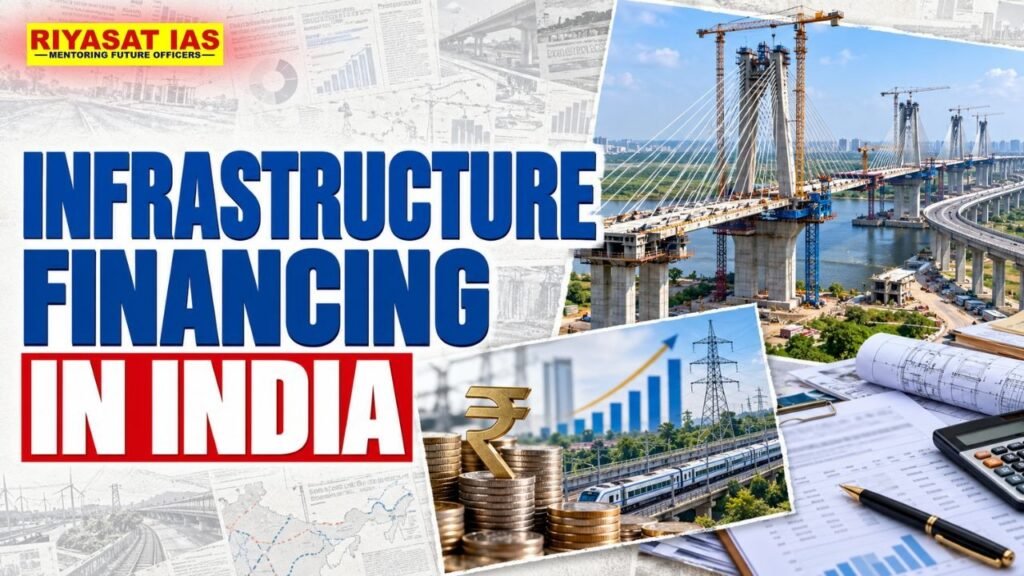
Creating infrastructure development requires a huge amount of capital to be invested in the creation of transport systems, ports, and power grids before any returns can be expected. As a result, commercial banks are often reluctant to finance such long-dated projects.
- India is now pursuing an alternative infrastructure development model that leverages government spending, development banks, and private investment, as well as innovative approaches to asset recycling, to fund infrastructure.
Infrastructure Financing in India
National Bank for Financing Infrastructure and Development (NaBFID)
- NaBFID has been established by the National Bank for Financing Infrastructure and Development Act, 2021, to facilitate infrastructure development by supplementing commercial banks’ reluctance to fund long-dated projects.
- The Reserve Bank of India (RBI) has given NaBFID the status of an All India Financial Institution (AIFI) in March 2022 in line with other development finance institutions (DFIs), including NABARD, SIDBI, NHB, and EXIM Bank.
- NaBFID’s credit operations commenced in March 2022.
- The bank has sanctioned credits amounting to ₹5.75 lakh crore as on 31 March 2026. Of this, about 71% of the total credit has been deployed in the form of highways, power, and renewable energy sectors.
- Additionally, about 41% of the total credit has been deployed in greenfield projects, which are often considered to be high-risk long-dated projects by private lenders.
Production Linked Incentive (PLI) Scheme
- Although the Production Linked Incentive (PLI) scheme was announced to promote domestic manufacturing of 14 critical goods, it indirectly incentivizes industrial infrastructure development.
- As on 31 March 2026, the total actual investment made in the country under the PLI scheme amounted to over ₹2.40 lakh crore, while the number of direct and indirect jobs created exceeded 14.15 lakh.
- According to the latest available data as on June 2026, the actual investment made in the country under the scheme is estimated at ₹2.6 lakh crore, leading to the creation of ₹23.8 lakh crore in value addition, ₹15.5 lakh crore in exports, and providing employment to around 14.6 lakh people.
- By supplementing domestic manufacturing capacity and enabling the creation of supporting industrial infrastructure, the PLI scheme not only promotes self-reliance but also creates the much-needed ecosystem for developing transport corridors and other infrastructure.
National Infrastructure Pipeline (NIP)
- National Infrastructure Pipeline (NIP) provides a comprehensive view of the country’s infrastructure development plans for implementing agencies and financiers.
- By integrating projects under the Prime Minister Gati Shakti (PM Gati Shakti) program, which has been launched to leverage technology to develop a unified vision for infrastructure development, NIP promotes better coordination and minimizes duplication of efforts among various ministries by using digital spatial planning.
Infrastructure Risk Guarantee Fund
- Union Budget 2026–27 announced the Infrastructure Risk Guarantee Fund to revive private investment in the infrastructure sector by addressing the financing challenges during the project’s inception and construction period.
- The Union government has proposed to provide partial credit guarantees to banks and financial institutions to reduce the risk premium on account of project delays and cost overruns during the construction period.
- Apart from this, the Union government has enhanced the allocation for the current fiscal to ₹12.2 lakh crore for public capital expenditure (PCE) compared to ₹11.2 lakh crore budgeted in the previous year’s Union Budget 2025–26.
City Economic Regions (CERs)
- To de-congest the metro cities, Budget 2026–27 announced the City Economic Regions (CERs) to promote the development of secondary cities, namely, Tier-II and Tier-III cities as economic growth poles for creating jobs and reducing the population pressure from the metro cities.
- The Central government has proposed to provide an outlay of ₹5,000 crore to each CER over a period of five years on a performance-linked basis.
Asset Monetisation for Infrastructure Financing
- Asset monetization helps release trapped public funds through the recycling of public assets to fund new projects.
InvITs and REITs
- InvITs and REITs enable institutional and retail investors to invest in pooled infrastructure assets, including toll roads, transmission lines, and commercial real estate.
- More than ₹1.5 lakh crore has been mobilized through InvITs and REITs so far.
- In addition to this, the Union Budget 2026–27 has proposed to facilitate REITs for mobilizing resources from institutional investors to unlock value from the commercial and industrial real estate (CIRE) held by Central Public Sector Enterprises (CPSEs).



National Monetisation Pipeline 2.0
- National Monetisation Pipeline (NMP) 2.0 proposes to mobilize a total of ₹16.72 lakh crore by leasing out select public assets to private players.
- NMP 2.0 has a target of ₹5.8 lakh crore from private concessionaires during FY2026 FY2030.
The portfolio of assets to be monetized under NMP 2.0 includes:
- Highways
- Freight corridors
- Power transmission lines
- Gas pipelines
- Airports
- Shipping berths
- Warehousing
- Urban infrastructure
- Mining leases
- Telecom towers
- Tourism circuits
Public-Private Partnership (PPP) in Infrastructure
Public-Private Partnerships (P3 or PPP) leverage private-sector agility and innovation and combine it with the government’s domain knowledge and land banks to execute high-quality infrastructure projects.
Major PPP Models
| PPP Model | Description | Risk & Commercial Dynamics |
| Build–Operate–Transfer (BOT) | The private sector partner finances, builds, and operates the infrastructure for a specified period and then transfers it to the government. | The private concessionaire bears the commercial risk and recovers the invested capital from the user charges. |
| Build–Own–Operate–Transfer (BOOT) | The private sector builds the infrastructure and owns it for the concession period. | It is suitable for large-scale infrastructure projects, such as power, involving long-term purchase obligations by the government. |
| Build–Own–Lease–Transfer (BOLT) | The private-sector partner finances and builds the infrastructure and leases it to the government for a fixed period. | The private-sector partner bears minimal demand risk, and it is suitable for rolling stock and dedicated freight corridors. |
| Design–Build–Finance–Operate–Transfer (DBFOT) | The private-sector partner is responsible for designing, financing, constructing, and operating the infrastructure for a specified period. | The private-sector partner bears substantial commercial and financial risks and is suitable for greenfield airports. |
| Hybrid Annuity Model (HAM) | The government makes upfront payments to the annuity recipient for hybrid annuity model (HAM)-based projects covering about 40% of the provision of the total project cost during the construction period, while the remaining 60% are recovered by the annuity payer from the government through regular toll collections. | The government bears the traffic risk, considering that the annuity payment is insulated from the traffic volume and makes payments to the private-sector partner on a time-bound and inflation-adjusted basis. |
| Operate–Maintain–Transfer (OMT) | A private-sector partner does not undertake financing or construction but operates and maintains the existing infrastructure. | It involves the least amount of risk for the private-sector partner and is suitable for brownfield projects. |
Major Challenges in Infrastructure Development in India
Infrastructure Financing Gap
- Despite the significant increase in PCE, the financing needs for the infrastructure sector far exceed the capacity of the public purse.
- Additionally, private and foreign capital has remained largely untapped despite big-ticket opportunities.
Limited Private Participation
- Private participation in India’s infrastructure development has remained limited due to the demand risk, statutory and environmental clearances, and complex dispute-resolution mechanisms.
Financing and Currency Risk
- Infrastructure projects typically involve long-dated loans, and the interest-rate and currency risks associated with them are considerable.
- Default risks often rise due to sudden fluctuations in interest rates and depreciation of the domestic currency against the foreign currency in case of external borrowing.
Project Delays and Cost Overruns
- Various factors, such as land acquisition delays, clearances for felling trees, and inter-ministerial coordination challenges often cause project delays and result in cost overruns.
Inefficient Transportation
- India’s transportation infrastructure remains heavily skewed toward road transportation.
- The lack of efficient logistics chain and connectivity between different modes of transportation increases the cost of transportation compared to other Asian emerging market counterparts.
Urban Congestion
- India’s urban centers have witnessed an influx of people, creating strain on water, sewerage, drainage, housing, transportation, and other key urban infrastructure.
Carbon Emissions
- India’s infrastructure development footprint involves substantial carbon emissions due to the extensive use of construction material and equipment, as well as reliance on fossil fuel-based transportation.
Last Mile Connectivity
- India’s challenging terrain often necessitates the construction of roads through mountainous or other difficult geographical conditions, which increases the cost of construction and maintenance.
Digital Infrastructure Gap
- The rollout of 5G and India Stack has catalyzed the digitization of India.
- However, rural, tribal, and economically disadvantaged sections of society face financial and digital literacy challenges and lack access to affordable handsets and reliable broadband services.
Way Forward
Infrastructure development is a critical pillar of India’s growth story, and achieving the government’s growth narrative of Viksit Bharat by 2047 will require a focused approach to project implementation, design, and financing.
Diversify Infrastructure Financing
- India needs to move away from the current overreliance on the Union budget and explore blended finance options by tapping the capital markets both domestically and internationally.
- It is critical to create financial ecosystems to mobilize long-dated patient capital, including through the National Investment and Infrastructure Fund (NIIF) and GIFT City.
- Apart from this, domestic capital markets can be leveraged by exploring avenues such as green bonds and ESG-linked bonds to reduce the cost of capital for climate-friendly infrastructure projects.
Strengthen PM Gati Shakti
- PM Gati Shakti has the potential to become a one-stop solution for integrated infrastructure planning, and its role needs to be expanded beyond the current consultative and indicative role to enable effective implementation.
- Endowing PM Gati Shakti with the necessary authority to expedite coordination between different ministries could help overcome the current implementation challenges.
Make Infrastructure Resilient to Climate Change
- With the increasing impact of climate change, India’s infrastructure development plans need to factor in the challenges posed by extreme weather conditions by building flood management systems and using alternate cleaner energy sources.
Improve Urban Infrastructure
- India’s urban centers need to be reimagined by leveraging cutting-edge technologies, such as artificial intelligence, for traffic management and water management.
- Municipal authorities need to take steps to improve their fiscal health and credit profile by adopting accrual accounting, updating property records, and installing user charges for better revenues.
Bridge the Digital Infrastructure Gap
- India needs to expand infrastructure connectivity by tapping the last-mile digital connectivity and creating digital infrastructure to bridge the urban-rural digital divide by focusing on rural and tribal areas.
- Initiatives, such as the Prime Minister-Wide Area Network (PM-WANI) and Common Service Centers (CSCs), will play a critical role in connecting rural areas to the digital ecosystem.
- Expanding optical fiber network connectivity to remote and economically disadvantaged areas will catalyze the digital transformation of these regions.
Leverage India’s Position as a Global Digital Infrastructure Powerhouse
- India needs to position itself as a global digital infrastructure powerhouse by promoting India’s DPI ecosystem in international forums, including the G20, BRICS, World Bank, IMF, and the Bank for International Settlements, to build an alternate digital infrastructure ecosystem to enable developing economies to leapfrog the current infrastructure capabilities.
FAQs
What is infrastructure financing?
Infrastructure financing refers to financing arrangements for developing large-scale infrastructure, including transport systems, power grids, water, and other utilities that take a long time to construct and repay.
What is NaBFID?
NaBFID is an infrastructure development finance institution that has been established under the NaBFID Act, 2021.
NaBFID is positioned to play a critical role in supplementing commercial banks’ reluctance to finance long-dated infrastructure projects.
As on 31 March 2026, NaBFID has sanctioned credit amounting to ₹5.75 lakh crore, of which about 71% has been deployed in the form of highways, power, and renewable energy sectors.
What is the Infrastructure Risk Guarantee Fund?
The Infrastructure Risk Guarantee Fund has been proposed in the Union Budget 2026–27 to provide partial credit guarantees to banks and other financial institutions to mitigate the project financing risk during the construction phase of the infrastructure project.
What is NMP 2.0?
National Monetisation Pipeline (NMP) 2.0 proposes to mobilize a total of ₹16.72 lakh crore by leasing out select public assets to private players.
NMP 2.0 has a target of ₹5.8 lakh crore from private concessionaires during FY2026 FY2030.
What are the major public-private partnership (PPP) models in India?
The major public-private partnership (PPP) models in India are build-operate-transfer (BOT), build-own-operate-transfer (BOOT), build-own-lease-transfer (BOLT), design-build-finance-operate-transfer (DBFOT), hybrid annuity model (HAM), and operate-maintain-transfer (OMT).
What are the major challenges of infrastructure development in India?
Some of the major challenges in India’s infrastructure development are financing gap, private participation, financing and currency risks, project delays and cost overruns, inefficient transportation, urban congestion, carbon emissions, last-mile connectivity, and a digital infrastructure gap.



 Ravi Raaz
 Hassan Khan
 Shadab Ali