
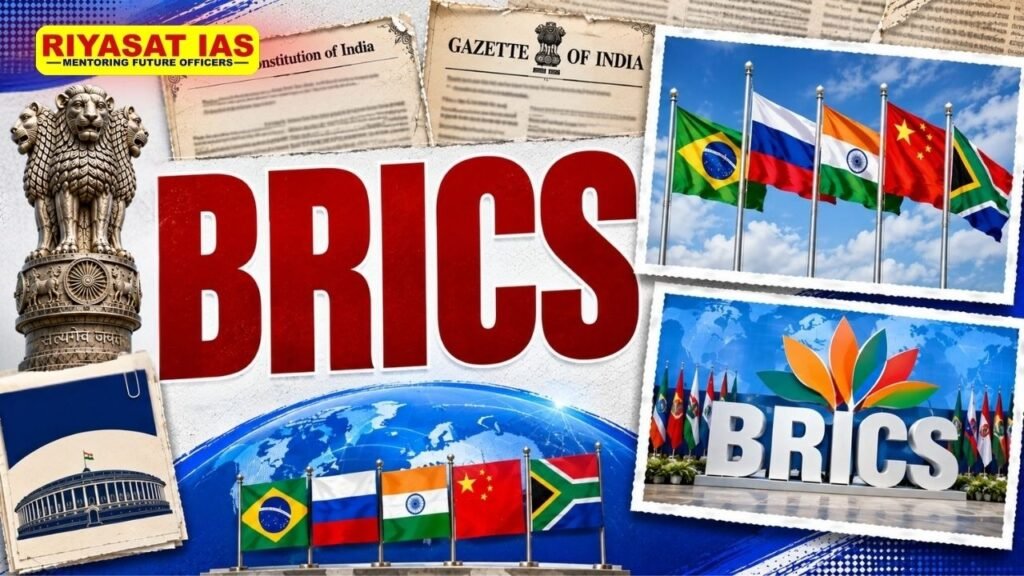
BRICS is a political, diplomatic and economic cooperation forum of the Global South that seeks to strengthen cooperation among emerging and developing countries and promote a more representative, equitable and effective global governance system. It is not a treaty-based international organisation, and it has no permanent secretariat or common budget. Its cooperation broadly operates through three pillars: politics and security, economy and finance, and people-to-people cooperation.
Evolution and Foundation
The term BRIC was coined in 2001 by Goldman Sachs economist Jim O’Neill to describe the growing economic importance of Brazil, Russia, India and China however, as an intergovernmental forum emerged through political initiatives of these countries.
- 2006: Brazil, Russia, India and China formally began BRIC cooperation at the foreign-minister level on the margins of the UN General Assembly.
- 2009: The first BRIC Leaders’ Summit was held at Yekaterinburg, Russia, establishing the summit-level mechanism.
- 2010–11: South Africa joined the grouping, converting BRIC into BRICS.
- 2014: The Fortaleza Summit established the New Development Bank (NDB) and the Contingent Reserve Arrangement (CRA), giving BRICS a stronger financial dimension.
- 2023: The Johannesburg Summit decided to expand BRICS by inviting Egypt, Ethiopia, Iran, Saudi Arabia and the UAE.
- 2024–25: The expansion became operational, while Indonesia formally became the 11th full member on 6 January 2025.
- 2024: The BRICS Partner Country category was created at the Kazan Summit.
- 2025: Nine partner countries were initially announced, followed by Vietnam as the tenth partner country.
- 2026: India assumed the BRICS Chairship, with Ambassador Sudhakar Dalela serving as India’s BRICS Sherpa.
Members and Partners
As of 2026, It has 11 full members: Brazil, Russia, India, China, South Africa, Egypt, Ethiopia, Iran, Saudi Arabia, the United Arab Emirates and Indonesia. The group also has 10 partner countries: Belarus, Bolivia, Cuba, Kazakhstan, Malaysia, Nigeria, Thailand, Uganda, Uzbekistan and Vietnam. Full members participate in all meetings and decisions are based on consensus, while partners have more limited participation rights.
The expanded BRICS has considerable global economic weight. According to the IMF-based data presented by the Brazilian and Presidency, the 11 members accounted for around 40% of global GDP in PPP terms in 2024, with the share projected at around 41% in 2025. They also represent nearly half of the world’s population.
Key Purpose
It seeks to provide a platform through which emerging and developing economies can coordinate positions on major global issues and strengthen their collective voice in international governance.
· Its objectives include reforming institutions such as the UN, IMF, World Bank and WTO, expanding South-South cooperation, strengthening economic and financial cooperation, promoting sustainable development and increasing the participation of developing countries in global decision-making.
· The objective is therefore not simply to create an alternative to Western institutions, but to make existing global governance structures more representative while simultaneously developing complementary mechanisms of cooperation.
BRICS Organisational and Working Structure
Rotating Presidency
· BRICS follows an annual rotating presidency, under which the chairing country determines the priorities of the year and organises the Leaders’ Summit and ministerial and technical meetings.
o India assumed the 2026 BRICS Presidency on 1 January 2026.
Leaders’ Summit: The Heads of State/Government Summit is the highest political forum of BRICS. Major strategic decisions and declarations are adopted through consensus.
Sherpa System
Each member appoints a senior representative known as a Sherpa, who coordinates the country’s position, prepares the agenda and negotiates outcomes before they reach the ministerial and leaders’ level.
· The Sherpa mechanism is particularly important because It does not have a permanent secretariat. The Sherpas therefore provide continuity, institutional coordination and agenda management between successive presidencies.
Ministerial and Working-Level Mechanisms
It has numerous ministerial meetings, working groups and technical mechanisms covering areas such as finance, trade, health, agriculture, science and technology, climate change, education, energy, industry, culture and counter-terrorism.
The expanded BRICS has therefore developed from a small economic grouping into a multi-sectoral cooperation platform.
Financial Architecture
A. New Development Bank
The New Development Bank (NDB) was established at the 2014 Fortaleza Summit by Brazil, Russia, India, China and South Africa.
· Its primary objective is to mobilise resources for infrastructure and sustainable-development projects in emerging markets and developing countries. The NDB has an authorised capital of US$100 billion.



· The bank has subsequently expanded its membership to include Bangladesh, the UAE, Egypt and Algeria, while Uzbekistan is also listed by the NDB among its members; this illustrates that the NDB’s membership is broader than the original BRICS five.
· The NDB is significant for the Global South because it seeks to provide infrastructure and sustainable-development finance while diversifying sources of development financing.
B. Contingent Reserve Arrangement
· The Contingent Reserve Arrangement (CRA) was established in 2014 with an initial committed resource of US$100 billion.
· It is designed to provide a financial safety net against short-term balance-of-payments and liquidity pressures, thereby complementing existing international financial arrangements.
C. Local-Currency Financing
· BRICS has increasingly discussed the use of local currencies and alternative payment mechanisms to reduce transaction costs and vulnerability arising from excessive dependence on a single international currency.
· However, it is important for UPSC answers to distinguish between promoting local-currency settlement/payment mechanisms and creating a common BRICS currency. No common BRICS currency has been established. The Brazilian BRICS Presidency explicitly clarified that the group was not pursuing creation of a common currency.
D. New Financial Initiatives
· The 2025 Rio de Janeiro Declaration supported further expansion of NDB financing, including greater use of local-currency financing and diversified funding sources. BRICS also began discussions on a proposed New Investment Platform and a BRICS Multilateral Guarantees initiative aimed at reducing investment risks and mobilising private capital for infrastructure and sustainable development.
Key Initiatives of BRICS
· New Development Bank: The NDB provides financing for infrastructure, renewable energy, transport, water and other sustainable-development projects in emerging and developing economies. The bank is intended to complement, rather than simply replace, existing multilateral development institutions.
· Contingent Reserve Arrangement: The CRA strengthens the financial resilience of participating economies by providing a potential liquidity-support mechanism during external financial pressures.
· BRICS Business Council: The BRICS Business Council promotes business-to-business cooperation, investment and commercial linkages among member economies.
· BRICS New Industrial Revolution Partnership: The PartNIR promotes cooperation in industrialisation, innovation, digital technologies, advanced manufacturing and industrial development.
· BRICS Agricultural Cooperation: BRICS cooperation in agriculture focuses on food security, resilient agricultural supply chains, sustainable agriculture and rural development. The expanded grouping has additional importance because several members are major producers or exporters of food, energy and agricultural inputs.
· BRICS Research and Innovation: The BRICS Action Plan for Innovation 2025–2030 seeks deeper cooperation in research, innovation, technology and knowledge exchange among member countries.
Relevance and Significance of BRICS
· Voice of the Global South: BRICS provides an important platform for developing countries to coordinate positions on global governance, development finance, climate change, trade and international security. Its expanded membership gives it representation across Asia, Africa, Latin America, Europe and the Middle East.
· Reform of Global Governance: BRICS advocates greater representation of developing countries in institutions such as the UN Security Council, IMF, World Bank and other multilateral bodies. For India, this supports its longstanding demand for a more representative and multipolar global order. BRICS members have repeatedly called for greater representation of developing countries in global decision-making.
· Economic Weight: The expanded grouping represents approximately 40% of global GDP in PPP terms and nearly half of the world’s population, giving it substantial potential influence over global economic trends.
· Energy Security: BRICS includes major oil, gas, coal and renewable-energy producers and consumers. Official BRICS data indicates that the group accounts for approximately 43.6% of global oil production and 36% of global natural-gas production. This gives the grouping considerable relevance for global energy security and commodity markets.
· Critical Minerals: BRICS countries possess significant reserves and production capacity in rare earths and other strategic minerals, which are essential for semiconductors, electric vehicles, batteries and renewable technologies. This creates opportunities for cooperation on mineral processing, technology transfer and resilient global value chains.
· Development Finance
o The NDB gives developing countries an additional source of infrastructure and sustainable-development financing.
o For India, the NDB’s India office in Gujarat provides an institutional link between India’s infrastructure priorities and BRICS development financing.
· Strategic Autonomy for India: BRICS allows India to simultaneously engage with Russia, China, Brazil, South Africa, Gulf countries, Iran and other emerging economies, while also participating in platforms such as the Quad, G20 and I2U2. It therefore supports India’s approach of multi-alignment and strategic autonomy rather than dependence on any single geopolitical bloc.
Challenges Faced by BRICS
Internal Geopolitical Differences
· BRICS contains countries with very different geopolitical interests.
· The relationship between India and China, the Russia–West confrontation, and differences among Middle Eastern members can make it difficult to develop common positions on sensitive strategic issues.
Economic Heterogeneity
· The members range from large industrial economies such as China and India to smaller and less-developed economies such as Ethiopia.
· Their differences in income levels, economic structures, trade interests and development priorities make common economic policies difficult.
China–India Strategic Competition
· China is by far the largest economy within BRICS and has substantial economic and political influence.
· For India, BRICS must therefore remain a platform for cooperation without becoming China-dominated.
Limited Intra-BRICS Trade
· Despite the group’s economic size, intra-BRICS trade remains relatively modest compared with the trade of its members with major developed economies.
· The Brazilian BRICS Presidency itself noted that trade and investment flows among BRICS countries remain relatively small compared with flows involving developed economies.
Absence of Permanent Institutional Structure
· BRICS does not have a permanent secretariat, constitutive treaty or common budget. The rotating presidency provides flexibility but can also create difficulties in maintaining institutional continuity and implementation of long-term projects.
· Consensus-Based Decision-Making: Consensus protects the interests of individual members but can also make decision-making slow, particularly when members have sharply divergent geopolitical interests.
Financial and Currency Challenges
· Greater use of local currencies faces practical obstacles such as convertibility, exchange-rate volatility, financial-market depth, payment-system interoperability and differences in capital-account regimes.
· Therefore, reducing dependence on existing reserve currencies is a long-term process rather than an immediate possibility.
India’s Approach towards BRICS
· India views BRICS as an important platform for Global South cooperation and reform of global governance, while simultaneously ensuring that it does not become an exclusive geopolitical bloc.
· India has consistently supported greater representation of developing countries in UN, IMF, World Bank and other multilateral institutions.
· India also sees BRICS as useful for advancing cooperation in digital public infrastructure, health, climate action, critical minerals, development finance and counter-terrorism.
· India’s approach can therefore be summarised as:
· “BRICS as a platform for reform, cooperation and strategic autonomy—not as an anti-Western alliance.”
Way Forward
· Strengthen Institutional Continuity: BRICS should improve coordination between successive presidencies and strengthen the Sherpa system, working groups and institutional mechanisms to ensure that initiatives continue beyond one presidency.
· Strengthen the NDB: The NDB should expand local-currency financing, climate finance, infrastructure lending and private-capital mobilisation while maintaining strong governance and financial credibility. The 2025 Rio Declaration specifically supported expanding NDB membership and strengthening its ability to mobilise diversified resources.
· Focus on Practical Cooperation: BRICS should prioritise areas where interests naturally converge, such as health, food security, energy security, critical minerals, climate finance, AI, digital technology and disaster management.
· Give Greater Voice to Developing Countries: BRICS should continue pushing for reforms in the UN Security Council, IMF, World Bank and WTO, while ensuring that its own internal functioning remains inclusive.
· Build Resilient Supply Chains: BRICS can develop cooperation in critical minerals, pharmaceuticals, agricultural inputs, energy and semiconductors, reducing vulnerabilities arising from excessive concentration of global supply chains.
Conclusion
BRICS is best viewed not as an alternative to the existing international order but as a mechanism for making that order more representative, inclusive and responsive to the Global South. Its future effectiveness will depend on converting its considerable demographic and economic weight into practical cooperation while managing internal geopolitical differences through dialogue, consensus and issue-based partnerships.
FAQs
1. What is BRICS?
BRICS is a political, diplomatic and economic cooperation forum of Global South countries that seeks stronger South-South cooperation and reform of global governance institutions.
2. How many full members does BRICS have in 2026?
BRICS has 11 full members, namely Brazil, Russia, India, China, South Africa, Egypt, Ethiopia, Iran, Saudi Arabia, UAE and Indonesia.
3. What is the New Development Bank?
The NDB is a BRICS-created multilateral development bank established in 2014 to finance infrastructure and sustainable-development projects in emerging and developing countries.
4. Does BRICS have a common currency?
No. BRICS has not created a common currency; its discussions focus primarily on local-currency settlement, payment systems and reducing transaction costs.
5. Why is BRICS important for India?
BRICS strengthens India’s Global South leadership, strategic autonomy, access to development finance, economic partnerships and efforts to reform institutions such as the UN, IMF, World Bank and WTO.




 Ravi Raaz
 Hassan Khan
 Shadab Ali