
About
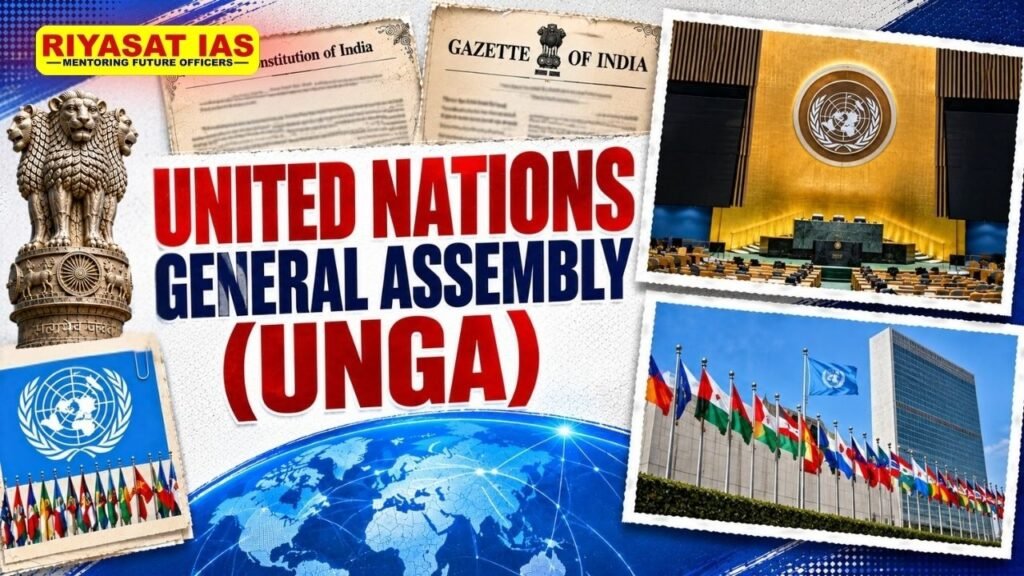
The United Nations General Assembly (UNGA) is the principal deliberative, policymaking and representative organ of the United Nations. It was established under the UN Charter in 1945 and provides a universal forum where all UN Member States participate in discussions on international peace and security, development, human rights and other global issues.
The UNGA is particularly important because it follows the principle of sovereign equality of states, under which every member has one vote, irrespective of its population, territory or economic power.
The UNGA has 193 Member States and normally meets in regular session from September to December each year, with further meetings when required. Its headquarters are in New York.
Structure of the United Nations
· General Assembly: The UNGA is the principal representative and deliberative body of the United Nations, with all 193 Member States participating.
· Security Council: The UN Security Council (UNSC) has the primary responsibility for maintaining international peace and security. It consists of 15 members, including five permanent members—China, France, Russia, the United Kingdom and the United States—and ten non-permanent members elected for two-year terms.
· Economic and Social Council: The ECOSOC coordinates international economic, social and environmental cooperation and consists of 54 members elected by the General Assembly.
· International Court of Justice: The ICJ, headquartered in The Hague, is the principal judicial organ of the UN and settles legal disputes between states and provides advisory opinions on legal questions referred to it by authorised UN organs and agencies.
· Secretariat: The Secretariat carries out the day-to-day administrative and operational work of the United Nations and is headed by the Secretary-General.
· Trusteeship Council: The Trusteeship Council was established to supervise the administration of Trust Territories. It suspended operations in 1994 after the independence of Palau, the last UN Trust Territory.
Composition and Working of the UNGA
The UNGA consists of all 193 UN Member States, and each member has one vote. The Assembly conducts its work through plenary meetings and six Main Committees:
- First Committee: Disarmament and International Security.
- Second Committee: Economic and Financial Affairs.
- Third Committee: Social, Humanitarian and Cultural Affairs.
- Fourth Committee: Special Political and Decolonization.
- Fifth Committee: Administrative and Budgetary Affairs.
- Sixth Committee: Legal Affairs.
Powers and Functions of UNGA
Deliberation on International Issues
· The UNGA can discuss any questions or matters within the scope of the UN Charter, including international peace and security, development, human rights and international cooperation.
· However, where the Security Council is exercising its functions regarding a particular dispute or situation, the General Assembly is subject to the limitations provided under the Charter.
Recommendations to Member States
· The UNGA can make recommendations to Member States and the Security Council on international issues.
· Unlike Security Council resolutions adopted under its binding powers, most General Assembly resolutions are not legally binding on Member States.
· Nevertheless, they can carry significant political, diplomatic and normative weight.
Election of Non-Permanent Members of UNSC
· The General Assembly elects the 10 non-permanent members of the Security Council.



· This gives the UNGA an important role in determining the composition of the Security Council.
Election of Members of Other UN Bodies
· The General Assembly participates in the election of members of several UN organs and bodies.
· For example, it elects members of the Economic and Social Council and, together with the Security Council, elects judges of the International Court of Justice.
Appointment of the Secretary-General
· The Secretary-General is appointed by the General Assembly upon the recommendation of the Security Council.
· Therefore, the UNGA formally appoints the Secretary-General, while the Security Council plays the decisive recommending role.
UN Budget
· One of the most important powers of the General Assembly is the consideration and approval of the UN budget.
· It also determines the financial assessments of Member States according to the applicable assessment system.
Human Rights and Development
· The UNGA provides a global forum for discussing human rights, sustainable development, poverty reduction, climate change, humanitarian issues and gender equality.
· The 2030 Agenda for Sustainable Development and its 17 Sustainable Development Goals (SDGs) were adopted by consensus at the UN Sustainable Development Summit in 2015.
Voting in the UNGA
· The basic principle is “one country, one vote.” Important questions require a two-thirds majority of members present and voting, while decisions on other questions are generally decided by a simple majority. Questions regarded as important include matters relating to:
o International peace and security.
o Election of non-permanent Security Council members.
o Admission of new UN members.
o Budgetary matters.
o Election of members of certain UN organs.
· This voting structure distinguishes the UNGA from the Security Council, where the five permanent members possess the veto power.
Major Achievements of the UNGA
· Universal Forum for International Dialogue: The UNGA provides virtually every country with an opportunity to participate in global discussions. This is particularly important for small and developing countries, which would otherwise have limited influence in major international institutions.
· Decolonisation: The General Assembly played a major role in advancing the international norm of self-determination and decolonisation. The 1960 Declaration on the Granting of Independence to Colonial Countries and Peoples became an important milestone in the global decolonisation process.
· Universal Declaration of Human Rights: The Universal Declaration of Human Rights (UDHR) was adopted by the UN General Assembly on 10 December 1948. Although the UDHR itself is not a treaty, it became a foundational document for the development of the modern international human-rights framework.
· Sustainable Development Goals: The UNGA adopted the 2030 Agenda for Sustainable Development in 2015, establishing 17 SDGs covering poverty, health, education, gender equality, climate action and sustainable economic development.
· Humanitarian and Global Development Agenda: Through debates, resolutions and specialised UN mechanisms, the General Assembly has kept issues such as poverty, food security, refugees, health, gender equality and sustainable development at the centre of the international agenda.
Challenges Faced by the UNGA
· Non-Binding Nature of Most Resolutions: The majority of UNGA resolutions are recommendatory rather than legally binding. This limits the Assembly’s ability to directly enforce its decisions when powerful states refuse to comply.
· Security Council Dominance in Peace and Security: Although the UNGA can discuss international peace and security, the Security Council has primary responsibility for maintaining international peace and security.
· Geopolitical Polarisation: Major geopolitical rivalries frequently divide UN members. Conflicts involving Russia and Ukraine, Israel and Palestine, the US–China rivalry and other regional disputes can produce sharply divided voting patterns and reduce consensus.
· Representation and Institutional Reform: The composition of major UN institutions does not fully reflect the contemporary distribution of global population, economic power and political influence. India and other countries therefore demand comprehensive reform of the UN system, particularly the Security Council.
· Financial Constraints: The UN’s effectiveness is affected by delays in member contributions and broader financial pressures. Developing countries also argue that global institutions require greater resources to address climate change, development, humanitarian crises and global health emergencies.
· Consensus versus Efficiency: The universal nature of the General Assembly gives it legitimacy, but the involvement of 193 states with diverse interests can make decision-making slow and politically difficult.
India and the UN General Assembly
· Global South Leadership: India has increasingly used multilateral platforms to articulate the concerns of developing countries relating to development finance, food and energy security, climate change, technology access and equitable global governance. India’s leadership of the Voice of Global South Summit has reinforced this diplomatic approach.
· Peacekeeping: India has been one of the major contributors to UN peacekeeping operations, providing military personnel, police personnel, medical support and other capabilities. This strengthens India’s argument that countries contributing substantially to international peace and security should have a greater role in decision-making.
· Counter-Terrorism: India has consistently used the UN platform to advocate stronger international action against terrorism and terrorist financing. India has also supported strengthening international legal mechanisms to address terrorism and prevent terrorists from exploiting gaps in the global system.
· Sustainable Development: India has promoted the SDGs, particularly through initiatives involving renewable energy, sanitation, financial inclusion, digital public infrastructure and poverty reduction. India’s initiatives such as the International Solar Alliance have also contributed to international cooperation on sustainable development and climate action.
Way Forward
· Strengthen UNGA’s Representative Role: The General Assembly should remain the central representative and deliberative forum of the UN while strengthening mechanisms for translating broad political commitments into concrete action.
· Reform the UN Security Council: A more representative Security Council would complement the legitimacy of the General Assembly by better reflecting Africa, Asia, Latin America and other under-represented regions.
· Improve Implementation: UNGA resolutions and global commitments should be supported by clear implementation mechanisms, measurable targets and regular monitoring.
· Strengthen Global South Participation: Developing countries should have greater access to finance, technology, capacity building and decision-making mechanisms within the UN system.
· Preserve Multilateralism: At a time of increasing geopolitical fragmentation, the UNGA should continue to provide a platform for dialogue, negotiation and peaceful resolution of international disputes.
Conclusion
The relevance of the UN General Assembly lies not merely in its ability to pass resolutions but in its legitimacy as the world’s most universal diplomatic forum. In an increasingly fragmented international order, strengthening the UNGA, reforming the wider UN architecture and improving implementation can help transform multilateralism from a forum of declarations into an instrument of collective action.
FAQs
1. How many countries are members of the UN?
The United Nations currently has 193 Member States, all of which are represented in the General Assembly.
2. What is the voting principle of the UNGA?
The UNGA follows the principle of one country, one vote, although important questions generally require a two-thirds majority.
3. Are UNGA resolutions legally binding?
Most UNGA resolutions are not legally binding, but they can have significant political, diplomatic and normative influence.
4. Who appoints the UN Secretary-General?
The General Assembly appoints the Secretary-General on the recommendation of the UN Security Council.
5. Why does India demand UN reforms?
India seeks reform to make the UN system, particularly the Security Council, more representative of contemporary demographic, economic and geopolitical realities.




 Ravi Raaz
 Hassan Khan
 Shadab Ali