
South Asian Association for Regional Cooperation (SAARC)
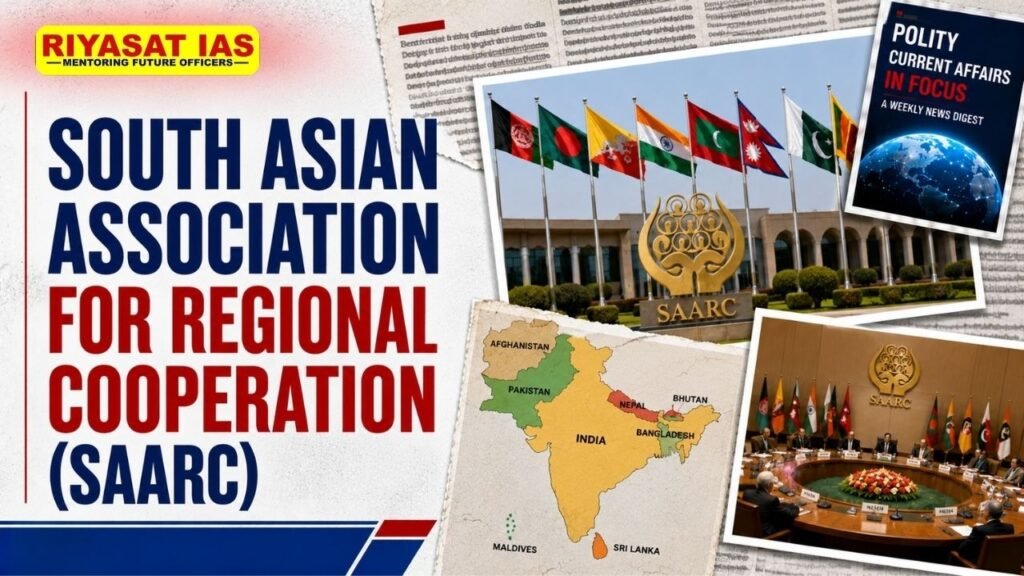
The South Asian Association for Regional Cooperation (SAARC) is the principal regional organisation of South Asia, established to promote regional cooperation, economic and social development, mutual trust and collective self-reliance among its member states. It was formally established through the SAARC Charter signed at Dhaka on 8 December 1985. The organisation is headquartered in Kathmandu, Nepal.
Historical Background
The idea of regional cooperation in South Asia gained momentum during the 1980s, when Bangladesh proposed greater institutionalised cooperation among South Asian countries.
The Foreign Ministers of Bangladesh, Bhutan, India, Maldives, Nepal, Pakistan and Sri Lanka adopted the SAARC Charter in Dhaka on 8 December 1985, formally establishing the organisation.
· Afghanistan joined SAARC in 2007, taking the membership to eight countries. SAARC therefore evolved from a seven-member initiative into a broader South Asian regional framework.
· The SAARC Secretariat was established in Kathmandu in January 1987. It coordinates and monitors the implementation of SAARC activities, facilitates meetings and acts as a communication channel between member states and other regional organisations.
· The 18th SAARC Summit, held in Kathmandu in November 2014, was the last summit-level meeting of the organisation. The Kathmandu Declaration called for deeper regional integration through cooperation in trade, investment, finance, energy, security, infrastructure, connectivity and culture.
Objectives of SAARC
SAARC’s central objective is to promote the welfare of the people of South Asia and improve their quality of life. Its major objectives include:
- SAARC seeks to accelerate economic growth, social progress and cultural development in South Asia.
- It seeks to provide people with greater opportunities to live with dignity and realise their potential.
- It seeks to strengthen collective self-reliance among South Asian countries.
- It promotes mutual trust, understanding and appreciation of the problems faced by member states.
- It encourages cooperation in economic, social, cultural, technical and scientific fields.
- It seeks to strengthen cooperation with other developing countries and international organisations.
Principles of SAARC
· Sovereign Equality: Member states participate on the basis of sovereign equality, irrespective of their differences in geographical size, population or economic power.
· Territorial Integrity and Political Independence: SAARC respects the territorial integrity, political independence and sovereignty of its member states.
· Non-Interference: Members are expected to respect the principle of non-interference in the internal affairs of other states.
· Mutual Benefit: SAARC activities are expected to generate mutual benefits for participating countries.
· Bilateral and Contentious Issues: A particularly important feature is that bilateral and contentious issues are excluded from SAARC deliberations. This was intended to prevent political disputes from paralysing cooperation in areas where consensus is possible.
· Consensus: SAARC generally operates through consensus-based decision-making, which gives every member an effective veto over major decisions.
SAARC Countries
SAARC currently has eight member states: Afghanistan, Bangladesh, Bhutan, India, Maldives, Nepal, Pakistan and Sri Lanka. Afghanistan joined the organisation in 2007. SAARC also has several observer states, including Australia, China, the European Union, Iran, Japan, Mauritius, Myanmar, South Korea and the United States.
Composition and Institutional Structure of SAARC
· Summit: The Summit of Heads of State or Government is the highest decision-making body of SAARC. It provides political direction to regional cooperation.
· Council of Ministers: The Council consists of the Foreign Ministers of member states and is responsible for formulating policies, reviewing progress and determining areas of cooperation.
· Standing Committee: The Standing Committee consists of the Foreign Secretaries of member states. It monitors programmes, coordinates cooperation and prepares the agenda for higher-level meetings.



· Programming Committee: The Programming Committee assists in the preparation of the annual programme and budget of SAARC and coordinates activities among different institutions.
· Technical Committees: Technical committees facilitate cooperation in specific areas such as agriculture, education, environment, health, science and technology, transport and other developmental sectors.
· SAARC Secretariat: The Secretariat is located in Kathmandu, Nepal. It coordinates and monitors SAARC activities, prepares meetings and facilitates communication between member states and regional organisations. It is headed by a Secretary-General, appointed by the Council of Ministers for a three-year term.
Achievements of SAARC
· SAFTA: The South Asian Free Trade Area (SAFTA) was established through the 2004 SAFTA Agreement, which entered into force in 2006. It sought to reduce tariffs and create a framework for expanding intra-regional trade and economic integration.
· Regional Energy Cooperation: A major achievement was the signing of the SAARC Framework Agreement for Energy Cooperation (Electricity) at the 18th SAARC Summit in Kathmandu in 2014. The agreement created a framework for electricity trade and cooperation among member states.
· Food Security: The SAARC Food Bank was created to provide a regional mechanism for maintaining food stocks and responding to food shortages and emergencies.
· Disaster Management: The SAARC Disaster Management Centre has promoted regional cooperation in disaster preparedness, risk reduction and resilient recovery. Training programmes and institutional mechanisms have helped member states exchange knowledge and practices in disaster management.
· Health Cooperation: SAARC has developed cooperation in areas such as public health, disease surveillance, maternal and child health and communicable diseases. During the COVID-19 pandemic, India proposed a SAARC COVID-19 Emergency Fund, demonstrating that the organisation could still provide a platform for regional humanitarian cooperation despite broader political tensions.
· Connectivity Initiatives: SAARC has attempted to develop frameworks for regional transport, motor-vehicle connectivity and rail connectivity. At the 2014 Kathmandu Summit, member states discussed the SAARC Motor Vehicles Agreement and SAARC Railways Agreement, although political differences subsequently prevented major progress.
Significance of SAARC
· Geographical and Civilisational Commonality: South Asia has strong historical, cultural, linguistic and social linkages. SAARC provides an institutional framework for converting these shared characteristics into regional cooperation and people-to-people connectivity.
· Economic Integration: Greater regional integration could create a much larger market and facilitate trade, investment, energy cooperation and regional value chains. For India, deeper South Asian integration could expand economic opportunities for its Northeastern and border regions.
· Energy Security: South Asia has complementary energy resources. Hydropower potential in Nepal and Bhutan, combined with India’s large electricity market and Bangladesh’s growing energy demand, creates opportunities for regional electricity trade. The 2014 SAARC Framework Agreement on Electricity was an important step in this direction.
· Strategic Importance for India: India shares borders with almost all South Asian countries and occupies a central geographical position in the region. A stable and prosperous neighbourhood is important for India’s security, economic growth, connectivity and regional influence.
· Platform for Regional Dialogue: Even when bilateral relations are difficult, SAARC provides an institutional platform through which countries can maintain dialogue and cooperation in non-political and developmental sectors.
Challenges Faced by SAARC
1. India–Pakistan Rivalry
· The most important obstacle to SAARC’s effectiveness is the persistent India–Pakistan strategic and political rivalry.
· Disputes relating to terrorism, Jammu and Kashmir, cross-border security and bilateral trust have repeatedly affected the functioning of the organisation.
2. Suspension of Summit Process
· The 18th SAARC Summit in Kathmandu in 2014 remains the latest SAARC Summit.
· The proposed 19th Summit could not be held after several countries withdrew from the planned Pakistan-hosted meeting in 2016 following heightened India–Pakistan tensions.
· This prolonged absence of summit-level political engagement has weakened the organisation’s momentum.
3. Low Intra-Regional Trade
· South Asia remains one of the least economically integrated regions of the world.
· High tariffs, non-tariff barriers, poor connectivity, restrictive trade policies and political tensions limit intra-regional trade.
4. Connectivity Deficit
· Weak road, rail, maritime and aviation connectivity prevents the region from fully exploiting its geographical advantages.
· Political disagreements have also delayed regional initiatives such as motor-vehicle and railway connectivity frameworks.
6. China Factor
· China’s growing economic and strategic presence in South Asia creates both opportunities and complexities.
· Several SAARC countries have deep economic relationships with China, while India views some Chinese infrastructure and strategic activities in the region through a security lens.
7. Institutional Weakness
· SAARC has no strong supranational authority, and its consensus-based decision-making can make collective action difficult.
· The organisation also lacks the institutional depth and integration mechanisms seen in organisations such as the European Union.
8. Overlapping Regional Organisations
· The emergence of BIMSTEC, BBIN and other sub-regional frameworks provides alternative platforms for regional cooperation.
· For India, these mechanisms can often move faster because they involve fewer countries and are less constrained by India–Pakistan rivalry.
Read this-BRICS
Way Forward
Revive the SAARC Summit Process: Member states should work towards restoring political dialogue and convening the next SAARC Summit, while keeping contentious bilateral issues outside the formal SAARC agenda as required by its Charter.
· Focus on Functional Cooperation: Even when political relations remain difficult, cooperation should continue in areas such as health, climate change, disaster management, education, food security and energy.
· Strengthen Regional Connectivity: SAARC should prioritise practical projects in roads, railways, waterways, aviation, digital connectivity and electricity transmission.
· Expand Regional Energy Trade: The region should use existing frameworks to develop cross-border electricity markets, particularly by connecting Nepal and Bhutan’s hydropower resources with India and Bangladesh’s energy markets.
· Reduce Trade Barriers: Greater implementation of SAFTA, harmonisation of standards, trade facilitation and improved customs connectivity can help increase intra-regional trade.
· Strengthen People-to-People Connectivity: Simplifying visas, improving tourism links, promoting academic exchanges and facilitating cultural interaction can strengthen the shared South Asian identity.
· Use Sub-Regional Platforms Complementarily: SAARC should coexist with BIMSTEC, BBIN and other sub-regional mechanisms. A flexible approach would allow cooperation to continue even when consensus at the broader SAARC level is difficult.
Conclusion
· SAARC’s problem is not the absence of regional interdependence but the inability to convert that interdependence into sustained institutional cooperation. Reviving SAARC requires a shift from conflict-driven politics to people-centric functional cooperation, supported by stronger connectivity, trade, energy integration and disaster cooperation. For India, a revitalised SAARC, complemented by BIMSTEC and sub-regional initiatives, can contribute to the vision of a peaceful, prosperous and interconnected South Asia.
FAQs
1. When was SAARC established?
SAARC was established through the SAARC Charter signed in Dhaka on 8 December 1985.
2. How many countries are members of SAARC?
SAARC has eight members: Afghanistan, Bangladesh, Bhutan, India, Maldives, Nepal, Pakistan and Sri Lanka.
3. Where is the SAARC Secretariat located?
The SAARC Secretariat is located in Kathmandu, Nepal, and coordinates and monitors the organisation’s activities.
4. When was the last SAARC Summit held?
The 18th SAARC Summit was held in Kathmandu, Nepal, on 26–27 November 2014.
5. What is the biggest challenge facing SAARC?
The India–Pakistan rivalry and resulting trust deficit remain the principal political obstacles to effective SAARC cooperation.




 Ravi Raaz
 Hassan Khan
 Shadab Ali