
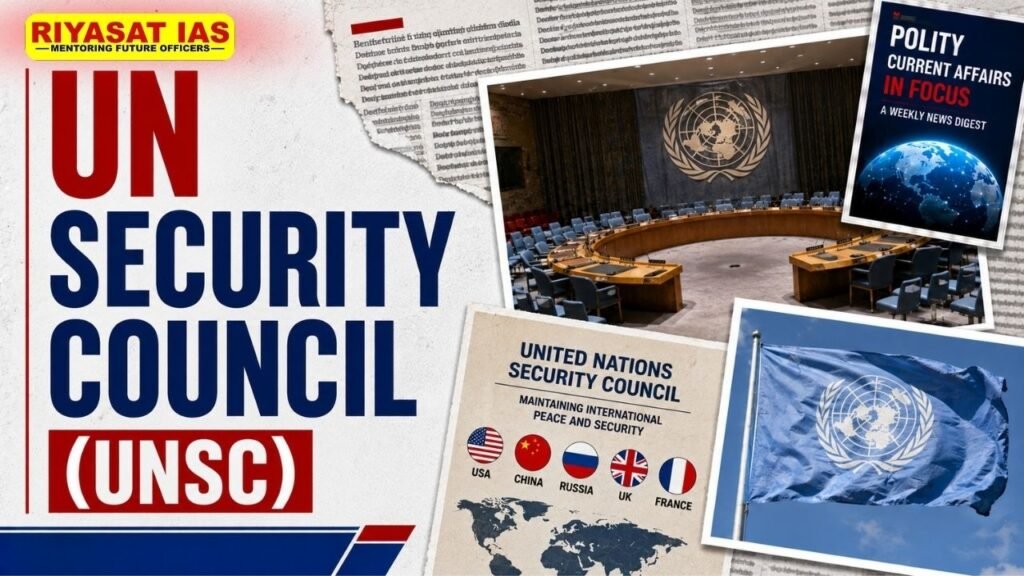
The United Nations Security Council (UNSC) is the principal organ of the United Nations responsible for the maintenance of international peace and security. It was established under Chapter V of the UN Charter and is the only UN body whose decisions can, under the Charter, impose legally binding obligations on Member States.
· Establishment: The United Nations Security Council was established in 1945 with the creation of the United Nations.
· Legal Basis: Its authority and functions are derived from Chapter V of the United Nations Charter.
· Headquarters: The UNSC operates from the United Nations Headquarters in New York City.
Structure and Composition of the UNSC
· The Security Council consists of 15 members, of which five are permanent members (P5) and ten are non-permanent members elected by the General Assembly for two-year terms. The permanent members are China, France, Russia, the United Kingdom and the United States.
· The ten non-permanent seats are distributed according to equitable geographical representation. For 2026, the non-permanent members are Bahrain, Colombia, Democratic Republic of the Congo, Denmark, Greece, Latvia, Liberia, Pakistan, Panama and Somalia.
o Non-permanent members do not possess veto power and are elected for two-year terms. The Council’s presidency rotates monthly among all 15 members according to the English alphabetical order of their names.
Powers and Functions of the UNSC
· Maintenance of International Peace and Security: The primary responsibility of the UNSC is to prevent threats to international peace, manage conflicts and facilitate peaceful settlement of disputes.
· Chapter VI: Peaceful Settlement of Disputes: The Council can investigate disputes or situations that may endanger international peace and recommend appropriate methods for their peaceful settlement.
· Chapter VII: Enforcement Action: When the Council determines the existence of a threat to the peace, breach of the peace or act of aggression, it can take enforcement measures under Chapter VII.
o These measures may include economic sanctions, diplomatic restrictions, arms embargoes and other non-military measures, while Article 42 provides for possible military action when non-military measures are inadequate.
· Sanctions: The UNSC can impose sanctions against states, organisations or individuals involved in activities that threaten international peace and security.
· Peacekeeping Operations: The Council authorises and establishes UN peacekeeping missions in conflict-affected regions.
· Authorisation of Use of Force: In certain circumstances, the UNSC can authorise collective military action to maintain or restore international peace and security.
· Admission of New UN Members: The Security Council recommends the admission of new states to the United Nations, after which the General Assembly takes the final decision.
· Appointment of the Secretary-General: The UNSC recommends a candidate for Secretary-General, who is then formally appointed by the General Assembly.
· International Justice: The Council can refer situations involving alleged international crimes to the International Criminal Court where the relevant legal conditions permit, particularly when the state concerned is not otherwise subject to the Court’s jurisdiction.
Voting and the Veto
· For substantive matters, a Security Council decision requires at least nine affirmative votes, including the concurring votes of the permanent members.



· A negative vote by any P5 member can therefore block substantive action. This is commonly known as the veto power.
· However, an important distinction is that a P5 abstention does not necessarily prevent adoption of a resolution if the required nine votes are obtained.
· The veto was designed to ensure that major powers would not be forced into collective action against their fundamental interests, but it has increasingly become one of the major criticisms of the Council.
G4 Nations and UNSC Reform
· The G4 comprises India, Brazil, Germany and Japan. These countries support each other’s aspirations for permanent membership of an expanded Security Council.
· The G4 argues that the current structure reflects the geopolitical realities of 1945 rather than the contemporary international system. The group supports expansion in both the permanent and non-permanent categories, with greater representation for Asia, Africa and Latin America.
· India’s G4 partnership is particularly important because it strengthens India’s argument that UNSC reform should reflect population, economic contribution, peacekeeping contributions and the contemporary distribution of global power. India has repeatedly coordinated with Brazil, Germany and Japan on Security Council reform.
Coffee Club / Uniting for Consensus (UfC)
· The Uniting for Consensus (UfC) group is commonly referred to as the “Coffee Club.” It includes countries that oppose the creation of new permanent seats on the Security Council.
· Important members include Italy, Pakistan, Mexico, Argentina, Spain, South Korea, Canada and Türkiye, among others.
· The group argues that creating additional permanent members would reproduce the existing inequality rather than make the Council genuinely representative. The UfC proposal favours expanding the Council primarily through elected, non-permanent seats, with greater opportunities for regional representation and rotation.
Major Issues in the UNSC
· Outdated Representation: The present structure largely reflects the post-World War II power structure. Since 1945, the UN has expanded from 51 founding members to 193 Member States, but the number of permanent members has remained unchanged.
· Lack of Developing-Country Representation: Africa has no permanent seat, despite representing more than a quarter of UN Member States. Similarly, Latin America and the Caribbean have no permanent representation, while Asia’s representation remains limited to China among the P5.
· Veto Power: The veto gives each P5 member the ability to block substantive action even when the majority of the international community supports a measure.
· Geopolitical Deadlock: Major-power rivalry increasingly affects Council functioning. Conflicts such as the Russia–Ukraine war and crises in West Asia have demonstrated how disagreements among permanent members can constrain collective action.
· Selective Action: Critics argue that the Council’s response can appear inconsistent because geopolitical interests of permanent members influence whether and how strongly it acts in different crises.
· Representation of Contemporary Power: Countries such as India, Japan, Germany and Brazil argue that their economic weight, population, diplomatic role and contributions to international peace should be reflected more adequately in the Council.
Challenges Facing the UNSC
· Veto Paralysis: The most immediate challenge is the possibility that disagreements among P5 members can prevent collective action.
· New Forms of Security Threats: The Council’s traditional focus on interstate conflict is increasingly challenged by terrorism, cyber threats, climate-related security risks, pandemics, transnational organised crime and autonomous weapons.
· Enforcement Deficit: Even when resolutions are adopted, implementation depends heavily on Member States and international cooperation.
· Legitimacy Crisis: The absence of permanent representation for Africa, Latin America and major emerging powers creates questions about the Council’s legitimacy.
· Reform Deadlock: Security Council reform requires a difficult amendment to the UN Charter, including approval by two-thirds of the General Assembly and ratification by two-thirds of UN Member States, including all five permanent members.
Why Does India Seek Permanent Membership?
· India is the world’s most populous country, has one of the world’s largest economies, is a major contributor to UN peacekeeping, has significant diplomatic reach and represents the interests of the Global South.
· India has also served multiple terms as a non-permanent member, most recently in 2021–22, demonstrating its experience in the Council. The UN records India as having served multiple elected terms since 1950.
· India therefore argues that a Council without permanent representation from countries such as India does not adequately reflect contemporary global realities.
Proposed UNSC Reforms
· Expand Permanent Membership: The Council should include new permanent members to reflect contemporary geopolitical and economic realities. The G4 proposal supports permanent representation for India, Brazil, Germany and Japan, alongside greater representation for Africa.
· Expand Non-Permanent Membership: Additional elected seats could increase geographical representation and provide more countries with opportunities to participate in Council decision-making.
· Reform the Veto
o Restricting the use of veto in cases involving mass atrocities.
o Requiring multiple permanent members to exercise the veto jointly.
o Increasing transparency and accountability regarding veto use.
o A more ambitious proposal would involve abolishing the veto, although this remains politically difficult.
· Improve Regional Representation: Africa’s demand for permanent and non-permanent representation should be addressed, while Latin America and Asia should also receive more equitable representation.
· Reform Working Methods: The UNSC can improve its effectiveness even before Charter reform by making its working methods more transparent, accountable, representative and responsive.
Way Forward
· UNSC reform should not be viewed simply as a competition for permanent seats. The objective should be to create a Council that is representative, legitimate, effective and accountable.
· India should continue working through the G4, L.69 Group, African partners and broader Global South platforms to build consensus for comprehensive reform.
· At the same time, India should support practical improvements in the Council’s working methods, transparency, peacekeeping, counter-terrorism and conflict-prevention mechanisms.
Conclusion
The credibility of the Security Council depends on the balance between representation and effectiveness. Reform should therefore expand representation without paralysing decision-making, strengthen the voice of developing regions and make the use of veto more accountable. A reformed UNSC that reflects contemporary geopolitical realities would strengthen, rather than weaken, the legitimacy of the United Nations.
FAQs
1. How many members does the UNSC have?
The Security Council has 15 members: five permanent members and ten non-permanent members.
2. Which countries are the permanent members of the UNSC?
The permanent members are China, France, Russia, the United Kingdom and the United States.
3. What is the G4?
The G4 consists of India, Brazil, Germany and Japan, which jointly support expansion of the Security Council and permanent membership for themselves.
4. What is the Coffee Club?
The Coffee Club or Uniting for Consensus group opposes the creation of new permanent seats and favours expanding the Council primarily through elected, non-permanent seats.
5. Why does India want permanent membership?
India argues that its population, economic weight, peacekeeping contribution, growing global role and representation of Global South interests justify permanent representation in a reformed Security Council.


 Ravi Raaz
 Hassan Khan
 Shadab Ali