
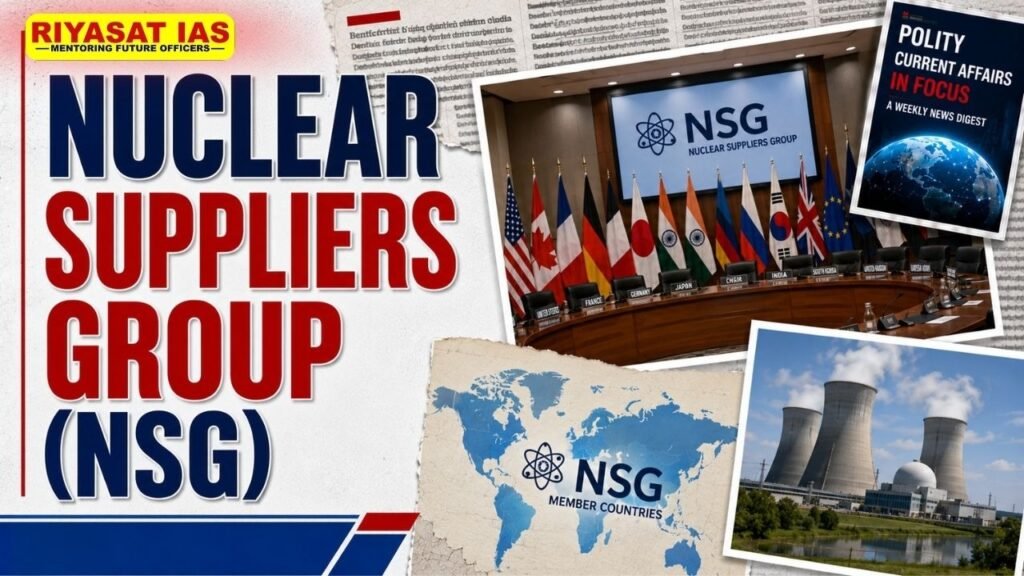
The Nuclear Suppliers Group (NSG) is a voluntary, non-legally binding group of nuclear-supplier governments that seeks to prevent the proliferation of nuclear weapons by regulating international transfers of nuclear material, equipment, technology and nuclear-related dual-use items. It simultaneously aims to ensure that legitimate peaceful uses of nuclear energy and international nuclear trade are not unnecessarily obstructed.
What is the NSG?
· The NSG is an export-control regime rather than a treaty-based organisation. Its Participating Governments implement the NSG Guidelines through their own national laws and export-licensing systems.
· The regime focuses on controlling the supply side of nuclear proliferation by establishing common conditions under which nuclear and nuclear-related items can be exported. The NSG Guidelines are therefore not directly legally binding on states, but participating governments commit to implementing them nationally.
· The NSG operates through consensus, meaning that decisions require agreement among all Participating Governments.
Background and Formation of the NSG
· The Zangger Committee was established in 1971 to clarify the interpretation of Article III.2 of the Nuclear Non-Proliferation Treaty (NPT) and developed the original “Trigger List” of nuclear items whose export would trigger IAEA safeguards.
1974: India’s Nuclear Test and the Emergence of NSG
· India’s peaceful nuclear explosion at Pokhran in 1974 demonstrated that nuclear technology transferred for peaceful purposes could potentially contribute to a nuclear-weapons capability.
· This prompted major nuclear-supplier countries to hold consultations in London in 1974, leading to the formation of what became known as the Nuclear Suppliers Group, initially called the London Club.
1978: First NSG Guidelines
· The first NSG Guidelines were published by the IAEA as INFCIRC/254 in 1978. They established conditions for nuclear transfers and incorporated the Trigger List.
1992: Dual-Use Controls
· Following renewed concerns about nuclear proliferation, particularly after the experience of Iraq, the NSG adopted Part 2 Guidelines in 1992 to regulate nuclear-related dual-use equipment, materials, software and technology.
· Thus, the NSG gradually evolved from controlling primarily nuclear materials and equipment to covering a broader range of dual-use technologies and sensitive nuclear-related transfers.
NSG Members / Participating Governments
The NSG officially uses the term “Participating Governments” rather than members, because it is not a treaty-based organisation. As of 2026, there are 48 Participating Governments: Argentina, Australia, Austria, Belarus, Belgium, Brazil, Bulgaria, Canada, China, Croatia, Cyprus, Czech Republic, Denmark, Estonia, Finland, France, Germany, Greece, Hungary, Iceland, Ireland, Italy, Japan, Kazakhstan, Latvia, Lithuania, Luxembourg, Malta, Mexico, Netherlands, New Zealand, Norway, Poland, Portugal, Romania, Russia, Serbia, Slovakia, Slovenia, South Africa, South Korea, Spain, Sweden, Switzerland, Türkiye, Ukraine, United Kingdom and United States. The European Commission and Chair of the Zangger Committee have permanent observer status. India is not a Participating Government, although it has formally adhered to the NSG Guidelines.



Salient Features of the NSG
· Voluntary Export-Control Regime: The NSG is a voluntary and non-legally binding arrangement, and each Participating Government implements the Guidelines through its own national legislation and export-control system.
· Two Sets of Guidelines: The NSG operates through Part 1 Guidelines, which govern transfers of nuclear material, equipment and technology, and Part 2 Guidelines, which regulate nuclear-related dual-use items, materials, software and technology.
· Trigger List: The NSG maintains a Trigger List containing nuclear items and technologies whose transfer requires specified safeguards and conditions because their export could contribute to sensitive nuclear activities.
· Dual-Use List: The regime also controls items that may have both civilian and military applications, particularly technologies that could contribute to the development of nuclear fuel-cycle capabilities or nuclear explosive programmes.
· Non-Proliferation Principle: The NSG’s Non-Proliferation Principle, adopted in 1994, requires suppliers to consider whether a proposed transfer could contribute to nuclear-weapons proliferation, even where other formal conditions may appear to be satisfied.
· Consensus-Based Decision-Making: NSG decisions are taken through consensus, giving every Participating Government an effective role in decisions concerning the Guidelines, control lists and participation.
· National Implementation: The NSG does not itself issue export licences. Individual governments make export decisions according to their national laws, regulations and licensing procedures, while applying the common NSG Guidelines.
Objectives of the NSG
The principal objective of the NSG is to prevent the proliferation of nuclear weapons and other nuclear explosive devices while allowing legitimate peaceful nuclear cooperation to continue. Its objectives include:
- The NSG seeks to prevent nuclear exports from contributing to unsafeguarded nuclear fuel-cycle activities or nuclear-weapons programmes.
- It seeks to harmonise national export-control practices among major nuclear suppliers.
- It seeks to strengthen international implementation of nuclear non-proliferation norms, particularly those associated with Article III.2 of the NPT.
- It seeks to prevent sensitive nuclear and dual-use technologies from reaching proliferation networks.
- At the same time, it seeks to ensure that responsible international trade in peaceful nuclear technology is not unnecessarily restricted.
International Atomic Energy Agency (IAEA)
· The International Atomic Energy Agency (IAEA) is an autonomous international organisation within the UN system that works to promote the safe, secure and peaceful use of nuclear energy. The IAEA and NSG perform different but complementary functions.
IAEA’s Major Role
· The IAEA primarily works through nuclear safeguards, verification, nuclear safety, nuclear security, technical cooperation and peaceful applications of nuclear technology.
· Its safeguards system uses technical measures to verify that states are honouring their international legal obligations and that nuclear material and technology are not diverted towards prohibited military purposes.
IAEA and NSG Connection
The NSG Guidelines are published through the IAEA’s INFCIRC series, although the IAEA does not control or administer the NSG.
NSG and India
· India’s Non-NPT Status: India is not a signatory to the NPT, and traditional NSG participation criteria have included adherence to the NPT or equivalent international non-proliferation arrangements. This has been one of the major obstacles to India’s full membership.
· 2008 NSG Waiver: A major breakthrough came in 2008, when the NSG adopted a specific policy statement permitting civil nuclear cooperation with India, taking into account India’s voluntary commitments, separation of its civilian and strategic nuclear facilities, its IAEA safeguards agreement and its commitment to adhere to NSG Guidelines. This waiver ended India’s long-standing isolation from international civilian nuclear commerce.
· India’s IAEA Safeguards Agreement: India concluded an agreement with the IAEA for the application of safeguards to its civilian nuclear facilities, which entered into force in 2009. India also brought an Additional Protocol into force in 2014.
· India’s Adherence to NSG Guidelines: India formally communicated in May 2016 that it would adhere to the NSG Guidelines and its national export-control system was harmonised with the relevant requirements. The NSG officially records India as a unilateral adherent to the Guidelines, but this does not confer Participating Government status.
· India’s Bid for Full NSG Membership: India applied for NSG membership in 2016. However, its application has not been accepted because the NSG operates by consensus and some participating governments have sought a broader criteria-based approach for considering the membership applications of non-NPT states.
Why NSG Membership Matters for India
· Full NSG membership could strengthen India’s integration into the global civilian nuclear supply chain and provide greater institutional participation in shaping international nuclear export-control rules.
· It could also strengthen India’s position as a responsible nuclear power, improve access to advanced nuclear technologies and facilitate India’s long-term ambitions for expanding nuclear energy.
· This is increasingly relevant because India is seeking a larger role for nuclear energy in its low-carbon electricity mix. The IAEA’s 2024 India Country Nuclear Power Profile recorded 24 operational reactors with 8,180 MW of installed capacity as of March 2024.
Conclusion
The NSG must balance two seemingly competing objectives: preventing nuclear proliferation and enabling peaceful nuclear cooperation. India’s case demonstrates the need for a credible, transparent and non-discriminatory export-control regime that recognises responsible nuclear behaviour while maintaining the integrity of global non-proliferation norms.
FAQs
1. Is the NSG a treaty-based organisation?
No. The NSG is a voluntary, non-legally binding export-control arrangement whose Guidelines are implemented through national laws.
2. How many Participating Governments does the NSG have?
The NSG currently has 48 Participating Governments.
3. Why was the NSG created?
The NSG emerged after India’s 1974 nuclear test to strengthen controls over nuclear exports and prevent peaceful nuclear cooperation from contributing to nuclear-weapons proliferation.
4. Is India a member of the NSG?
No. India is not a Participating Government, but it has formally adhered to the NSG Guidelines since 2016.
5. What is the difference between the NSG and IAEA?
The NSG regulates nuclear exports and supplier behaviour, whereas the IAEA verifies safeguards and promotes the safe, secure and peaceful use of nuclear technology.




 Ravi Raaz
 Hassan Khan
 Shadab Ali