
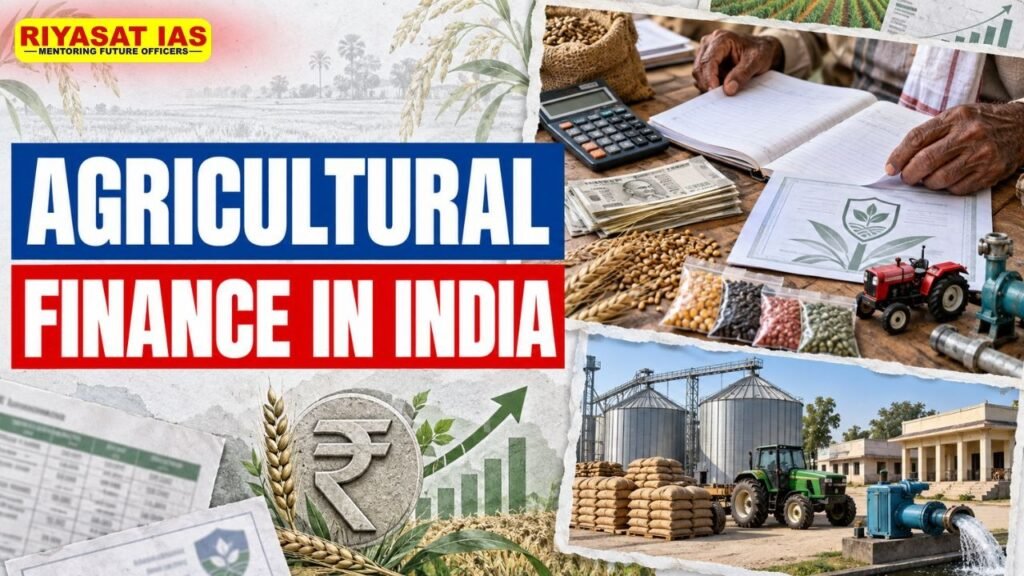
Agricultural finance is concerned with the financial aspect of farming and agribusiness. It examines how growers procure, allocate, and manage the capital needed in farms and for agri-marketing activities. Agricultural credit in India is considered indispensable since farmers require financial assistance to purchase agricultural inputs, invest in farm equipment, acquire livestock, irrigate, store, and transport their produce to the market.
Agricultural finance, in general, has two dimensions: micro finance, which focuses on understanding the financial and economic aspects of individual farms and agribusinesses, and macro finance, which is regarded as the study of the sector’s overall credit situation, credit and investment policies, and macro-level institutional aspects.
Meaning of Agricultural Finance
The term agricultural finance generally refers to the study of how money works in the agricultural sector: how agricultural producers get and spend cash on cultivating commodities. Murray (1953) defined agricultural finance as the financial analysis of borrowing money and storing financial reserves in the farm, coupled with the study of farm-lending organizations. Meanwhile, Tandon and Dhondyal (1962) defined it as a specialized branch of agricultural economics that is explicitly concerned with the financial resources in farming activities.
In context, it, therefore, refers to the mechanism by which cultivators get connected to banks and formal credit agencies to buy agricultural produce, seeds, and chemical fertilizers, acquire livestock and farm equipment, improve their holdings, and pay their market dues.
Macro vs. Micro Dimensions
Agricultural finance is a broad concept that entails a comprehensive examination of the credit situation of farms and agribusinesses at both macro and micro levels.
Macro Finance
Macro finance typically refers to the study of the overall situation of agricultural credit and the law, rules, and procedures that govern farm financing:
Key points:
- Sector-level agricultural credit demand.
- Terms and conditions for loans and credit facilities.
- Policy and regulatory supervision of financing activities.
- How credit flows promote rural development and farm growth.
Micro Finance
Micro finance, on the other hand, examines how individual farms and agribusinesses handle and manage their finances.
Key points:
- Daily and seasonal farm expenses.
- Individual farmer’s borrowings and repayments.
- Analysis of daily capital allocation and expenditures.
- How farmers budget and optimize their resources.
The perspective of both macro and micro finance is critical in examining agricultural finance issues. While most of the country’s formal credit institutions implement macro-level agricultural finance guidelines, the success of these regulations ultimately depends on how well individual farmers utilize the borrowed money.
Common Agricultural Loans in India
Farmers in India have several loan options to choose from depending on their needs: crop, combine harvester, multipurpose gold, drip irrigation, tractor, poultry, and dairy loans, among others.
- Crop loans: These are short-term seasonal agricultural credits provided by commercial banks and rural cooperative institutions to support short-term expenditures during cultivation.
- Kisan Credit Card (KCC) loans: This scheme was introduced in 1998 and provides a line of cash credit to farmers to meet their short-term cultivation and allied needs in a timely manner.
- Combine Harvester loans: These loans enable farmers to buy combine harvesters to help speed up the reaping process and minimize losses at the same time.
- Multipurpose Gold loans: Farmers with gold jewelry can use the precious metal as collateral to get a loan that can assist with their various farm-related needs.
- Drip irrigation loans: This program supports farmers by helping them install highly efficient water-saving irrigation systems in their farms.
- Tractor loans: Farmers can use the funding facilities to buy tractors to help with tilling, reaping, haulage, and other operations.
- Poultry loans: These are credit schemes that help finance sheds, equipment, feed, and chicks to set up a profitable commercial egg or meat production enterprise.
- Dairy loans: This credit program assists farmers with purchasing milch cattle, constructing sheds, and acquiring milking and cooling equipment.



Major Lenders of Institutional Finance
Farmers can get their financing needs met from several formal credit agencies:
- National Bank for Agriculture and Rural Development (NABARD): This is the apex policy-oriented organization that manages, regulates, and oversees the country’s rural and agricultural credit.
- Nationalised (Public Sector) Banks: They are the primary lenders of agricultural credit, providing short-term crop loans and term loans for farm equipment.
- Private Sector Banks: They are significant contributors of credit to the agricultural sector through specialized agricultural credit lines, agri-business loans, and priority sector advances.
- State Bank of India: It has the largest agricultural financing network in the country through its extensive branch network in the rural and urban centers, offering specialized agricultural financing products and schemes.
Key Benefits of Farm Finance (Loans)
Agricultural finance offers numerous benefits to farmers and the rural community in general:
- Securing farm produce: Farm finance enables farmers to buy quality agricultural inputs and chemicals that would have been unaffordable.
- Facilitating mechanization: Credit facilities make it possible for growers to purchase farm machinery and equipment, cutting down on time and costs of cultivation.
- Adding value and marketing: With farm finance, a farmer would be able to buy equipment to help grade and market their produce profitably.
- Avoiding post-harvest losses: With proper storage facilities, farmers can store their surplus harvests in on-farm godowns and sell them when prices are high.
- Transporting farm produce to market: Farm finance makes it possible for farmers to buy vehicles to help transport their produce to nearby towns and cities where demand is high.
- Meeting rural electricity needs: Credit makes it possible for farmers to install electricity connections, pumps, and other related appliances.
- Hedging against production risks: Farm finance helps cushion farmers against losses incurred due to weather conditions in a season.
- Mitigating market risks: Credit makes it possible for farmers to purchase farm produce from neighboring farmers when prices are low and sell to distant buyers when prices are high.
- Helping meet statutory requirements: Farmers can use finance to purchase equipment for processing activities to meet statutory requirements for selling farm products.
Challenges in Agricultural Credit System
Several challenges hinder the smooth flow of credit to the agricultural sector in India:
- Lack of collateral: Most marginal and tenant farmers find it difficult to get credit from commercial banks due to their lack of collateral.
- Cost of borrowing: The high-interest rates often burden farmers with huge debts, especially when there are adverse weather conditions and low market prices.
- Documentation: Most farmers are hesitant to take loans due to the lengthy procedures and paperwork involved in the loan application process.
- Knowledge and awareness: Most farmers lack the knowledge of financial terms and conditions and how loan agreements affect their ability to repay loans on time.
- Inaccessibility: Banking institutions have limited branches in remote areas making it difficult for farmers to access credit.
- Weather fluctuations: Unpredictable weather changes in a season can cause serious damage to farm crops, leaving farmers unable to repay their loans.
- Price fluctuations: Large-scale changes in commodity prices on harvest day can also affect farmers’ ability to clear their debts.
- Cumbersome procedures: Most banks have many steps and procedures when sanctioning a loan, deterring farmers from taking loans.
Way Forward
India needs to enhance its agricultural credit system by promoting faster and more accessible loan processes as well as increasing financial literacy among the rural community. Streamlining the loan approval processes and reducing paperwork will encourage more farmers to take bank loans instead of informal lenders. Equally important is the need for credit institutions to promote a balanced short and long-term loan program to ensure continued growth in the farm sector.
Frequently Asked Questions
What is agricultural finance?
It refers to the financial aspect of farming and agribusiness. It examines how growers procure, allocate, and manage the capital needed in farms and for agri-marketing activities.
What are the two primary dimensions of agricultural finance?
It has two dimensions: micro finance, which focuses on understanding the financial and economic aspects of individual farms and agribusinesses and macro finance, which is regarded as the study of the sector’s overall credit situation, credit and investment policies, and macro-level institutional aspects.
What is the core focus of macro finance in agriculture?
Macro finance deals with the aggregate credit supply, lending regulations, monitoring frameworks, and policy initiatives designed to direct institutional money into the farm economy.
What does micro finance cover in a farming context?
Micro finance covers day-to-day budgeting, farm-level debt management, input expenditure, and operational decisions made by individual farmers.
What is a crop loan?
It is a short-term borrowing arrangement that provides farmers with immediate cash to cover seasonal cultivation expenses.
When was the Kisan Credit Card (KCC) introduced?
The Kisan Credit Card scheme was launched in 1998 to ensure farmers have flexible, timely short-term credit for seasonal crop needs and allied farm operations.
What is a tractor loan?
It is a specialized machinery term loan offered by banks to help farmers finance the purchase of tractors for field cultivation and haulage.
What is a drip irrigation loan?
It is a credit facility that helps farmers invest in water-conserving drip irrigation equipment.
What are the biggest roadblocks in Indian agricultural finance?
The main constraints include inadequate collateral, procedural delays, high effective borrowing costs, limited financial awareness, sparse banking infrastructure, erratic weather shocks, and price volatility.
Why is credit so critical to Indian agriculture?
It provides the liquidity required to purchase inputs, adopt modern machinery, build storage, arrange transport, and absorb climate or market shocks, ensuring farm operations remain commercially viable.
Transform your UPSC preparation with expert mentorship, structured guidance, and exam-focused study resources. Join our UPSC Mentorship Programme to strengthen your Economy, Agriculture, and Current Affairs preparation.


 Ravi Raaz
 Hassan Khan
 Shadab Ali