
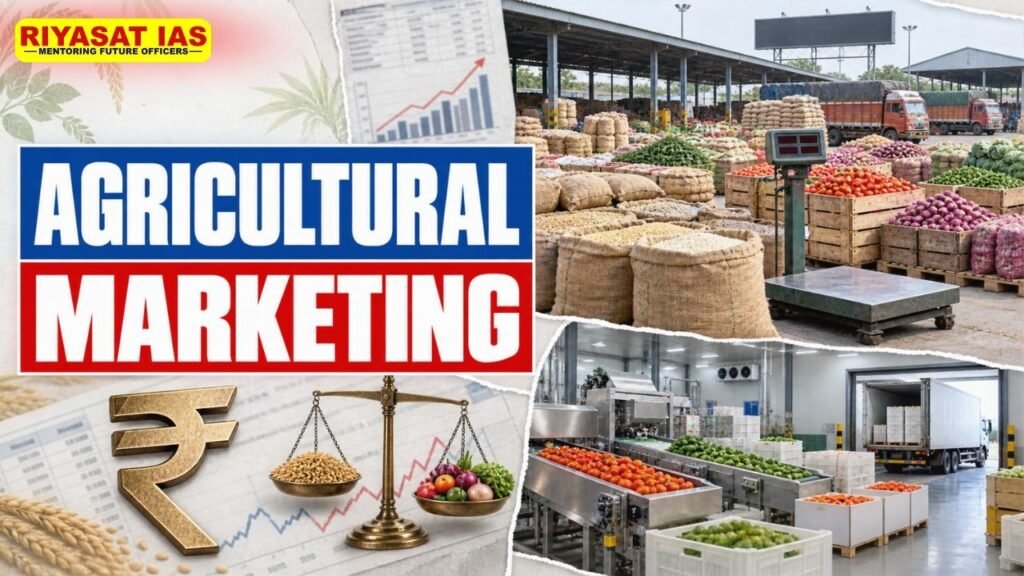
Agricultural marketing is not just about mandi yard. It involves every step in crop production chain till it reaches consumers’ plate, including harvesting, aggregation, sorting, scientific storage, freight, processing, packaging, branding, wholesale, retail, and international trade.
Efficient agricultural marketing ensures fair realization for growers, minimizes post-harvest losses, reaches lucrative destinations, and ensures that grocery bills for an average household remain manageable.
At present, agricultural marketing faces severe cold-chain deficits, scattered production, networks of commission agents, hefty logistics overheads, and poor linkages to organized buyers. Addressing these deep-seated issues requires an integrated value-chain approach involving growers, processors, bulk retails, exporters, and consumers.
Upstream: Sources of Constraint at Farm Gate
Most agricultural marketing challenges occur before a crop reaches a mandi yard:
Fragmented Small Land Holdings
Most Indian farmers grow on a small scale and in a fragmented manner. This limits their ability to aggregate any marketable surplus, and they have little leverage while transacting with a wholesale buyer.
Lack of Collective Aggregation Mechanism
There is a dearth of FPOs, cooperatives, or local depots to collectively sell a marketable surplus.
Asymmetry in Information
Growers lack timely price discovery at alternate destinations, demand-supply dynamics, arrivals, and quality specification vis-à-vis their produce grade. Therefore, selling blind leads to foregone opportunities at better prices.
Post-Harvest Distress Sales
Immediate family expenses, outstanding dues, and lack of local storage options induce farmers to sell their entire harvest at the farm gate, which coincides with a post-harvest price dip.
In addition, there is no opportunity for grading, sorting, and size segregation to capture a premium.
No Grading/Sorting at Village Level
With no sorting infrastructure at the field level, good and bad quality lump together, impacting overall realization.
Absence of Primary Processing Hubs
Primary processing activities (cleaning, sun-drying, milling, waxing, pulping, chilling, bagging) are not easily accessible, which increases rotting risks and denies the grower the margin of value addition through processing.
Inadequate Warehouses and Silos
The dearth of scientific warehouses and silos results in tarpaulin-stored produce getting compromised and inability to store to fetch a higher price during a seasonal dip.
Cold-Chain Deficit
Most perishable agricultural produce such as fruits, vegetables, milk, fish, and poultry require a cold-chain logistic solution.
However, the current deficit of pre-cooling centers, cold storage, and reefer vans results in extensive losses at various stages.
Sub-Optimal Freight Structure
Poor feeder roads, dearth of dedicated freight carriers, and high costs of transporting marginal produce from remote areas to a mandi yard further add to the logistics cost.
Intermediary Dominance
Local commission agents and traders often act as moneylenders to the farmers, offering them credit of seeds, fertilizers, and transport.
This creates a moral obligation on the farmer to sell to them, divesting a large chunk of the consumer rupee.
Lack of MRL and Packaging Awareness
Access to high-value retail chains and exports requires adherence to food safety and hygiene standards (MRL limits), which most small growers are unaware of or lack the testing infrastructure.



Inaccessibility of Institutional Credit
Due to documentation formalities, small growers are denied credit by banks. This compels them to take informal loans at a high-interest rate which, in turn, drives distress selling at the earliest.
Downstream: Constraints from Mandi to Consumer
While upstream farm-level issues constrain supply, downstream logistics and trade-related problems dictate realization:
Structural Inefficiencies in Mandi
The erstwhile state APMC notified produce mandis that dictated who could sell and to whom.
Mandi infrastructure suffers from overcrowding, and price discovery is opaque, with arhatiyas capturing a significant transaction discount.
Mandi Levies and Cess
Transaction costs in a mandi comprise hefty levies, state cess, and agent commissions, which come on top of the distress sale by a farmer at the farm gate.
Alternate Marketing Avenues
The 2020 farm acts recognized the need to create alternate private marketing channels beyond APMC monopoly.
However, most states repealed their farm acts, which could have created an alternate trading platform for growers, buyers, and traders.
Intermediaries
A crop undergoes several layers of trading before it reaches a retail outlet or a consumer.
The successive value capture by commission agents and traders without any tangible value addition comes at the expense of the grower’s margin.
Processing Deficit
India has a dearth of modern food processing infrastructure that adds value to perishable produce.
Processing capacity is concentrated in certain regions, and perishable agricultural produce rots before it can be processed into purees, concentrates, or other value-added forms.
Lack of Brand Value and Consumer-Ready Packaging
Gunny bags full of farm-fresh vegetables fail to find buyers at premium retail outlets due to the absence of appropriate packaging, consumer-ready size, and brand equity.
Inordinate Logistics and Freight Costs
A combination of sub-optimal routes, multiple loading/unloading, highway connectivity deficit, cold-chain deficit, and high fuel costs add to the logistics cost borne by both growers and consumers.
Price Discovery Asymmetry
Without access to price discovery tools, farmers sell at a lower price as compared to what could have been realized through alternate channels.
Constraints in e-NAM Digital Trading Platform
e-NAM was conceptualized to create a pan India digital trading platform.
However, the lack of state-level adoption, grading infrastructure at mandi gates, and inter-state shipping carriers affects its efficacy.
Asynchronous Regional Agricultural Markets
Agricultural markets in India are not synchronized, leading to wide price variations between geographical markets.
A bumper crop in a state can lead to a price collapse with farmers being forced to sell on roads while consumers in another state face a shortage.
Inter-state freight, local taxes, cold-chain deficit, and market-intelligence asymmetry prevent smoother flow of goods from surplus to deficit pockets.
Constraints in Organized Retail and Quick Commerce
Supermarkets, organized retail chains, and quick commerce require a steady and predictable supply of consumer-ready products.
Small growers and even rookie FPOs lack the maturity in supply-chain management or financial resources to meet their requirements, pushing them back to traditional mandi.
Export and Cold-Chain Bottlenecks
Exporting agricultural produce comes with a host of requirements including residue testing, phytosanitary checks, farm-to-fork traceability, cold-chain logistics, and high-speed port handling.
The current infrastructure deficit creates hurdles in addressing such requirements, which in turn restricts India’s share in international agricultural trade.
Food Safety Regulations
Modern food retailing requires adherence to stringent hygiene and residue norms, which disqualifies most Indian farms from accessing premium domestic and international markets.
Default Risk and Contract Management
Direct contracting between growers and corporates is often stalled by default risk on either side or a lack of legal recourse.
Both parties remain hesitant to enter into long-term supply contracts due to no dispute-resolution mechanism in place.
Way Forward:
- Professionalize FPOs: Encourage consolidation among small growers into strong farmer companies to realize better price discovery, negotiate with institutional buyers, and access institutional credit.
- Farm Gate Infrastructure: Encourage private and state investment in setting up processing, grading, and storage infrastructure at the field level to avoid transit losses.
- Cold Logistics: Develop cold logistics chains such as reefer vans and cold storage, especially in fruit, vegetable, dairy, and fisheries belts.
- Processing Clusters: Set up small processing units in the hinterlands to process seasonal surplus into tomato puree, fruit pulp, and other downstream products, utilizing the in situ labor force in non-farm activity.
- Market Intelligence: Enable mobile phone-based price intelligence tools so that farmers can make informed choices on where and when to sell.
- Modernize Mandis: Modernize traditional mandis with digital tools such as electronic weighing scales, e-bidding, and direct electronic clearance of dues.
- Direct Connect to Institutional Buyers: Facilitate direct connections between farmer groups and processors, hotel chains, retail chains, and quick commerce to negate the need for multiple layers of commission agents.
- Adopt Global Quality and Traceability Standards: Help farmer groups realize the need for residue testing and adopt appropriate packaging and labeling to meet global and domestic organized retail requirements. A QR code on a package of farm produce can give full traceability of a product back to the farm.
Frequently Asked Questions
What does agricultural marketing entail?
It encapsulates all activities related to any step in a crop’s journey from field to fork. It includes post-harvest aggregation, grading, storage, freight, processing, retail, and international trade.
What are the key constraints in agricultural marketing?
Fragmented small land holdings, collective bargaining deficit, cold storage deficit, opaque mandi practices, multiple middlemen, low processing, and high logistics cost comprise key constraints in agricultural marketing.
How do Farmer Producer Organizations (FPOs) benefit farmers?
FPOs enable small growers to consolidate their harvest, realize better price discovery, and access institutional credit and processing infrastructure.
What role does cold logistics play in agricultural marketing?
Most fresh agricultural produce requires cold logistics for extended shelf-life. The lack of cold logistics contributes to large-scale losses.
What is e-NAM’s objective?
e-NAM aims to digitize mandi trading by bringing disparate mandis on one digital platform, enabling wider price discovery and easier trading.
Why is regional market synchronicity important?
Unless markets are integrated, a bumper harvest in one state will lead to price collapses in that state and surpluses in another.
How does agricultural marketing help increase farm incomes?
By eliminating middlemen, reducing post-harvest losses, capturing the value of processing, and direct contracting with organized buyers, agricultural marketing helps increase farm incomes.
What changes are required to make Indian produce fit for export?
Trusted testing labs, pack-houses, phytosanitary certification, digitized farm traceability, cold-chain logistics, and faster ports are required to make Indian produce fit for exports.



 Ravi Raaz
 Hassan Khan
 Shadab Ali