
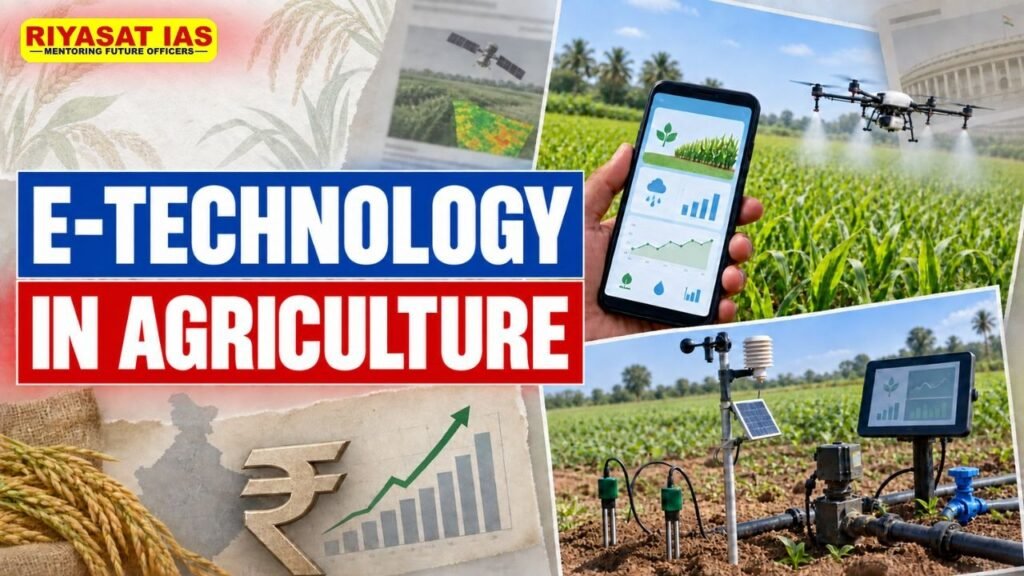
India’s agriculture is dominated by small and marginal farmers. Enhancing their crop yield and household income is crucial to the country’s rising aspirations of economic growth and alleviating hunger and poverty in rural areas.
Over decades, successive targeted interventions to boost food grain production, starting from the Green and White Revolutions, and the recent Blue and Yellow Revolutions, continue to change India’s approach to agriculture. Agricultural transformation in India started with an intensive area development programme initiated in 1960. Growers were provided with high-yielding variety (HYV) seeds, chemical fertilizers, mechanization, institutional credit, and access to markets.
Agriculture is currently witnessing the convergence of biotechnology and information and communication technology (ICT).
What is E-Technology in Agriculture?
E-technology comprises the electronic media, internet resources, and digital tools increasingly incorporated into the day-to-day activities of cultivating and growing. Within the industry, two main avenues of application distinguish ICT:
- Direct contribution to enhancing productivities by providing growers with specialized tools, hardware equipment, and know-how that directly impact crop and livestock yields.
- Aids decision-support systems that provide timely data to help the growers make sowing, irrigation, and selling decisions.
Combining agricultural biotechnology with information technology can reduce rural poverty, generate employment, increase agricultural production, and promote transparent supply chains.
How does E-technology benefit Farmers?
Through applications, the digital tools bridge the long-standing information gap between the rural growers and urban markets. By enhancing competitiveness and productivities, the online platforms provide growers with the following:
- Current commodity market prices
- Local agricultural advisories
- Local and international markets
- Modern agricultural practices
- Commercialization and marketing opportunities
In addition to crop production, electronic sensors and digital tagging systems monitor, manage, and track livestock herds and flocks.
Key Benefits of E-Technology in Agriculture
Better decision-making
Access to the latest data helps growers make better decisions at all stages of cultivating. In addition, the international sharing of information helps them understand the changing market trends.
Targeted farm planning
Digital tools such as farm-specific agricultural software provide targeted advice and assist the growers with the amounts of fertilizers and other best practices.
Community effect
When digital tools are applied at a community level, the productivity gains are massive. Internet tools such as social media also facilitate closer cooperation within the locality.
Rapid adoption of innovations
Connectivity speeds up the rate at which research findings reach the farm, enabling growers to quickly adopt new technologies such as improved stress-resistant varieties.
Wider applicability
The e-tools help disseminate the latest technical know-how in agriculture to small-scale farmers and backyard growers.



Challenges of E-Agriculture in India
Despite the tremendous potential, digitization presents some challenges to Indian agriculture:
- Low awareness of the tools: Most growers are still unaware of the available digital tools.
- Uneven penetration of technology: Modern technology is available in some states but not in others.
- The digital divide: Wealthy large-scale farmers are quick to adopt the new technology, leaving small-scale growers in the dark, therefore aggravating the income inequality.
- Low literacy levels: Most farmers are illiterate and cannot engage with the current digital tools; thus, technology introduces an informal middleman who charges commissions to perform simple tasks.
- Poor network coverage in rural areas: The lack of proper infrastructure causes wide regional variances in the service delivery.
Initiatives by the Indian Government in E-Agriculture
National Agriculture Market (e-NAM)
Announced in the Union Budget 2014–15 and launched on 14 April 2016, e-NAM is an electronic trading platform that aims to link physical APMC mandis into a unified national agricultural market. Implemented by the Small Farmers Agribusiness Consortium (SFAC), a body set up by the Department of Agriculture & Cooperation through the Agri-Tech Infrastructure Fund (ATIF). It started with 21 mandis in 8 States and completed its first 250-mandi phase on 6 October 2016.
AGMARKNET
Launched in 2000 by the Union Ministry of Agriculture and executed by the National Informatics Centre (NIC), the system tracks and shares commodity market prices and arrivals at wholesale markets nationally.
e-Choupal
This private initiative by ITC offers an internet-based kiosk, managed by a local farmer (sanchalak), which serves as an alternate procurement channel and provides weather, best practices, and input market information.
DBT Central Agri Portal
Launched in 2013, the portal facilitates agriculture welfare schemes and processes direct benefit transfers for subsidies on modern equipment to farmers.
Village Resource Centres (VRCs)
Using Satellite Communication (SATCOM) networks and Earth Observation (EO) satellite data, the VRCs offer geographical, meteorological, and resource information at the village level.
Digital Agriculture Mission (2021–2025)
This initiative promotes the rapid adoption of emerging technologies such as Artificial Intelligence (AI) and blockchain, remote sensing and GIS, agricultural drones, and robotics.
Unified Farmer Service Platform (UFSP)
Similar to the UPI, the UFSP provides a digital framework to enable and regulate exchanges of information and value within the agricultural ecosystem. The UFSP:
- Acts as the central coordination platform for the agri-ecosystem
- Registers public and private service providers
- Implements checks and balances
- Standardizes data formats and provides open APIs
- Facilitates data exchange between disparate schemes and private digital platforms
AgriStack
An end-to-end digital infrastructure designed to provide a unified digital experience to farmers, offering agricultural services and products across the supply and food value chains.
Sandesh Pathak
A joint initiative by C-DAC Mumbai, IIT Madras, IIIT Hyderabad, IIT Kharagpur, and C-DAC Thiruvananthapuram, this application converts text SMS into speech to facilitate information dissemination to illiterate farmers.
State-based E-Technology Initiatives
eSagu (Andhra Pradesh & Telangana)
Meaning “cultivation” in Telugu, this system connects individual cultivators with agricultural scientists to provide personalized farm management advice from sowing to harvesting. Local coordinators take photos of the fields and upload them to the scientists who give specific recommendations within 24 hours.
AGRISNET (Tamil Nadu)
A technology-based farmers’ network set to digitize the Department of Agriculture processes and provide advisory services.
Jio Agri (JioKrishi) Platform (Maharashtra)
This pilot scheme was launched in Jalna and Nashik in 2020. The system digitizes the entire crop cycle and uses basic farm data and machine learning and artificial intelligence models to provide personalized farm advise.
Future prospects of Digital Agriculture
Bridging the digital divide is critical to achieving the benefits of the e-tools. Expanding the tools’ reach requires improving internet connectivity, boosting digital literacy, buying cheaper tools, and building better infrastructure. Adopting remote sensing technology and GIS would maximize farming gains. Above all, proactive policies and robust digital infrastructure will ensure that modern technology works for the benefit of all farmers, not just the wealthy.
Frequently Asked Questions
What is e-Technology in agriculture?
E-technology comprises electronic networks, software, applications, and digital tools used in farming to facilitate day-to-day activities, enhance yields, share know-how, and provide transparent markets for the growers.
How does ICT benefit practicing farmers?
ICT provides growers with mandi prices, local weather updates, and advisories on controlling pests and connects them directly to buyers, therefore helping them make better decisions at the farm gate.
What are the major challenges facing e-agriculture in India?
The major challenges are lack of awareness, poor rural connectivity, cost of technology, poor infrastructure, and the fact that bigger farms will benefit more than the small and marginal holders.
What is the role of the National Agriculture Market (e-NAM)?
The online portal unifies physical APMC mandis into a national market where buyers can bid on the produce.
How does AGMARKNET work?
The system, run by the National Informatics Centre (NIC), collates and shares market arrivals and prices of commodities at wholesale level.
What is unique about the e-Choupal?
The e-Choupal, a brainchild of ITC, puts internet kiosks managed by local farmers (sanchalak) in villages, therefore eliminating the middlemen and giving direct access to market information.
What is AgriStack?
It is an integrated digital infrastructure that connects farmers to a range of services and products through a single digital umbrella.
What is the role of the Unified Farmer Service Platform (UFSP)?
Similar to the UPI that connects all financial applications, UFSP provides a digital interface to facilitate the seamless exchange of information between various government and private digital platforms that provide agricultural services.
How does the eSagu system work?
The system connects individual farmers with scientists to help manage their farms. The local coordinator takes photos of the farm and shares them with experts who then reply with specific recommendations within 24 hours.
Transform your UPSC preparation with expert mentorship, structured guidance, and exam-focused study resources. Join our UPSC Mentorship Programme to strengthen your Economy, Agriculture, and Current Affairs preparation.


 Ravi Raaz
 Hassan Khan
 Shadab Ali