
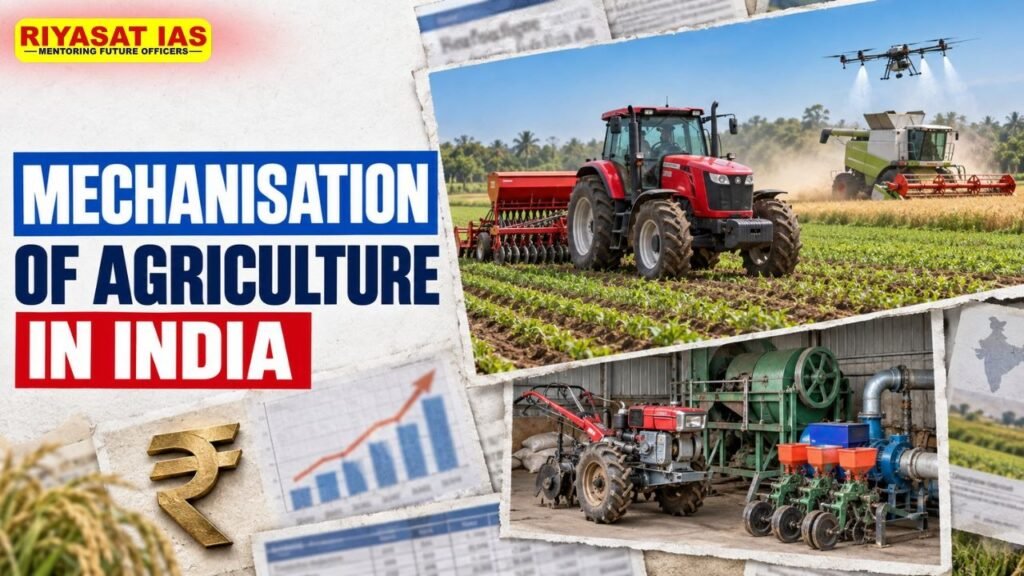
Indian agriculture is gradually transforming towards mechanisation. With the reduction in available field labour and tight harvest windows, farmers are beginning to look into mechanisation solutions from rotavators and harvesters to customised machinery. Whilst the tractor continues to be India’s undisputed agricultural workhorse, demand for purpose-built equipment is on the rise. However, compared to the global agricultural machinery leaders, India still has some way to go before its overall farm-machinery adoption reaches an advanced level.
Agriculture and Mechanisation in India
Agriculture accounts for approximately 16% of India’s Gross Value Added (GVA) and constitutes nearly 45.8% of the Indian workforce. Despite its large-scale presence, the agriculture sector has been one of the prime contributors to disguised unemployment in the country.
Mechanisation offers a solution to this problem and opens a window of opportunity.
By increasing field efficiency, mechanisation not only leaves room for alternative higher-value rural activities but also helps address issues of skill-set development in the youth as well as the adoption of modern agronomic practices. Whilst the tractor continues to be the workhorse of Indian farming, the farm machinery basket has diversified into three broad categories:
- Traction Power Equipments: Tillage equipments, automated spraying rigs, straw balers, front end loaders and laser land levelers.
- Harvesting Equipments: Self propelled combine harvesters.
- Planting Machinery: Mechanical rice transplanters.
Despite the inroads being made in these areas, adoption of purpose-built non-tractor farming machinery lags behind in India.
Benefits of Agricultural Mechanisation
Efficient Utilization of Agricultural Inputs
Machines bring scientific intervention to the manual and experience-based tasks that have characterized agriculture till now. Drills and calibrated spraying rigs ensure that seeds and agro-chemicals are placed and applied at accurate depths and intervals respectively, reducing wastage of inputs and lowering production costs. This has a trickle-down effect on the conservation of chemical content in the soil and water bodies surrounding the farmland.
Significant Reduction in Labour Costs
With a significant proportion of rural workers employed in peak-season agricultural work, mechanisation offers a means to significantly cut down on the costs and inefficiencies of employing such large seasonal workforces.
- Manual harvesting involving 5 to 7 workers in an acre of wheat costs around ₹5,000 as compared to a ₹2,000 to ₹3,000 cost per acre for employing a combine harvester that cuts, threshes, cleans and deposits the wheat crop into a trolley in a mere hour.
Improvement in Land Productivity
Cultivators enable the breaking of hardpans and the bringing under cultivation of marginal and previously uncultivated land. In addition to enabling higher crop yields, mechanisation replaces the need for traditional draught animals, thereby releasing the amount of land that had hitherto been dedicated to fodder cultivation back into the active farming cycle.



Direct Social Benefits
- Alleviating the Burden on Women: With an increasingly large proportion of men choosing to move away from agriculture to non-farm urban employment, women are increasingly shouldering the share of agricultural tasks that have hitherto been considered menial and hard work. Ergonomic machines directly tackle this issue.
- Drawing Youth Back into Agriculture: The introduction of technology-driven machinery reduces manual workloads and encourages the youth to look at agriculture as a viable career option as well as a source of entrepreneurship as well as mechanised employment.
The Dalwai Committee Finding
According to the Dalwai Committee on Doubling Farmers’ Income, adopting farm mechanisation can reduce input costs by 25%, improve crop productivity by 20% and increase overall farm income by 25% to 30%.
Challenges to Agricultural Mechanisation
- Small and Fragmented Land Holdings: With an average Indian farm size of a mere 1.08 hectares and the plots often being fragmented and non-contiguous, mechanisation solutions that require large-scale investments in machinery may face an uphill task in being implemented at a wide scale in India.
- High Capital Investment: Modern machinery tends to be capital intensive and farmers with small and marginal land holdings may find it impossible to make such large-scale investments without government or private-sector support.
- Friction in Agricultural Term Loans: Unlike short-term crop loans (e.g. the KCC model), term loans for farm machinery come with cumbersome documentation. In addition, the lack of credit experts in rural banking branches can cause delays in assessing the viability of a given piece of farm machinery and the associated collateral requirements.
- Lack of Awareness and Market Hesitance: Many growers are not aware of the latest range of specialized equipment. Additionally, growers have to weigh if the productivity gains would outweigh losses due to fluctuating crop prices.
- Reliance on Family Labour: In the absence of alternate employment opportunities in the non-farm sector, farms tend to absorb surplus family members, who in turn act as cheap or free labour. Since they are regarded as a sunk cost, families are often reluctant in making investments to make work easier or reduce the number of family members employed in agriculture.
Government Initiatives Supporting Mechanisation
- Sub-Mission on Agricultural Mechanization (SMAM): Launched in 2014, the Sub-Mission provides subsidies for purchasing machinery as well as funds field demonstrations, which display the latest in horticultural and agricultural equipment to growers.
- Crop Residue Management Scheme: Active across Punjab, Haryana, Uttar Pradesh and the NCT of Delhi, the scheme deals with the problem of stubble burning by funding crop residue management initiatives and providing financial assistance for machinery purchases. It also supports the creation of equipment parks.
- FARMS Mobile App (Farm Machinery Solutions): A digital platform, FARMS connects growers with machinery owners and servicers, enabling on-demand equipment rentals.
Way Forward
- Simplify Farm Machinery Term Lending: Farm machinery term-loans need to be simplified in documentation and approval, similar to the ease of a Kisan Credit Card, and loan officers need to be trained in assessing farm machinery as collateral.
- Scale Shared Economy and Rental Models: Small growers do not need to invest in a piece of machinery as long as they can get it done. Custom Hiring Centres (CHCs) and mobile aggregation platforms can enable such small-scale growers to hire expensive machinery on an hourly or per-acre basis.
- Build Local Repair and Spare-Part Networks: A broken machine in the middle of a crop season is an expensive lesson. Creating networks of certified repair workshops, skilled rural mechanics and spare parts dealers in proximity to cultivators helps ensure machinery downtime is minimised during crucial periods.
Frequently Asked Questions
What is agricultural mechanisation?
It refers to the use of mechanical and motorized equipment throughout every step in the agricultural production cycle, from ploughing, sowing and pesticide application to harvesting, threshing and post-harvest processing.
Why is mechanisation necessary for Indian agriculture?
It reduces input costs through precise application, addresses the cyclical manpower shortage and lowers overall harvesting losses by reducing wastage and increasing yield through scientific intervention.
What are the biggest roadblocks to adopting farm machinery in India?
Small and fragmented plot sizes (avg. 1.08 ha), the high cost of machinery, complicated term-loan procedures, lack of awareness on specialized equipment and reliance on free family labour are the biggest roadblocks to adopting farm machinery in India.
What is the role of the Sub-Mission on Agricultural Mechanization (SMAM)?
Launched in 2014, SMAM subsidises machinery purchases by growers and sets up custom-hiring facilities and demonstrations to showcase the latest in agricultural machinery.
What is the FARMS Mobile App?
The FARMS (Farm Machinery Solutions) mobile app is a digital service platform that enables growers to rent agricultural equipment and services from Custom Hiring Centres (CHCs) and private machinery owners.
What are Custom Hiring Centres (CHCs)?
CHCs are local equipment banks, which provide machinery on a hire basis. They enable small and marginal growsers to access high-value modern machinery on an hourly or daily basis.
How can small and marginal farmers benefit from mechanisation without buying equipment?
By using the shared-economy model — small growers can take advantage of the mechanisation revolution without incurring the large capital expenditures (CapEx) of purchasing a machine. Custom Hiring Centres (CHCs), as well as app-based aggregators, enable small growers to take advantage of mechanisation and reduce costs without buying expensive machinery.
What were the Dalwai Committee’s projections regarding farm mechanisation?
The committee calculated that mechanisation could reduce farm input costs by 25%, increase overall crop productivity by 20% and increase overall farmer income by 25% to 30%.
Transform your UPSC preparation with expert mentorship, structured guidance, and exam-focused study resources. Join our UPSC Mentorship Programme to strengthen your Economy, Agriculture, and Current Affairs preparation.


 Ravi Raaz
 Hassan Khan
 Shadab Ali