
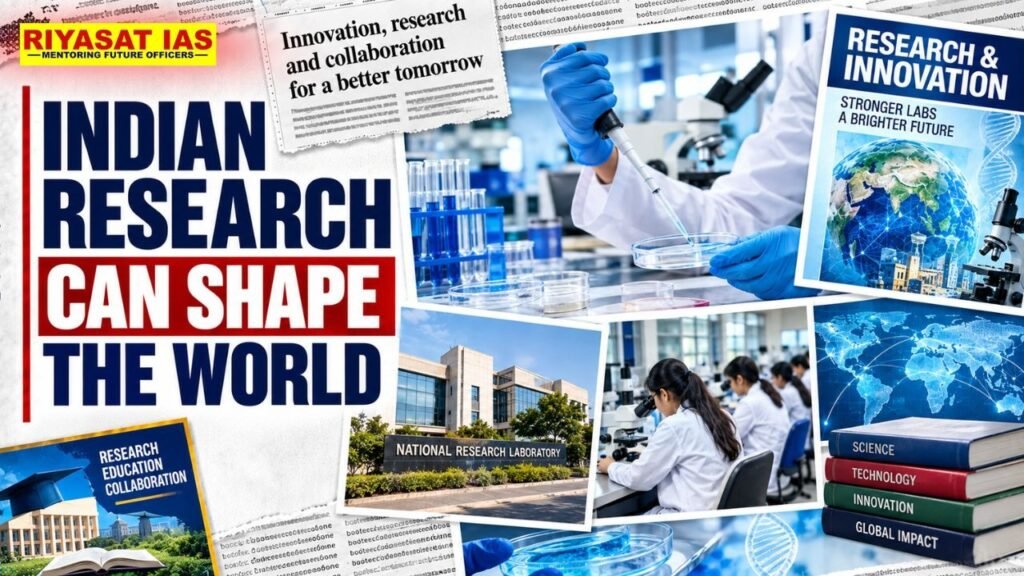
GS Paper III – Science & Technology
People fret about the buses India has missed in its technological growth. The list is familiar: aircraft, advanced weapons, new materials, and biotechnology. In each, we look at what others built decades ago and ask why we did not.
Catch-up-itis
- Value: This introspection has value to it — and also danger.
- Streamlining Systems: The value is that it compels us to integrate the question — are our systems getting streamlined and enabled.
- Looking Back: It is not a bad thing to be catching up on. The history of much of the world industrially is a history of catching up.
- The Danger: The danger is that catch-up-itis can be a habit.
- Ambition: If our ambition is just dictated by what someone else has done already, we will always come late to the party and pay for licences and know how to just build something that another team built somewhere.
- Price of Catch-up: Technological catch-up is an expensive price to pay, which comes repeatedly with each new iteration.
Science and Technology
What you then ask, and it derives from a tectonic shift in the relationship to science and technology.
- Science: By science, we refer to the discovery of things, curiosity about why things exist and the efforts that goes into explaining reason for existence and numbers or abstract ideas in math.
- Technology: When we say Technology, we talk about making tools to make human lives change world.
- Previous Relationship: Up till then most of the history these were considered as two parallel enterprises with technology lagging behind science for long periods of time — at times by a century.
- Fundamental Research and Application: One of the statistical observations is that over the past 50 years or so we have seen fundamental research increasingly and inextricably linked to application.
- Genes and Viruses: Much of the knowledge we have about gene regulation came from work with viruses that infect bacteria.
- CRISPR Technology: In the last couple of years, studying how bacteria defend themselves yielded CRISPR technology — a capability with truly limitless application.
- Reduced Time and Distance: The distance and time from curiosity to application is short today.
- Seismic Shift: This shift allows thought and training to take the lead, backed by the fact investing into fundamental research will start leading rather than chasing.
- The Next Bus: The next bus we get on and massage along with the fact that it is still stationary.



Get on the Bus First
Four things needed to be addressed for Indian science to have a global impact focused on the development of transformative technologies.
- First — High Quality Education: First invest in high quality education, at scale.
- AI and Learning: The democratization of learning that AI enables gives us the option to reach millions of under-served students within our currently dysfunctional institutions, as well as outside them whenever possible.
- Experiential: However, science is a doing thing — so to learn science is to do science.
- Experimental Foundries: Hundreds of experimental “foundries” in engineering, biology, chemistry and math should be created; where young people work with real instruments on real problems.
National Laboratories
- Second — Releasing National Labs from Insularity: Second, national labs must be freed of insularity.
- Less Accessibility: Most of our national labs are currently not very accessible to researchers or students and companies outside their walls.
- More Engagement: It is simple for this to happen actually, which gives benefits to both laboratories and universities.
- Three Zones: All national labs must be structured along three zones:
- Green: Open interaction.
- Amber: Collaboration.
- Red: Strategic work.
- Focus: The bulk of India’s world class labs belong in the green and the amber zones.
Flexibility
- Third — Flexibility: The third is flexibility.
- Topic 1: We Hear are a Low Trust Society, and Our Regulators Should Supposedly Trust Our Research System to be More Flexible.
- Compliance: The answer here is to say that we need such draconian regulations because of an utter lack of faith in other people to follow guidelines.
- Islands of Excellence: However, India does have several fairly good islands of excellence in universities, institutes and laboratories.
- Compliance: While they do comply with the rules and the regulations, they must be released from the burden of General Financial Rules compliance — a burden that few other countries impose on their scientists.
- Accountability: Outcome rather than process at every step must be the way to go with accountability.
- Institutional Flexibility: If these institutions were given leeway, you could see some of them leap ahead.
Regulatory Reform
- Fourth – The Regulatory System: Fourth, we still have a lot of work to do in terms of our regulatory system.
- Biological Material and Clinical Trial Approvals: Biological material and clinical trial approvals continue to be slow & unpredictable.
- Institutional Burden: The more hoops companies and researchers have to jump through, the less likely small and medium-sized institutions are to compete — because it takes time, money and only deep-pocketed players can spend that.
- High Quality Regulation: Therefore high-quality, timely regulation is vital.
Way Forward
- Step-by-Step: None of these things are beyond us; they can be done piece-meal.
- Current Efforts: A Lot of Them Are Already Doing It in Silos.
- Scaling Up: What is needed is the choice to make those pockets the norm, and a handful who take this task upon themselves.
- Science-Driven Nation: Will there be a science-driven nation of global different from those most engaged in scientific and technological activity as long underdeveloped country digital entrepreneurs?
- Continuous Improvement: 10% better in every sector/field and every year will make us close to seven times better in 20 years.
Conclusion
Get out of the rut of technological catch up and eye on next gen science & tech for India. Science from India can have global impact through development of transformative technologies with investment in high quality education, accessible national laboratories and institutional flexibility and good, fast regulation.
UPSC Mains Practice Question
Q. India must move beyond technological catch-up and focus on leading the next wave of science and technology. Discuss the institutional and regulatory reforms required to make India a science-driven nation with global impact.
→ UPSC Toppers & Success Stories: Explore the journeys and preparation strategies of successful aspirants guided by Riyasat IAS Mentorship.
→ Join UPSC Mentorship 2027: Take the next step towards a structured, focused, and strategy-driven UPSC preparation journey.




 Ravi Raaz
 Hassan Khan
 Shadab Ali