GS – II | Health | Leprosy | Public Health
Why in News?
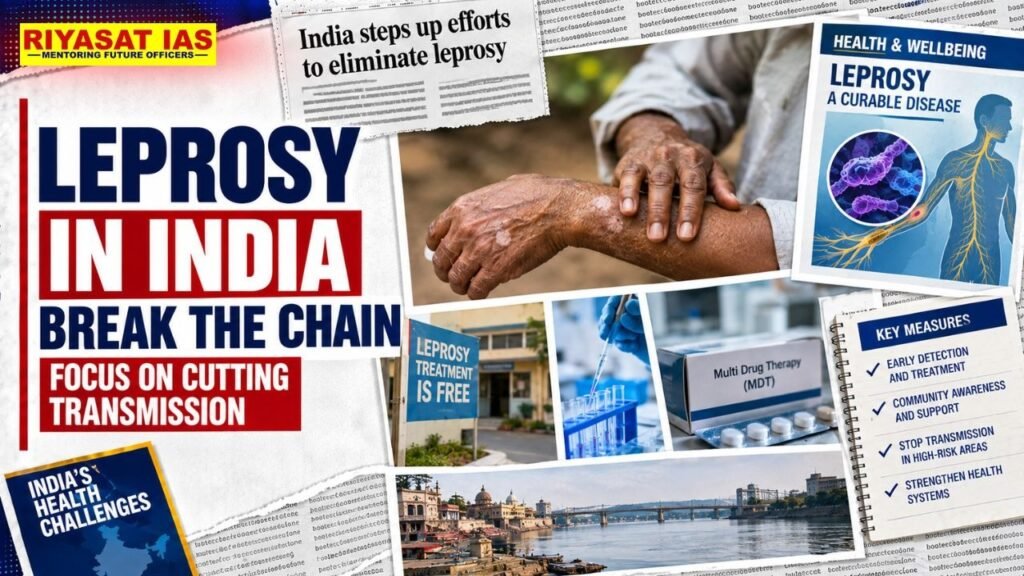
Although the prevalence rate of leprosy including grade-2 disability among adult and child cases in India has declined over the last decade, continuing transmission of leprosy amid numerous pockets restricts our ability to achieve targets set forth in the National Strategic Plan (NSP) as well as those laid out in the Roadmap for Leprosy 2023–2027
Background
- Decreasing Incidence: The prevalence, which reached over 5 leprosy cases per 10,000 people in the last survey conducted in India, was below 1 case/10,000 by 2005, and allowed the World Health Organization (WHO) to declare that ‘India [had] eliminated [leprosy] as a public health problem’.
- Complacency of Government: But the governing body grew complacent and allowed the leprosy surveillance programme to be incorporated with general health services.
- Multi-drug Treatment: Multi-drug treatment regimens also shortened the duration for which patients remained formally registered, further reducing prevalence but allowing continued transmission.
- Escalating Disability: There was a surge in disability due to leprosy in the early 2010s leading to go door-to-door for screening.
National Strategic Plan and Transmission
- NSP Transmission Dominant: Today, the NSP appropriately focuses on cutting transmission (multiple times according to WHO).
- Children: The two programmes must run in tandem since India reported nearly 46% of all cases across the globe amongst children aged under five years.
- Disproportionate Disease Burden: The decline in disease burden has also been quite uneven — Chhattisgarh, Jharkhand, Odisha, and Maharashtra have disproportionately thight national accounts.
- District-Level Progress: According to January 2025-26 National Leprosy Elimination Programme report, only 148 districts reach the target of achieving ‘interruption of transmission’ (requires field verification) against projected target of 300.


Screening and Detection
- Extensive Screening: In 2025–26, especially endemic areas were covered, and over 70 crore people screened by the workers and 24,367 cases detected.
- ASHA Workers: Nearly 40 lakh suspected cases were flagged by ASHA workers with confirmation for 48,027 cases.
- Post Exposure Prophylaxis: Workers also provided single-dose rifampicin as post-exposure prophylaxis for 91.1% of those who have come in contact and are likely to develop the disease among the identified 16.9 lakh municipalities.
Digital Surveillance and MIP Vaccine
- Digital Surveillance: The government has open to digital surveillance.
- MIP Vaccine: The government is currently in talks to conduct trials with MIP vaccine that may expedite pathogen clearance among patients considered high transmitters of the virus.
Persistent Gaps in Care
- Late Diagnosis: Nerve damage was evident in many of the patients by the time they presented for care, with stigma to blame for this.
- Clinical Gaps: The pathology of leprosy is obscure for many clinical practitioners who either do not know about it or misdiagnose it as a skin condition.
Way Forward
- Interrupt Transmission: Taken together, the state ought to make interrupting transmission a primary outcome and prevalence a secondary one.
- Don’t Lower Detection or Change Elimination Targets: It should also not be tempted to do this by relaxing detection and changing its elimination targets.
- The Number of New Cases Was Much Higher Than Projected: 41% for overall incidence, 91.6% for children and 34% for grade-2 disability.
- Investments: Rather, it needs to intensify its investments to fulfil the existing 2026-27 projections.
- Program Activities Targeted Efforts and Social Context: Find ways to 48 with the potential to facilitate change.
Conclusion
When reading these facts together, the state should focus on halting transmission while treating prevalence second-order. It will also need to resist the temptation to relax detection or reduce its targets for elimination, and rather ramp up investments to deliver on the existing projections in 2026-27.
UPSC Mains Practice Question
Q. While the prevalence of leprosy and the grade-2 disability rate have dropped in India, its continued transmission in many pockets remains a challenge. Discuss in the context of the National Strategic Plan and Roadmap for Leprosy 2023-2027.
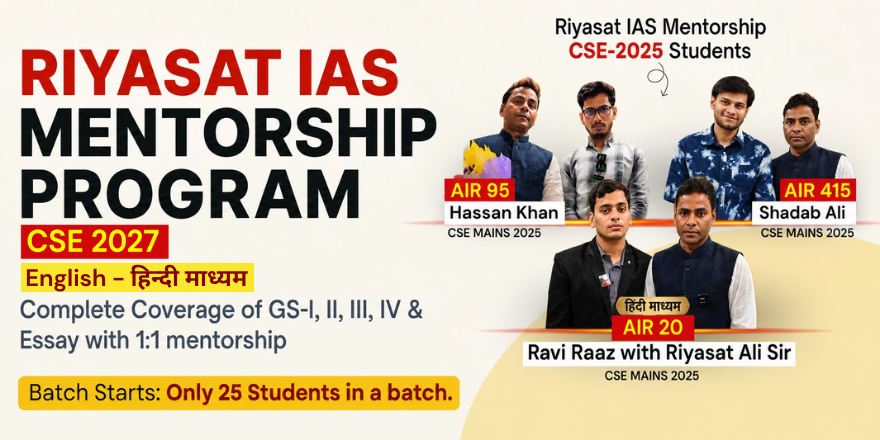
Join Riyasat IAS Mentorship Program for UPSC CSE 2027
Whether you are preparing for your first attempt or looking to improve your previous performance, the right mentorship can help you identify mistakes, strengthen your strategy and stay consistent throughout your preparation.
👉 Explore the UPSC Mentorship Program by Riyasat IAS
Build the Right Strategy. Improve Your Preparation. Prepare to Succeed.
UPSC Mentorship Program | UPSC CSE Mentorship | UPSC Mentorship 2027 | UPSC Prelims & Mains Mentorship | Personalised UPSC Guidance
Don’t prepare randomly. Prepare with the right strategy and expert mentorship.



 Ravi Raaz
 Hassan Khan
 Shadab Ali