
GS-III – Economy | Employment | Demographic Dividend & inclusive growth
Why in News?
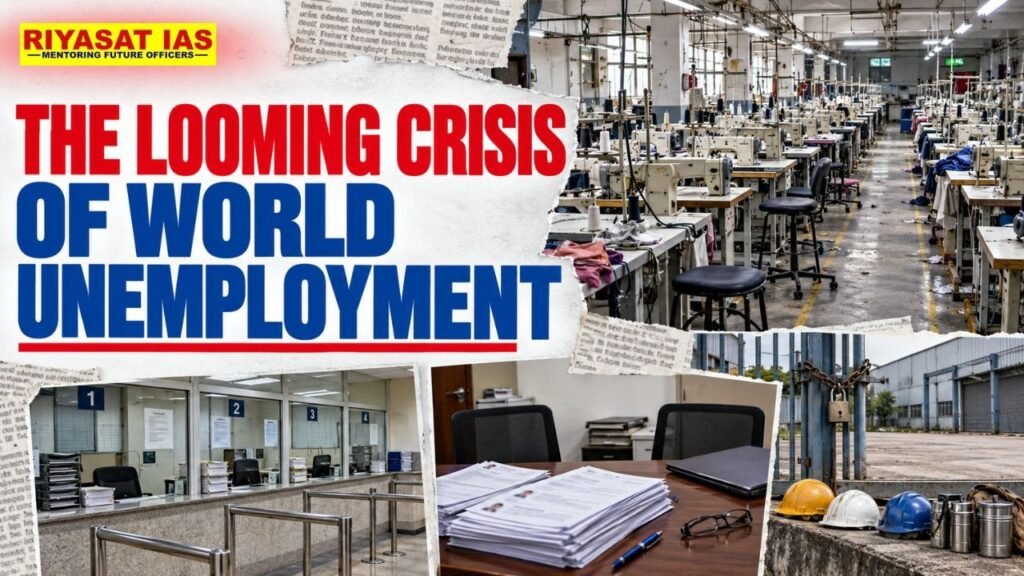
- World Bank Cautions: The world economy has never been closer to reaching the edge of unseen apocalypse according to new World Bank forecasts.
- The Job Deficit: According to World Bank President Ajay Banga, in the coming decade, 1.2 billion young men and women of the Global South will enter the work force but over that time the size of economy may only be capable of sustaining no more than 400 million viable jobs.
- Employment Gap: This amounts to a shocking shortage of 800 million jobs.
- Demographic Abyss: The first task of the demos is clear such an unprecedented demographic chasm, if not begun to address forthwith, will consume what should be the greatest demographic dividend of the 21st century and turn that into a trans-generational truth generator for unrest.
A Failing Blueprint
- The demographic dividend : For decades, economic theorists have touted the demographic dividend as the chief engine that is going to drag developing nations out of perpetual poverty.
- The standard explanation: When fertility falls, the share of working-age people compared with dependents increases for a time, yielding a demographic dividend;
- High productivity.
- Elevated domestic savings.
- Rapid capital accumulation.
- East Asian Economic Miracle: This formula powered the East Asian economic miracle in the second half of the twentieth century.
- Different Context: But that stock model is breaking down today.
- Youth Bulges: The youth bulges of developing nations like India come at a point when the main escalators of economic mobility are closing down.
- Absorption Challenge: The scale of demographic growth in many countries is outpacing the speed at which their domestic markets, infrastructures and institutional frameworks can absorb new labour – an Absorption Challenge.
- Risk: Making a potential dividend into a looming crisis.
The Consequence of Trade, Technology and Manufacturing
- Transforming Global Economy: The global trade, technology, and manufacturing economy is reshaping so fast that it defines the problem at hand.
- Manufacturing — A Distinctive Role: For decades light manufacturing was the essential stepping stone for poor countries moving from subsistence agriculture.
- Labour Absorption: It continued to absorb millions of unskilled and semi-skilled workers into productive urban employment.
- Automation : Manufacturing is much less labor-intensive today due to automation, robotics and sophisticated industrial software.
- Premature deindustrialisation: Developing countries are currently facing premature de-industrialisation with their manufacturing sectors shedding jobs while still being well below the income thresholds within which industrial economies of previous decades experienced similar levels of decline.
- Skill Gap: Most of the global economy now favours a high-skilled, technology-based labour force.
- Youth Challenge: Millions of youth in developing countries do not have access to:
- Modern digital infrastructure.
- Quality vocational training.
- Tertiary education.
The High Level Economic Development Taskforce
- World Bank Recommendation — opening the door to private capital and breaking down those regulatory barriers stubbornly choking domestic entrepreneurship in many developing economies.
- Entrepreneurial Constraints: Potential entrepreneurs face:
- Prohibitive costs of capital.
- Erratic regulatory environments.
- Predatory taxation.
- Legal System: The lack of simple and sound legal structures, along with the poorly defined nature of property rights, drives away long-term foreign direct investment.
- Capital Allocation: This limits capital to be at speculative assets instead of creating employment generating opportunities.
- Needed Reforms: To launch, scale and hire 1 million small and medium-sized firms —the biggest job-creators in the world today — we also need to simplify regulatory regimes, develop transparent governance structures, and strengthen the integrity of institutions.



India and Infrastructure
- India’s status: Lagging behind but does better on another key recommendation – ensuring infrastructure is improved.
- Business Competition: The business is facing a tough competition in the global supply chain, and it can also not grow locally if it suffers from:
- Routine power failures.
- Very high logistics costs: due to ruined roads.
- Port congestion.
- Modernising Infrastructure: Physical and Digital infrastructure modernization works two-fold economic justification,
- The construction and rollout phase itself absorbs enormous amounts of immediate labour.
- The assets that maturity transformation creates reduce the cost of business across the economy.
Sector-Specific Strategies
- Importance of Sector-Specific Strategies: It is within this sweeping macroeconomic transition that sectoral, specific strategies are the most plausible route to mass labour absorption.
Agriculture and Agri-Value Chains
- Still the Biggie: Especially in developing countries, agriculture is still the main employer.
- Transformation: Moving from low-yield to both technology enabled agri-tech and commercial agriculture can catalyze the transformation of rural economies.
- Investment Areas:
- Cold-chain logistics.
- Localised food processing.
- Climate-resilient farming techniques.
- Rural Employment: These can build high-value rural value chains, leading to productive job creation with decent income for youth.
- Migration: This may decrease the urgent waves of distress migration to urban centers.
Health Care and Care Economy
- Potential for Employment: Health care and the larger care economy open up further opportunities for job growth.
- Rising Demand: Their is boom for better trained and skilled health-care professionals, life-long care nurses, community health workers and Google specialists.
- Double Dividend: In fact, investing in health human resources provides a powerful double dividend:
- Generate millions of good, non-offshorable jobs here at home.
- Nurtures the human capacity which can keep national (and therefore citizens’) productivity over long-term
- Employment of Women: All Such Jobs are Mostly For Young Females, Who Are Denied Access to Formal Labour Markets.
Tourism and Culture
- Job Creation : Tourism and culture provide an unparalleled medium for decentralised job creation.
- Labour Intensive: Tourism is a labour-intensive industry, employing semi-skilled and unskilled workers.
- Automation Resistance: It is resistant to full automation.
- Multiplier Effect: This has the most uniquely wide multiplier effect with revenues spilling down to:
- Local transport providers.
- Hospitality workers.
- Artisans.
- Historical preservation efforts.
- Investment Needed: Strategic investments in renewable infrastructure for tourism, and global destination marketing turn directly into jobs.
Manufacturing
- The Manufacturing Reimagined: It calls for its manufacturing to be also reimagined.
- Potential Areas:
- Modern light assembly.
- Green-transition manufacturing.
- Production of solar components.
- Electric two-wheelers.
- Energy-efficient materials.
- Decentralised production networks.
- Labour Absorption: Labours in bulk can still be absorbed by these when supported with skill building programmes with agility.
Social and Global Consequences
- Youth Unemployment: As history has shown, large generations of educated and restless young people deprived of the means to participate in a productive economy.
- Frustration erodes trust in governments.
- Social polarisation increases.
- The ideologies of the extremists or criminals can find reason to nurture.
- Civil unrest can emerge.
- The Global FIN: If we fail to provide livelihoods in the Global South, forced migration flows toward the Global North will necessarily intensify.
- Instability of Politics: This can an worsen political tensions in the whole world.
Way Forward
- International finance : International cooperation to make long-term development financing affordable and technology transfers available.
- Domestic Reforms: Unfortunately, reforming these institutions is among the hardest and most politically painful work necessary for developing nations.
- Private sector dynamism : In order to avoid high youth unemployment becoming a long-term structural change we need the following unprecedented articulation of:
- International finance.
- Domestic political courage.
- Private sector dynamism.
- Increasingly available resources: The financial wealth and the technological means to meet this challenge exist globally.
- An Inclusive Global Order: The challenge is to create an inclusive global order which gives every young person a fair chance and the means to work, contribute and prosper.
India at the Epicentre
- Most populous nation on the planet: India, as the most populous country in the world sits at the heart of this convergence.
- Young Workforce Entrants: India has millions of people having entered the workforce every year since God can only tell how long.
- Employment Test: The economy has had its challenges in converting GDP growth to employment creation.
- Immediate Challenges:
- Matching skills to markets.
- Persistent underemployment.
- Low female labour force participation.
- An agrarian sector that, while only contributing 16% of GDP (FY24), still takes in nearly half the population.
- Age: India, with median age less than 30 needs to now transition to value creation happening in labour-absorbing fields.
- Otherwise its much celebrated demographic dividend could turn into a demographic disaster.
Conclusion
- Avoiding economic disaster from the lingering absence of employment for a generation requires uncharacteristic alignment between international finance and domestic political courage together with private sector dynamism.
- India will have to pivot towards labour absorbing value creation within its shrinking demographic window.
- Failing that, the much-admired demographic dividend could become a demographic disaster.
UPSC Mains Practice Question
Q. If the economy does not grow enough to produce sufficient jobs, the demographic dividend can become a demographic disaster. Explain (with special reference to India) within the context of Global South.
Prepare for UPSC with Riyasat IAS Mentorship – Get expert guidance, structured preparation, current affairs analysis, and personalised mentorship through our UPSC Mentorship Program.
Essay Foundation Course: Master UPSC Essay writing with structured guidance, thematic preparation, examples, and expert evaluation.




 Ravi Raaz
 Hassan Khan
 Shadab Ali