
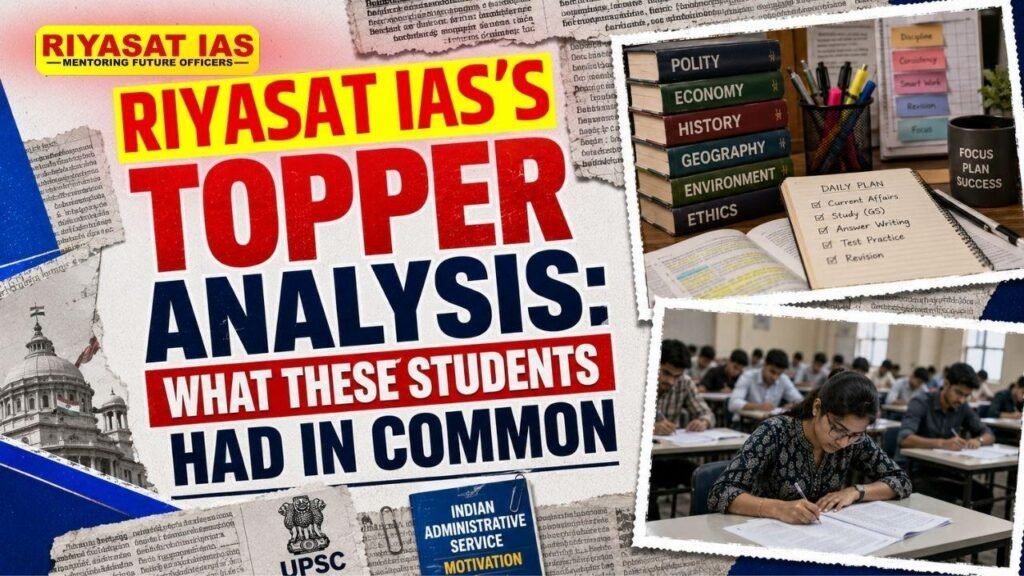
Looking across Riyasat IAS Mentorship selections — Ravi Raaz (AIR-20, CSE-2025), Hassan Khan (AIR-95, CSE-2025), Abhishek Vashistha (IAS-2025), Shadab Ali Khan (AIR-415, CSE-2025), Ayushi Pradhan (AIR-36, CSE-2023), Devansh Mohan Dwivedi (AIR-228, CSE-2024), Mohan Mangawa (IPS-2024), Maya Chahar (AIR-547, CSE-2022), and Nidhi Singh (AIR-748, CSE-2022) — certain preparation patterns appear consistently across very different aspirant profiles, medium choices, and examination cycles. These patterns are what the preparation data across the programme reveals.
Pattern 1: They Submitted Answers Consistently and Received Specific Feedback on Each One
Every selection from Riyasat IAS Mentorship came from an aspirant who submitted written answers regularly and received specific, written feedback on each submission — not model answer comparisons, not rubric scores, but feedback specific to the sentences they wrote. Ravi Raaz’s Ethics and Essay answers were evaluated with specific feedback on argument structure and case study reasoning. Ayushi Pradhan’s Daily Answer Writing programme produced consistent evaluated writing across the preparation cycle. Hassan Khan’s two-cycle mentorship meant two years of consistently submitted and evaluated GS answers.
The single most consistent preparation characteristic across all programme selections: they did not rely solely on self-evaluation of their written work. External, specific feedback on actual submitted writing was a regular feature of every student’s preparation. This is the most consistently identifying pattern across the full results record.
Pattern 2: They Did Not Change Direction at Every Difficulty
Several of the programme’s selections came from aspirants who had attempted UPSC previously without achieving selection — and who committed to a specific preparation change identified through mentorship rather than making wholesale strategy overhauls. Hassan Khan sustained two cycles of mentorship. Mohan Mangawa maintained Regular Mentorship across CSE-2022, 2023, and 2024 before achieving IPS selection in his first UPSC selection. Abhishek Vashistha continued mentorship after his IPS selection in CSE-2022 and returned for the IAS-targeted cycle.
This pattern — sustained commitment to specific, diagnosed preparation changes rather than repeated wholesale strategy changes — is one of the clearest differentiators between aspirants who eventually select and those who do not. None of the programme’s selections changed sources, optional subjects, or preparation approach at the first sign of difficulty. They diagnosed what specifically needed to change and changed specifically that.
Pattern 3: They Treated Hindi Medium as a Distinct Preparation, Not a Translation
Both Ravi Raaz (AIR-20, CSE-2025) and Mohan Mangawa (IPS-2024) prepared in Hindi medium — and both prepared through mentorship that addressed the specific requirements of Hindi medium UPSC preparation: the native Hindi source framework, the correct formal administrative Hindi register in answers, and the GS current affairs guidance built around Hindi newspaper analytical content.



Neither of these selections prepared using translated English-medium guidance delivered in Hindi. The preparation was built specifically for Hindi medium — which is both what the programme provides and what the results reflect. An AIR-20 in Hindi medium and a first-attempt IPS selection in Hindi medium are not produced by English-medium preparation with Hindi instruction.
| Want the preparation pattern these students followed applied to your specific situation? → Apply for Riyasat IAS Mentorship |
Pattern 4: Their Essay and Ethics Preparation Was Structured and Evaluated
Ravi Raaz’s programme specifically included Ethics and Essay mentorship — the two components that, together with Interview, carry 525 of the total Mains-plus-Interview marks available. Ayushi Pradhan’s programme included the Essay component alongside Daily Answer Writing. The pattern: aspirants who achieved high-rank selections had Essay and Ethics preparation that was structured and evaluated, not self-managed as supplementary components.
Essay (250 marks) and Ethics GS Paper 4 (250 marks) together equal the entire Optional Subject in mark weight. Among programme selections, both components received specific programme attention — not as afterthoughts in the final month, but as evaluated preparation components across the cycle.
Pattern 5: The Mentorship Was Sustained, Not Episodic
Every selection listed came from a sustained mentorship relationship — not from occasional consultation. The programme’s Regular Mentorship students (Nidhi Singh, Maya Chahar, Mohan Mangawa) maintained consistent weekly engagement over the full preparation cycle. The CSE Main Mentorship students (Ravi Raaz, Hassan Khan, Shadab Ali Khan, Abhishek Vashistha) had weekly sessions with regular answer submissions across the Mains preparation phase.
The difference between episodic consultation and sustained mentorship is the longitudinal preparation record: a mentor who has read 40 of your consecutive answers knows your specific chronic weaknesses, your improvement trajectory, and your exact preparation gaps in a way that periodic consultations cannot produce. All programme selections maintained the sustained engagement that makes this longitudinal knowledge possible.
Complete Selections Record — Riyasat IAS Mentorship
| Student | Result | Medium | Programme Component |
| Ravi Raaz | AIR-20, CSE-2025 | Hindi | Ethics, Essay & Interview Mentorship |
| Hassan Khan | AIR-95, CSE-2025 | — | CSE Main Mentorship 2024 & 2025 |
| Abhishek Vashistha | IAS-2025 (AIR-14) | — | CSE Main Mentorship (IPS→IAS conversion) |
| Shadab Ali Khan | AIR-415, CSE-2025 | — | CSE Main Mentorship 2025 |
| Devansh Mohan Dwivedi | AIR-228, CSE-2024 | — | CSE Main Mentorship Program 2024 |
| Mohan Mangawa | IPS-2024 (1st selection) | Hindi | Regular Mentorship CSE 2022, 2023, 2024 & Interview |
| Ayushi Pradhan | AIR-36, CSE-2023 | — | Daily Answer Writing & Essay Program |
| Maya Chahar | AIR-547, CSE-2022 | — | Regular Mentorship Program 2020-21 |
| Nidhi Singh | AIR-748, CSE-2022 | — | Regular Mentorship Program |
| Ilma Afroz | AIR-217 (IPS-2018) | — | Student of Riyasat Ali Sir at CL Educate Ltd. |
Frequently Asked Questions
Do all Riyasat IAS Mentorship students achieve top-100 ranks?
No — and presenting it that way would be misleading. The selections record spans AIR-20 to AIR-748, representing competitive selections across the rank range. What the programme aims to produce is not a guaranteed rank but the specific preparation quality — individually evaluated answer writing, personalised preparation planning, sustained progress tracking — that gives each aspirant the best preparation trajectory their effort and ability can produce. The results record shows what that trajectory has produced across different aspirant profiles and cycles.
What is the most important single thing these students did that aspirants can replicate?
Submitted written work consistently for external evaluation and acted on the specific feedback. Every selection from the programme followed this pattern. It is also the most commonly missing preparation activity among aspirants who prepare extensively and do not achieve selection — not because they lacked knowledge, but because no one read their actual answers and told them specifically what needed to change. This is the preparation input that the programme most directly provides and that the results record most clearly confirms.
Is there a pattern across which programme components produce the best results?
The highest-rank selections (AIR-20, AIR-36, AIR-95) came from students in Essay, Ethics, and sustained answer writing programmes — the components that most directly develop the analytical expression quality that Mains marks at the highest level. This is consistent with the preparation principle the programme is built around: GS knowledge is the raw material; analytical expression in evaluated writing is the manufacturing process that converts it into marks.
Conclusion
Across Riyasat IAS Mentorship selections from CSE-2018 through CSE-2025, five patterns are consistently present: regular evaluated answer submission, sustained rather than episodic mentorship commitment, direction change based on diagnosis rather than difficulty, native medium preparation (for Hindi medium selections), and specific Essay and Ethics programme engagement. These are not abstract principles — they are what the preparation record of the programme’s selections shows, consistently, across different aspirant profiles, examination cycles, and rank outcomes.
| Riyasat IAS Mentorship — Personal Guidance for UPSC CSE Direct mentorship from Riyasat Ali Sir │ Hindi & English Medium │ 100% Online — Apply Now |


 Ravi Raaz
 Hassan Khan
 Shadab Ali