GS – II | Health | International Relations | Global Health Governance
Why in News?
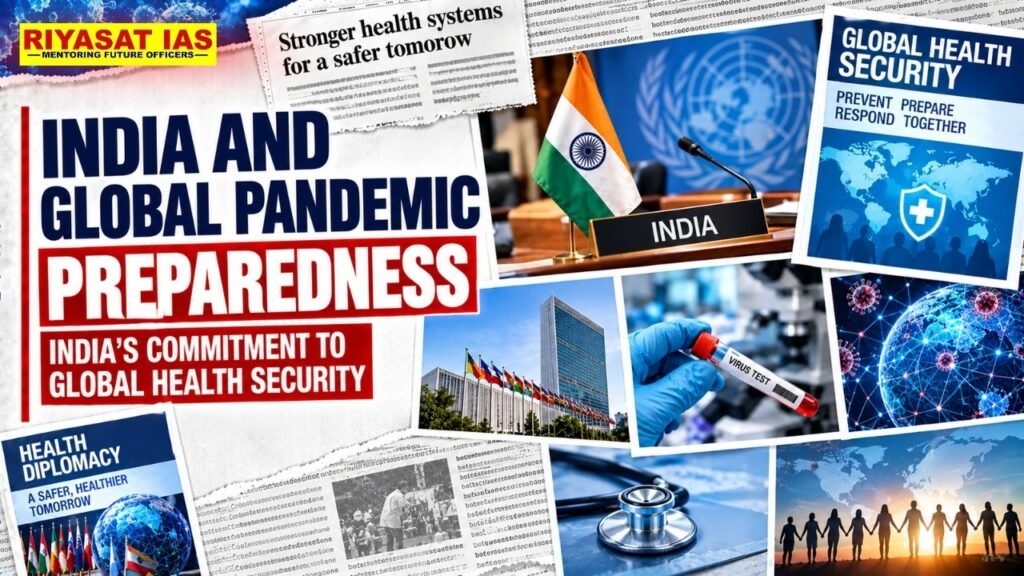
- UN HLM: India commented on the Political Declaration on Pandemic Prevention Preparedness and Response (PPPR) at the United Nations High Level Meeting (UN HLM), New York, September 2026.
- An Emerging Global Legal Regime: The Declaration participates in the emerging global legal system on pandemics with the WHO-Pandemic agreement (PA) leading.
Shaping the framework
- Adoption of the PA: The PA was adopted in 2025 by 124 member-states at a Conference, including India.
- Voting: All countries voted in favour, with 11 abstentions, demonstrating a consensus across HICs/LICs/LMICs.
- Main Negotiation: The negotiations were about how to balance national sovereignty and international cooperation, the North-South divide.
- One Health: Identified high-level questions included whether it is possible for a global treaty to set legally binding targets on things like ‘One Health’ without addressing funding for countries with weak health systems.
- Harmonisation: Or if it is possible to harmonise national pandemic regulations within global frameworks.
- Vaccine Sharing: And whether private manufacturers can be required to share vaccines in real time at affordable prices.
- Pathogen Access and Benefit-Sharing: Negotiations for an annex on the PABS system are still being worked out, meaning that the PA is not yet open for ratification.
- Equitable Access: PABS could be part of an equitable approach to distribution in a pandemic, ensuring that during widespread availability LICs and LMICs receive their fair share of vaccines, medicines and other therapeutics.
- Global Legal Regime: The PA has established a unique global legal regime for the PPPR despite lacking ratification.
- Operationalisation: Operationalisation makes it imperative for nations like India to juggle between the interests of HICs, LICs & LMICs.
- Global Health Governance: This will decide whether the PA merely deepens inequities from COVID-19 or creates inclusive global health governance.



India’s line
- Multilateral Aspects: Multilateral aspects of the PA were then firmly set within the principle of national sovereignty, a triumph attributed to India at the UN HLM.
- Global Pandemic Preparedness: India reaffirmed its pledge of robust and effective global pandemic preparedness but insisted that international coordination is only viable if demonstrated.
- Equitable Access: First is equitable access to drugs, vaccines and therapeutics, and the establishment of global public goods (such as digital infrastructure — which admittedly also fit its own national priorities).
- National Circumstance: Respect for national sovereignty and primacy of member-states in shaping global policy interventions — according to national circumstance.
- United States: In contrast, the United States refused to recently support the PABS and declared WHO action relating to pandemics as an affront to our nations sovereignty.
A South-South health role
- Equitable Global Regime: An equitable global regime on PPPR is as much an Indian interest as it is a Global South responsibility.
- Pharmacy of the World: India is known as the pharmacy of the world and produces one of the highest percentages (by volume) of vaccines across the globe.
- Vaccine Distribution: However, it requires a fair vaccine distribution system worldwide.
- Patents: The patents for the vaccines India manufacturing they are control by global pharma companies.
- APIs: India already depends on imports for Active Pharmaceutical Ingredients (APIs).
- Access to Global North Technology: India needs access to the latest Global North technology for manufacturing better quality of personal protective equipment and medical devices.
- Ministerial on South–South Cooperation: Simultaneously, it is important for India to spearhead South-South Cooperation, pitching in its technological strength to bear to others in the Global South.
- Global Public Goods: The size of India’s health system compares to that of a continent and as the Health Secretary mentioned at UN HLM, its investments in digital health infrastructure/network, laboratories networks and One Health are global public goods.
Way Forward
- The first: To work on some of the technical areas of the PA (One Health, surveillance, health workforce strengthening with partners — to build trust amongst other countries in the Global South — and a ‘store’ of operational solutions to national sovereignty challenges.
- Second: Exploiting its leading role in existing political orders. For instance, under the United Kingdom’s G-20 presidency in late 2027 and with respect to the H20 summit (a health and development G-7 and G-20 partnership), pandemic preparedness is one of core health agendas. As the president of the G-20 in 2023 and the initiator of the Global Initiative for Digital Health, India wields significant power in health matters on this platform. Another is Indian Ocean Region Partners for Multilateralism, launched in 2026 at the initiative of the European Union (co-sponsors: Australia, Barbados, Brazil, Canada, India and Kenya).
- 3rd: Aligning domestic policy and regulatory architecture with its own PA priorities. Global leadership is always based on domestic strength. India also must ensure that our national policies on PPPR such as regulation of access to biological material and distribution of the benefits are indeed equitable, thereby enabling India to seek the highest standards in equity at a global level.
Conclusion
- Get out of your own WAY: Ultimately, a PA will require a willing India to succeed… and in turn, a stronger PA is the answer for India’s pandemic management.
UPSC Mains Practice Question
Q. “Global Solidarity has to be shown in action” Place India in the context of building a fair, just and moral global regime for PPR through WHO-Pandemic Agreement and Pathogen Access and Benefit-Sharing (PABS) system.
Ready to Prepare for UPSC 2027 with the Right Guidance? Join Our Personalised UPSC Mentorship Program and Get Expert Support, Answer Writing Guidance, Current Affairs Strategy and Regular Performance Feedback.


 Ravi Raaz
 Hassan Khan
 Shadab Ali