
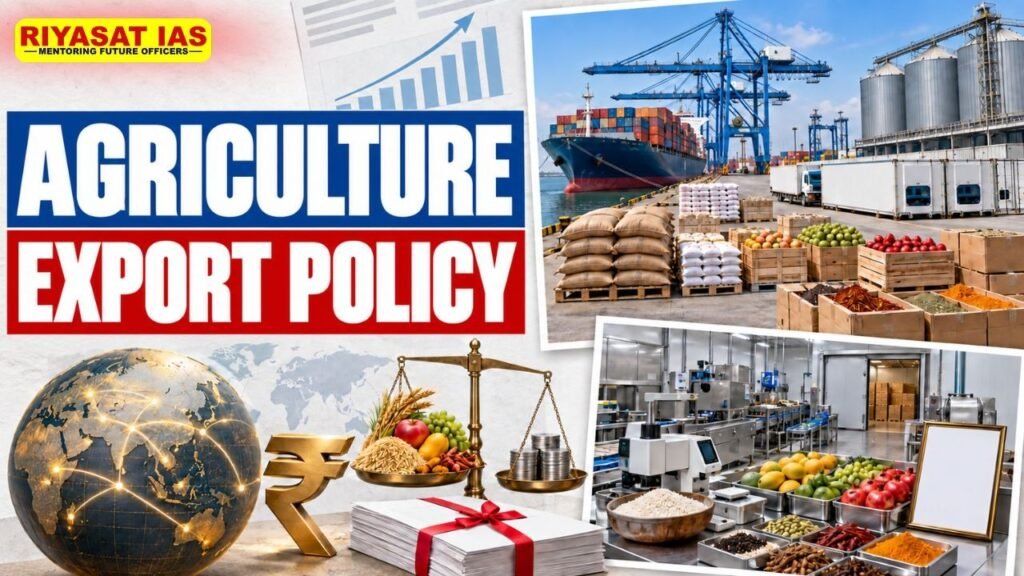
India feeds a significant portion of the planet, but its agricultural dominance has a paradox. While second in milk, spices, cereals, and fresh produce, it only contributes to barely over 2% of global farm exports. Almost half the Indian labor force depends on a mere 2.4% of the world’s arable land and 4% of its freshwater resources. In addition, 8 to 18% of fresh produce, fish, and vegetables get wasted due to the lack of cold chains and processing infrastructure prior to reaching the consumer.
The export policy tackles this issue by suggesting a shift from creating a dumping ground for local surplus to high-value produce with a favorable farm-gate price.
A Vision and Core Targets
The main objective of the agriculture policy is to capitalize on the nation’s strong agricultural performance while providing stable income to farmers through favorable trade rules.
The targets comprise:
- Increasing agricultural exports to around $30 billion to $60 billion, as a first step, and then aiming to achieve $100 billion with predictable trade rules.
- Diversifying farm outputs to include high-value, organic, ethnic, and perishable goods.
- Creating institutions to deal with the complexities of international trade, including negotiating food safety rules in other countries.
- Ties to connect farmers with global value chains to assure farm-gate prices against middlemen.
Key Focus Areas
Fixing the Agricultural Trade Framework:
- The government aims to fix agricultural trade rules to remove uncertainty and promote more grain exports.
- Predictable Pro-Export Policies should replace ad-hoc trade restrictions and provide stability for global buyers.
Logistics and Infrastructure for Perishables
- Fresh agricultural products require cold chains, pack houses, testing labs, and quick offloading at ports to maintain quality.
- Mega Food Parks and logistics corridors fit the bill by minimizing wastage due to poor storage conditions.



Breaking Silos
- Different government agencies, including commerce, food processing, logistics, and local administration, handle various aspects of agri-trade. Coordinated inter-agency efforts can ensure seamless movement of goods without getting stuck in red tape.
Empowering States
- The states bear the onus of setting up export promotion clusters within their jurisdiction and need to be empowered to leverage the opportunities.
Farming Clusters: An Operational Strategy
- Cluster farming could help small-scale farmers who do not have the resources to export on their own. Farmers growing similar crops in a given region could form a cluster and sell their harvests collectively to meet the quality and quantity specifications of global buyers.
Going Up the Value Chain
- It makes little sense for farmers to sell their produce directly as it entails low revenues. Instead, they should think of downstream processing and value addition through purees, dried products, branded items, and organic farming.
Developing “Brand India”
- The focus will be on developing a recognizable “brand” that global buyers could identify with. It will be easier to sell GI-tagged and organic products through this framework.
Leveraging Private Investment and Agri-Startups
- The government will encourage private organizations to set up warehouses, processing facilities, cold storage, and logistics to support farmers.
- The Agri-Startup Fund will finance startups working on innovative logistics solutions, among other things.
Enhancing Quality Assurance
v Global buyers dictate the demand, including safety and residue levels, and farm-gate prices. Setting up testing labs and certification bodies will facilitate smoother international trade by ensuring conformity.
Frequently Asked Questions
What is the main objective of the government’s agriculture export policy?
The policymakers want to transform the country’s farm economy from a domestic surplus to a high-value international market. In other words, they seek to increase farmers’ incomes by boosting sales while ensuring quality certification, value addition, favorable pricing, and predictable trade rules.
Are any revenue targets specified in the document?
Yes, the policymakers set a target of doubling farm exports, which were valued at roughly $30 billion to $60 billion, and eventually reaching $100 billion.
Why should farmers consider collective farming instead of individual sales?
Collective farming works best when farmers sell in bulk. The policymakers want to encourage farmers to form collectives or clusters of growers who specialize in similar crops. It would enable them to satisfy international buyers’ quality and quantity specifications.
Why is Brand India important in agricultural exports?
Most Indian farm products get sold as commodities in bulk. However, branded products fetch better prices, especially at the retail level. The policymakers want to create a “brand” that international buyers can recognize and trust. It will benefit organic, GI-tagged, and other certified farm produce.
What will the policymakers do to minimize post-harvest losses?
The policymakers will invest in downstream infrastructure, including cold chains, pack-houses, and testing laboratories, to minimize wastage.
Preparing for UPSC? Get personalised guidance.
Join our UPSC Mentorship Programme for structured preparation, answer-writing guidance, current-affairs support, regular evaluation and personalised feedback.




 Ravi Raaz
 Hassan Khan
 Shadab Ali