
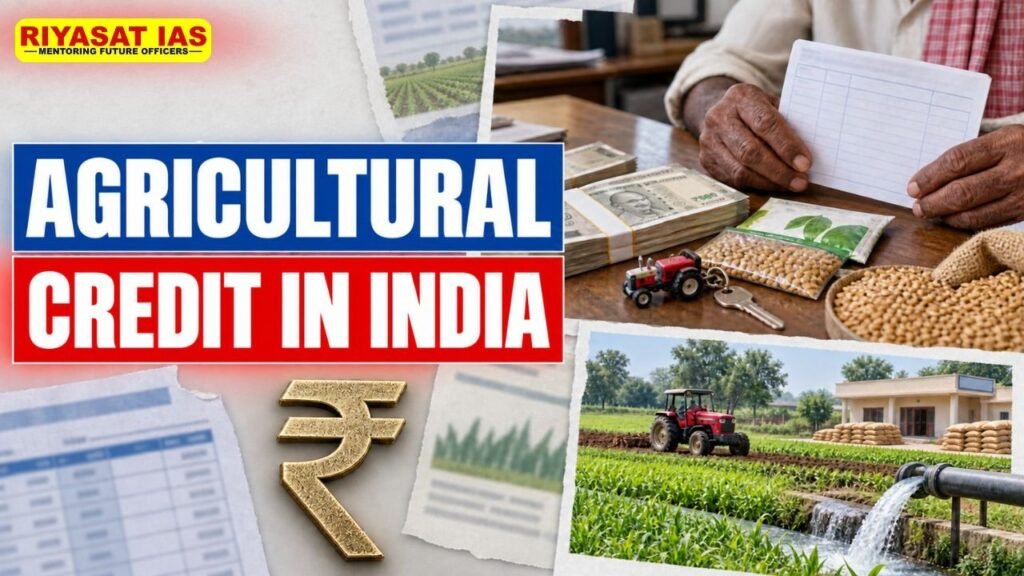
Agricultural credit caters to the needs of farmers with respect to sowing, fertilizers, tractors, irrigation, harvesters and even warehouses. As per NABARD estimates, the flow of institutional credit has reached an all-time high this fiscal and is poised to cross ₹32.5 lakh crore in FY 2025–26.
However, with regard to the disbursement pattern, there are some structural concerns – the skewed allocation of short-term crop loans, wide regional variations and a systemic tilt against marginal and tenant farmers.
NABARD – The Engine Behind Rural Lending
- The National Bank for Agriculture and Rural Development (NABARD) was set up in 1982 based on the recommendations of the B. Sivaraman Committee (CRAFICARD).
- It is pertinent to note that NABARD doesn’t provide direct credit to individual farmers. The apex development bank fulfills the role of a wholesale lender as well as an institutional builder.
- As a refinancing organization, NABARD replenishes the system by providing funds to commercial banks, Regional Rural Banks (RRBs) and even cooperative banks so that they continue to extend credit to the farm sector.
- NABARD has a mandate to undertake institutional development, credit monitoring and developmental financing in rural India.
Three Major Disparities in Institutional Credit Distribution
While there is no doubt that institutional credit is flowing into the system, it is not reaching the end-users due to a slew of factors. The three main issues regarding credit delivery in rural India are:
1. Short-term Focus
Around 60% of the loan disbursements cater to the short-term needs of the cultivators. There is minimal credit available for long-term capital assets such as tractors, harvesters and drip irrigation.
2. Regional Variations
- Credit distribution does not follow the pattern of cropped area in the country. For instance, the Southern states get around 48% of the total agricultural credit in the country despite having only 17% of the cropped area in the country.
- The Central India region gets 13.7% of the pie. Eastern India gets an even smaller share of 8.2%. This suggests that the rural banking infrastructure in these regions is not strong enough to support credit disbursement.
3. Marginal Farmers Tilt
Landless agricultural workers and even tenants comprise the majority of India’s farming community. However, due to their inability to present land as collateral, these workers are denied credit by the banking system.



The Players in the Agricultural Credit Ecosystem
India has a multi-layered system when it comes to institutional credit. There are various regulators, commercial banks, cooperative societies and even shadow lenders.
The Regulators
These entities do not provide credit, but set the policy and also ensure that the system follows the rules.
- Reserve Bank of India (RBI) – Sets the rules, directions and financial targets for the agricultural credit system.
- NABARD – Implements the guidelines and also releases funds to the lending institutions.
- Scheduled Commercial Banks (SCBs) – These constitute the backbone of the agricultural credit system in the country. They provide more than 70% of the credit on a formal front.
- Regional Rural Banks (RRBs) – These banks were set up to give commercial banking facilities to the rural populace.
- Cooperative Credit Institutions – They are a three-tier system comprising the village-level Primary Agricultural Credit Societies (PACS), the district-level District Central Cooperative Banks (DCCBs) and the apex State Cooperative Banks. These societies usually provide short-term credit to the farmers.
- Agriculture and Rural Development Banks (ARDBs) – They provide long-term project financing to the cooperative sector.
- Shadow Lenders – Village moneylenders, traders and commission agents continue to provide credit to the cultivators. This informal system accounts for around 28% of credit in the system. Despite the exorbitant interest rates, these lenders provide quick credit with little or no documentation.
Key Credit Schemes for Cultivators
- Priority Sector Lending (PSL) – As per the Reserve Bank of India (RBI), the domestic banks are mandated to set aside 18% of the Adjusted Net Bank Credit (ANBC) for the agriculture sector.
- Kisan Credit Card (KCC) – The card was launched in 1998 to provide farmers with an easy access to credit. The card provides funds for cultivation, family needs and allied activities.
- Modified Interest Subvention Scheme (MISS) – This scheme provides 7% interest subsidy on crop loans to farmers, bringing the rate down to 4% per annum for those who repay the principal on time.
- Agriculture Infrastructure Fund (AIF) – It offers medium and long-term debt financing for infrastructure development in the agriculture sector.
- Rural Infrastructure Development Fund (RIDF) – Managed by NABARD, this fund provides loans for the development of roads, bridges, irrigation and other infrastructure projects to the State Governments.
Way Forward
India would need to recalibrate the system to ensure that farmers get the long-term funds that would help in enhancing productivity. It is essential that the credit system is expanded across the Eastern and Central states to ensure that the capital reaches the end-users.
There is also a dire need for innovative credit schemes to provide loans to marginal and tenant farmers. Such schemes could take the form of a Joint Liability Group (JLG) and would require minimal or no documentation. The introduction of peer-to-peer guarantees would also help.
Frequently Asked Questions
What is NABARD’s mandate?
NABARD was set up in 1982 and it serves as the apex developmental bank for rural financing in the country.
Which committee recommended the setting up of NABARD?
The CRAFICARD committee headed by B. Sivaraman recommended the setting up of NABARD.
Can an individual farmer get loan directly from NABARD?
NABARD does not provide direct credit to the farmers. The institution provides funds to commercial banks, cooperative and regional rural banks. The latter then disburse the money to the end-users.
Which states get the least share of farm credit?
Eastern and Central India gets the least share of farm credit. Southern India gets around 48% of the pie.
Who regulates the targets for agricultural lending in India?
The Reserve Bank of India lays down the target for agricultural lending and NABARD undertakes the implementation.
How does Kisan Credit Card (KCC) benefit farmers?
The Kisan Credit Card provides farmers an easy access to credit for crop production without any hassle. The card also offers credit facility for allied activities.




 Ravi Raaz
 Hassan Khan
 Shadab Ali