
Socrates: Ethical Insights
“Education is the kindling of a flame, not the filling of a vessel.” — Socrates
“The unexamined life is not worth living.” — Socrates
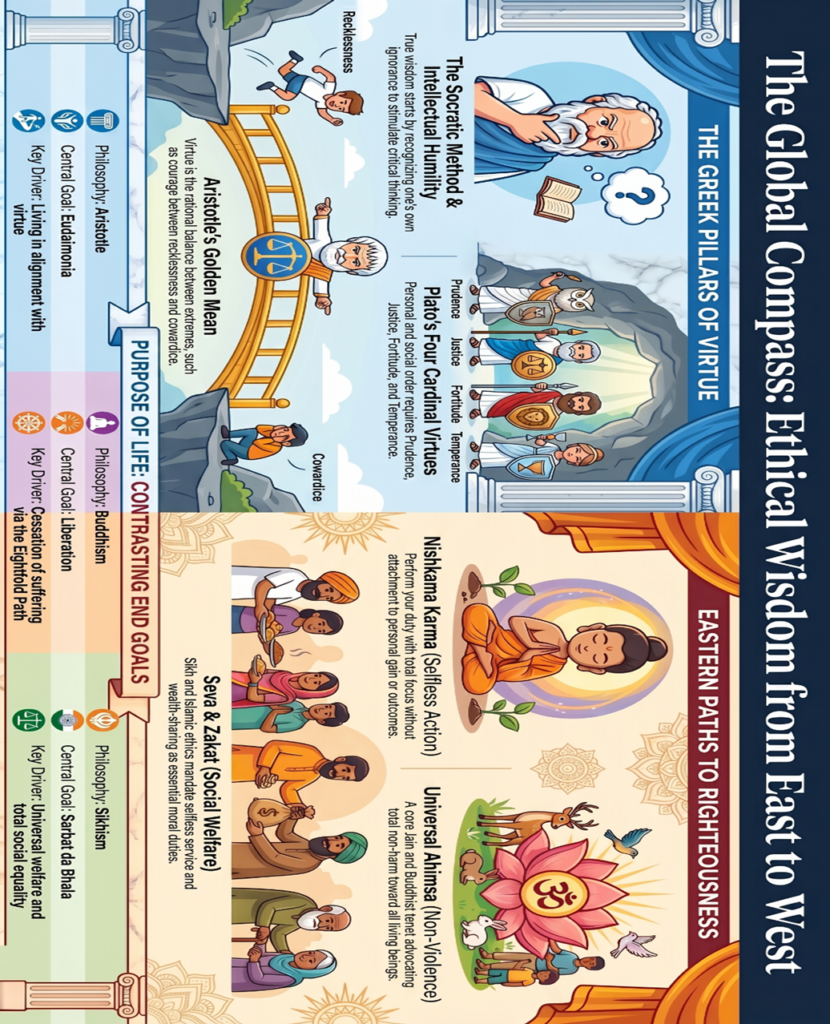
- Virtue Ethics: Socrates believed that virtue is the highest good and that knowledge is necessary for virtue. He emphasized that moral virtues are a form of knowledge, arguing that true self-development centers on the active pursuit of goodness, justice, integrity, and friendship.
- Moral Absolutism: He held that there are absolute standards of right and wrong, which can be discovered systematically through reason and open dialogue.
- Ethical Intuitionism: Socrates suggested that humans possess an intuitive knowledge of good and evil, showing that people have an inherent, baseline sense of justice and morality even if they cannot express it clearly.
- Intellectual Humility: He famously declared his own ignorance, asserting that he was wise only because he recognized his complete lack of knowledge. This principle of intellectual humility encourages continuous learning and open-mindedness.
- Dialectical Method (Maieutics): Socrates used dialogues and debates involving probing questions to stimulate critical thinking, expose logical contradictions, and uncover underlying beliefs to arrive at objective truth.
- Moral Courage: He believed firmly in the freedom to speak one’s mind, the ability to speak the truth, and the absolute importance of objectivity.
Plato: Ethical Insights
- Theory of Forms: Plato asserted that the material world is merely a shadow of the real world, which is composed of eternal, unchangeable, and perfect Forms.
- Allegory of the Cave: This allegory depicts prisoners chained inside a cave who mistake passing shadows on a wall for absolute reality. The journey out of the cave into the sunlight symbolizes the difficult philosophical ascent to true knowledge and understanding.
- Four Cardinal Virtues: Foundational to personal ethics and political philosophy:
- Prudence: Wise decision-making and practical wisdom.
- Justice: Fairness, righteousness, and order in social structures.
- Fortitude: Courage in facing adversity and maintaining ethical principles.
- Temperance: Self-control, moderation, and mastery over desires.
- Tripartite Theory of the Soul: Plato divided the human soul into three parts: Reason (intellect), Spirit (emotions/courage), and Appetite (desires). These parts must be balanced rationally to achieve a virtuous life.
- Justice in Society: He argued that for a society to function harmoniously, each segment must perform its specific duty for the benefit of the whole, balancing the collective against individual interests.
- Plato’s Republic: He envisioned a meritocratic utopia ruled by philosopher-kings—leaders possessing absolute wisdom, completely free from the corrupting influences of private wealth and family ties.
Aristotle: Ethical Insights
- The Golden Mean: Aristotle’s cornerstone ethical theory posits that virtue always lies as a rational balance between two behavioral extremes: excess and deficiency. For example, the virtue of courage is a mean between the excess of recklessness and the deficiency of cowardice.
- Virtue Ethics: He concentrated on developing virtuous habits through continuous, active practice. Virtues are character traits that enable individuals to lead a flourishing, meaningful life.
- Eudaimonia: He defined Eudaimonia as the highest form of human happiness and fulfillment, achieved strictly by excelling in one’s life role and living in perfect alignment with virtue.
- Teleology: Aristotle’s philosophy is deeply teleological, suggesting that everything in nature possesses an inherent purpose, function, or ultimate end goal (telos).
- Political Philosophy: In Politics, he identified three legitimate, common-good forms of government (Monarchy, Aristocracy, and Polity) alongside their respective corrupt deviations (Tyranny, Oligarchy, and Democracy).
Classical Indian Philosophy
The overarching concept of Dharma in Indian philosophy represents moral duty, natural law, obligation, and righteousness, extending far beyond narrow religious boundaries.
Orthodox Schools (Astika)
- Nyaya: Focuses on logic, rigorous reasoning, and epistemology. Ethically, it emphasizes that choices and decisions must be grounded in sound evidence and right knowledge.
- Vaisheshika: Explores metaphysics and reality, highlighting moral responsibility and personal accountability to urge individuals to act righteously.
- Samkhya: A dualistic system distinguishing between matter (Prakriti) and pure consciousness (Purusha). It advocates for the transcendence of material desires to achieve liberation (Moksha) through self-realization.
- Yoga: Combines philosophy with physical and mental techniques. It treats moral values, self-discipline, self-control, and the cultivation of inner virtues as non-negotiable foundations for spiritual growth.
- Purva Mimamsa: Emphasizes performing one’s duties and ritual actions (Svadharma) responsibly according to classical injunctions.
- Uttara Mimamsa (Vedanta): Centers on the Upanishads, strongly advocating for Ahimsa (non-violence), righteousness, and selfless service, recognizing the shared divinity within all beings.



Heterodox Schools (Nastika)
- Buddhism: Advocates for the permanent cessation of human suffering through a practical framework of ethical conduct, meditation, and wisdom.
- Jainism: Places absolute, unyielding non-violence (Ahimsa), strict truthfulness, and non-possession at the center of liberation.
- Charvaka: A materialistic, skeptical philosophy that rejected the supernatural, emphasizing direct sensory perception as the only valid source of human knowledge.
- Ajivika: An ancient school based on strict determinism, asserting the inevitability of fate (Niyati).
Applied Scriptural and Religious Lessons
The Ramayana: Core Ethical Lessons
- Standing by Righteousness: Vibhishana’s choice to leave his brother Ravana to join Lord Rama illustrates that moral duty must override familial ties when family actions are fundamentally unjust.
- Practice Humility: Hanuman, despite possessing immense, extraordinary powers, remains entirely humble and dedicated to a higher purpose, showing that true strength is expressed through humility.
- Victory of Good Over Evil: Upholds that consistent ethical conduct and righteousness will ultimately defeat systemic vice.
- Respect for All: Lord Rama’s graceful acceptance of Shabari’s humble offering proves that human dignity and kindness must be extended to everyone equally, completely transcending social hierarchies.
The Bhagavad Gita: Core Ethical Lessons
- Nishkama Karma: The landmark philosophy of performing one’s duty with sincerity, focus, and dedication without personal greed or attachment to the final outcomes. This is vital for preserving integrity and clarity in public service.
- Prioritizing Dharma: Krishna’s guidance to Arjuna during intense internal conflict shows that objective moral duty and justice must always take precedence over personal relationships and emotional dilemmas.
- Continuous Self-Improvement: Teaches that constant self-reflection, ethical refinement, and character growth are essential to execute one’s duties effectively.
Islamic Ethics: Core Lessons
- Divine Universal Morality: Establishes absolute ethical principles derived from the Quran and Hadith, emphasizing that moral values are stable, objective, and independent of personal whims.
- Foundational Ethical Pillars: Includes Tawhid (unity driving social justice), Ihtiram (deep respect for all creation), Ikhlas (pure sincerity of intent), and Iqtisad (moderation in lifestyle and behavior).
- Social Responsibility via Zakat: Mandates sharing a dedicated portion of personal wealth with the poor, legally and morally embedding empathy and social responsibility into the community fabric.
Buddhist Philosophy: Core Lessons
- The Four Noble Truths: Diagnoses the nature of suffering (Dukkha), its origin in craving, its cessation, and the step-by-step path leading to liberation.
- The Eightfold Path: A highly practical guide focusing on Right Action (ethical behavior), Right Livelihood (non-harming professions), Right Speech (kind, truthful communication), and Right Mindfulness.
- Universal Ahimsa: Demands total non-violence towards all living beings, reflecting the deep interconnectedness of all life.
- Mindful Consumption: Directs individuals to ensure their consumption of global resources is ethical, sustainable, and causes minimal harm to the environment.
Jain Philosophy: Core Lessons
- Centrality of Ahimsa: Places the absolute protection of all life forms—from the smallest organism to human beings—at the center of human morality.
- Aparigraha and Environmental Ethics: Practicing self-discipline and non-possession (Aparigraha) directly translates into a sustainable lifestyle that protects the natural ecosystem, demonstrating deep ecological awareness.
Sikh Philosophy: Core Principles
- Sarbat da Bhala: The core commitment to the universal welfare of all, driving total equality across caste, creed, and gender.
- Seva (Selfless Service): Practiced through institutionalized community kitchens (Langar) to break down artificial social barriers while cultivating humility and community cohesion.
- Kirat Karni & Vand Chakna: Mandates earning a livelihood through completely honest means while selflessly sharing earnings with those in need.
Example:
Socratic Method in Public Administration Training:
Public administration academies use the Socratic method to train probationary officers through probing questions on real-life ethical dilemmas, fostering critical thinking, intellectual humility, and sound moral reasoning.
Example:
Scriptural Anchors for Public Service Delivery:
Civil servants draw inspiration from principles like Nishkama Karma and Sarbat da Bhala to deliver welfare schemes impartially, viewing public service as a moral duty dedicated to the welfare of all.
Case Study Analysis
Context & Dilemma
A prominent Member of Parliament (MP) faces severe allegations of accepting material bribes from a business tycoon in exchange for raising targeted parliamentary questions designed to damage a rival corporate conglomerate (“Cash for Query” scandal). The issue was exposed by the MP’s former partner, prompting the MP to dismiss the evidence as a product of personal animosity. You are Arjun, a highly respected and non-partisan legislator appointed by the Parliament’s Ethics Committee to lead this independent investigation under intense media scrutiny, political pressure, and public outcry.
Ethical Dilemmas Faced by Arjun
- Upholding Institutional Integrity vs. Political Loyalty: Safeguarding the public trust in the sanctity of the parliamentary system against intense partisan pressures from political colleagues.
- Objective Fact-Finding vs. Personal Vengeance: Sifting through evidence objectively while ensuring the source’s potential personal bias or bad faith motivations do not distort the factual truth of the investigation.
- Public Transparency vs. Privacy Rights: Balancing the public’s right to know with the non-negotiable confidentiality rights of the accused MP during an active probe.
Proposed Approach & Investigation Management
- Adhering to Absolute Objectivity: Follow the Socratic ideal of truth by relying exclusively on verified bank transactions, digital footprints, and audited data rather than circumstantial rhetoric.
- Balanced Confidentiality: Conduct all witness testimonies and evidentiary audits behind closed, in-camera doors to protect confidentiality, while publishing structured, data-verified interim compliance updates to satisfy public transparency without compromising due process.
- Impartial Enforcement: Deliver a clear, evidence-backed final report to the Ethics Committee without fear or favor, recommending strict statutory penalties if misconduct is proven, thereby reinforcing constitutional morality.
Proactive Preventive Measures
- Enforcing Strict Financial Disclosures: Implementing mandatory, real-time digital registries for all legislators to disclose assets, corporate consultations, and hospitality benefits received.
- Codifying Conflict of Interest Protocols: Launching automated monitoring tools within the parliamentary question-filing system that flag when a legislator poses a query directly impacting a corporate group where they hold investments.
- Mandatory Ethics Briefings: Institutionalizing bi-annual ethical reasoning and code-of-conduct workshops for all elected representatives to ground public leadership in probity and democratic accountability.
Practice Questions
Question 1: “The unexamined life is not worth living.” Critically analyze the relevance of this Socratic insight for a modern public administrator facing systemic corruption and institutional inertia. (10 marks, 150 words)
Question 2: Compare and contrast Aristotle’s concept of the ‘Golden Mean’ with the Buddhist principle of moderation in the context of framing progressive environmental consumption policies. (10 marks, 150 words)
Question 3: “The erosion of institutional probity in public life is fundamentally a crisis of ‘Knowledge without Character’ and ‘Politics without Principles’.” Evaluate this statement in light of Mahatma Gandhi’s Seven Social Sins and the philosophical insights of Plato’s Republic. (10 marks, 150 words)




 Ravi Raaz
 Hassan Khan
 Shadab Ali