
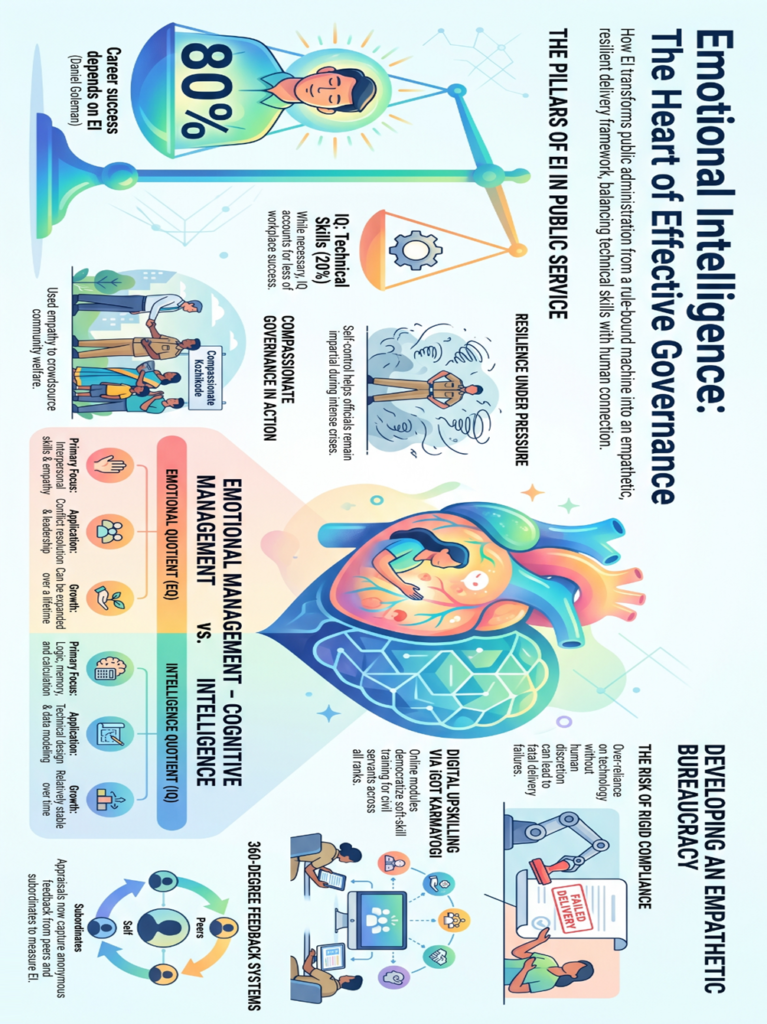
Emotional Intelligence (EI) has emerged as a cornerstone of effective leadership and management, particularly within the realm of civil services and public administration. Daniel Goleman’s assertion that “80% of success at work depends on EI, while only 20% depends on IQ” underscores the critical role of EI in navigating the complex, highly sensitive landscapes of public service.
Emotional Intelligence in Civil Services
- Self-Control: It allows civil servants to actively manage their emotions and behaviors under severe pressure, ensuring that their decisions are strictly guided by objective ethics and constitutional principles rather than transient impulses or emotional reactivity.
Example: Resilience Under Pressure: Senior administrators maintaining their composure and executing their duties impartially during intense public agitations or sudden law-and-order crises. For example, IAS officer Divya Mittal exemplified self-control by continuing her grassroots development work professionally despite facing abrupt administrative transfers.
- Effective Communication: Clear, empathetic communication is vital for civil servants to successfully convey public policies, gather feedback, de-escalate panic, and protect institutional trust.
Example: Digital Crisis Communication: Administrators leveraging technology transparently to provide verified, real-time facts during disasters. For instance, in Kerala, District Collector Dr. Adeela Abdulla utilized social media platforms highly effectively to engage with the public, curb fake news, and systematically guide citizens through containment protocols during the COVID-19 pandemic.
- Empathy and Compassion: Empathy enables civil servants to deeply comprehend the underlying perspectives, fears, and lived experiences of diverse communities, translating abstract regulations into compassionate, people-centric governance.
Example: Community-Led Public Services: Officials co-creating social support networks with ordinary citizens. For example, Prashant Nair, as District Collector of Kozhikode, established “Compassionate Kozhikode”—a highly successful, volunteer-driven institutional project that crowdsourced meals, healthcare, and infrastructure improvements for vulnerable sections.
- Negotiation and Conflict Resolution: These are vital tools for public servants operating in a diverse and highly polarized society. Emotionally intelligent civil servants can act as neutral mediators, defusing communal or labor disputes, finding common ground, and preserving social harmony through calm, respectful, and evidence-based dialogue.
- Adaptability: Civil servants must adapt rapidly to unexpected administrative emergencies and structural resource constraints through emotional resilience and situational agility.
Example: Resource Mobilization in Crises: Launching innovative, non-traditional solutions to handle infrastructure shortfalls. For example, IAS officer Smita Sabharwal dynamically responded to tight public utility constraints by pioneering the “Fund Your City” campaign in Telangana, motivating citizens and corporate entities to collectively fund and co-create urban infrastructure.
- Positive Work Environment: Emotionally intelligent leaders build a healthy organizational culture grounded in mutual respect, psychological safety, and horizontal collaboration. This blocks burnout, elevates internal morale, and enhances collective productivity across public delivery departments.
Challenges in Developing Emotional Intelligence in Civil Services
- Workload and Pressure: Severe institutional understaffing and excessive workloads frequently foster a frantic, outcome-at-all-costs mentality. This structural friction limits the time required for reflection, undermining the development of emotional intelligence and deliberate ethical reasoning.
- Lack of EI Training: Traditional foundational training frameworks for civil servants focus heavily on literal legal procedures, file hierarchies, and technical rules, leaving minimal scope for cultivating core behavioral competencies like EI.
- Cultural Disconnect: A deficit of deep socioeconomic and cultural sensitivity can lead to systemic administrative blind spots. For example, an urban-bred regulatory officer handling field assignments in tribal pockets may find it challenging to intuitively grasp the historical resource dependencies and unique social anxieties of the rural poor.
- Technology and the Human Touch: While digitization streamlines delivery, over-relying on rigid, fully automated algorithms can dangerously strip governance of vital human discretion.



Example:
The Exclusion Errors of Biometric Saturation: In Jharkhand, the tragic demise of a young girl, Santoshi Kumari, due to starvation highlighted how a rigid, technology-centric enforcement of biometric authentication in the Public Distribution System (PDS) can create fatal delivery blockages if administrators lack the emotional intelligence to override code failures in emergencies.
- Excessive Anonymity and Hierarchy: Rigidly layered bureaucratic setups and absolute anonymity can cause officials to shift blame horizontally. This discourages personal accountability and makes it difficult for proactive civil servants to act swiftly on their moral intuition and EI.
- Resistance to Change: Status-quo-oriented senior administrators frequently dismiss soft-skill behavioral interventions as superficial or secondary, believing that fear-driven discipline and absolute authority are sufficient to manage public delivery, thereby stalling progressive reforms.
Strategies for Developing Emotional Intelligence in Civil Servants
- Self-Awareness Training: Implementing regular psychometric diagnostics and interactive workshops to help public servants actively identify their personal emotional triggers, thereby reducing biases during crucial administrative choices.
- Empathy-Building Exercises: Enforcing immersive community engagement field modules to keep administrators grounded in grassroots realities.
Example: Grassroots Field Immersions: District leaders systematically visiting remote hamlets to audit welfare performance firsthand. For instance, Rohini Bhajibhakare, as District Collector of Salem, institutionalized empathy-driven governance by conducting unannounced visits to marginalized rural blocks, actively tailoring local schemes around their immediate feedback.
- Capacity Building Programs: The Department of Personnel and Training (DoPT) has integrated structured, continuous modules focusing on conflict resolution, baseline interpersonal communication, and stress mitigation into mid-career civil service training.
- Integrated Government Online Training (iGOT Karmayogi): Digitally democratizing soft-skill learning by hosting easily accessible online modules on emotional self-regulation, enabling civil servants across all ranks to learn how to de-escalate high-stress scenarios at their own convenience.
- National Training Policy: The policy explicitly mandates the systemic integration of emotional intelligence into the core curriculum of all national and state administrative training institutions to transform the civil service from a rule-bound machine into an empathetic delivery framework.
- Continuous Evaluation via 360-Degree Feedback: Transitioning annual appraisals away from unilateral top-down grading by implementing 360-degree feedback systems. This compels officials to reflect on their emotional intelligence, interpersonal conduct, and peer collaboration skills by capturing anonymous feedback from superiors, colleagues, and subordinates alike.
- Mindfulness and Stress Management Techniques: Incorporating institutional support setups to preserve administrative composure under crisis. For example, programs like “Samadhan” run by the Maharashtra state government provide professional mental health counseling and mindfulness modules to help public safety officers cope with operational trauma and maintain ethical clarity.
Behavioral Comparison Frameworks
Emotional Quotient (EQ) vs. Intelligence Quotient (IQ)
The psychological distinctions between cognitive intelligence and emotional control are analyzed across five key dimensions:
| Aspect | Emotional Quotient (EQ) | Intelligence Quotient (IQ) |
| Definition | Measures an individual’s capacity to recognize, interpret, and constructively manage emotions. | Measures an individual’s cognitive processing, analytical velocity, and academic intelligence. |
| Primary Focus | Intrapersonal and interpersonal skills like empathy, self-awareness, and emotional modulation. | Cognitive capacities like mathematical calculation, logical inference, and raw memory retrieval. |
| Core Application | Fostering high-trust collaborations, resolving complex labor or civic conflicts, and empathetic public communication. | Technical system design, structural policy formulation, data modeling, and academic excellence. |
| High-Scorer Traits | High personal resilience, situational adaptability, and intuitive compassion. | Exceptional analytical thinking, fast information processing, and technical problem-solving. |
| Developmental Nature | Highly fluid; can be continuously expanded over a lifetime through conscious self-reflection and empathy building. | Relatively stable over time, bounded heavily by baseline cognitive development and genetic footprints. |
Artificial Intelligence (AI) vs. Emotional Intelligence (EI)
The intersections of computational capability and human emotional resonance shape the future of modern digital governance:
| Parameter | Artificial Intelligence (AI) | Emotional Intelligence (EI) |
| Definition | A system or machine’s capacity to aggregate big data and execute complex tasks that mimic human cognition. | A human’s capacity to evaluate, interpret, and leverage emotional valences to drive righteous behavior. |
| Human Interaction | Processes interaction mechanically via automated natural language processing or pre-coded chatbots; lacks subjective empathy. | Deepens human connection through active listening, interpreting non-verbal cues, and real-time perspective-taking. |
| Decision-Making | Parses massive datasets instantly to make hard choices based solely on pre-defined criteria, risk patterns, and rules. | Integrates emotional valences alongside data, balancing logic with compassion for holistic public outcomes. |
| Primary Application | Scaling public welfare delivery, predicting weather anomalies, and running automated infrastructure monitoring. | Administrative leadership, participatory community mediation, crisis de-escalation, and inclusive governance. |
| Inherent Limitations | Absolute deficit of genuine consciousness, human intuition, and the capacity to weigh moral grey zones. | Quantifying it objectively is highly difficult; scaling it across a massive organization requires deep personal effort. |
Negative Alterations & Deviations of EI
- Manipulation of Others: Unscrupulous actors in positions of power can leverage their understanding of human psychological triggers to artificially stoke collective fears, polarize public opinion, and manipulate electoral sentiment for personal or narrow political gain.
- Tolerance Toward Injustice: Misapplying emotional regulation as a tool for total emotional suppression can lead to dangerous administrative passivity. Officials may choose to maintain absolute personal calm and project a veneer of neutrality in scenarios that demand urgent moral outrage and immediate, assertive intervention against human rights violations or illegal extraction syndicates.
- Rigid Laws and Bureaucratic Compliance: A rigid insistence on formal, rule-bound compliance can strip public leaders of their functional agency, overriding their emotional intelligence.
Example:
The Palmolein Import Scam Case: The historical conviction of former Kerala Chief Secretary Jiji Thomson highlights how a rigid culture of hierarchical compliance can compel top bureaucrats to suppress their internal voice of conscience and implement questionable, non-transparent directives issued by political executives, resulting in severe institutional damage.
Conclusion
Emotional intelligence is not a soft luxury but an essential operational requirement for sustainable civil service. It empowers public administrators to successfully balance the strict precision of law with the essential warmth of human empathy. In a governance landscape increasingly dominated by automated metrics, algorithms, and big-data efficiency, cultivating a robust EI ensures that basic human dignity and compassion remain at the absolute heart of public governance.
Previous Year Questions
Q. Apart from intellectual competence and moral qualities, empathy and compassion are some of the other vital attributes that facilitate civil servants to be more competent in tackling crucial issues or taking critical decisions. Explain with suitable illustrations.
Q. How will you apply emotional intelligence in administrative practices?
Practice Questions
Question 1: Is Emotional Intelligence a better predictor of career success than IQ? Provide arguments and contemporary examples from Indian civil administration to support your view. (10 Marks, 150 Words)
Question 2: In what ways can Emotional Intelligence assist frontline civil servants in effectively managing job stress and avoiding systemic burnout under fluid crisis situations? (10 Marks, 150 Words)
Question 3: “Can a civil servant’s compassion sometimes lead to structural challenges in enforcing statutory laws and fiscal regulations ?” Discuss the critical balance between empathetic compassion and objective public duty, with relevant real-world illustrations. (10 Marks, 150 Words)


 Ravi Raaz
 Hassan Khan
 Shadab Ali