
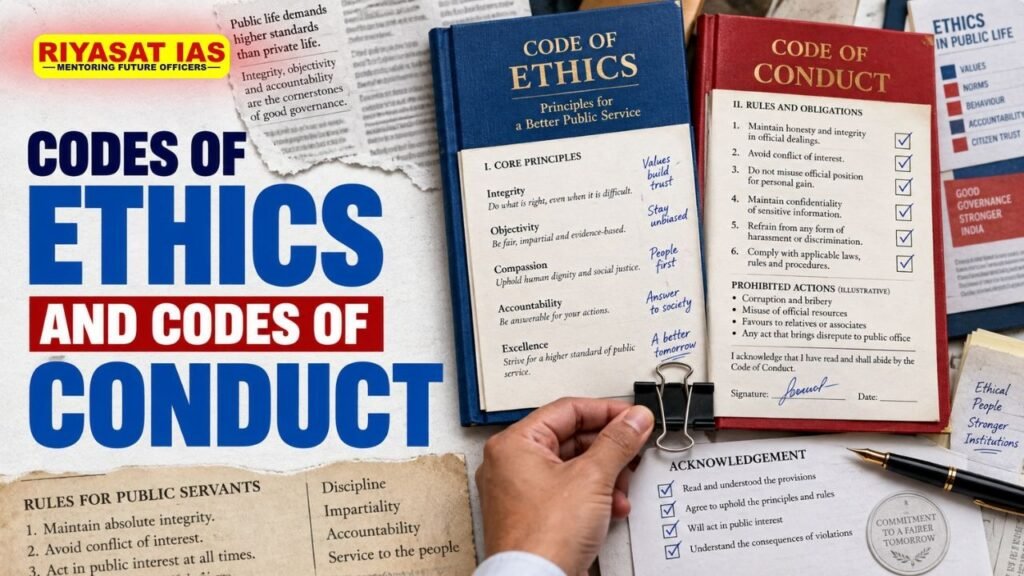
Public institutions cannot function merely on the basis of personal goodness. They require a shared set of values as well as clear rules of behaviour. A Code of Ethics and a Code of Conduct serve these two related but different purposes. The Second Administrative Reforms Commission (2nd ARC), in its report Ethics in Governance (2007), highlighted the need to distinguish between them. In simple terms, a Code of Ethics explains the values a public servant should uphold, whereas a Code of Conduct lays down the behaviour expected in particular situations.
Thus, the Code of Ethics may be seen as the moral foundation of public service, while the Code of Conduct gives that foundation a practical and enforceable form.
Meaning and Difference
Code of Ethics
A Code of Ethics contains the broad values and principles that members of an organisation are expected to follow. In public administration, these values may include integrity, impartiality, political neutrality, transparency, accountability, commitment to public service and respect for the Constitution.
Such a code is mainly aspirational. It guides judgement, especially in situations where written rules do not provide a direct answer. Since ethical principles are broad, their violation does not ordinarily lead to punishment unless the conduct concerned also violates a law or service rule.
Code of Conduct
A Code of Conduct is more specific. It states what an official may or may not do and usually deals with observable behaviour. Rules concerning gifts, private employment, political activity, use of official information, conflict of interest and misuse of office are examples of conduct rules.
Unlike a Code of Ethics, a Code of Conduct is enforceable through departmental and disciplinary mechanisms. Its breach may result in an inquiry or a prescribed penalty.
A Simple Illustration
The expectation that a civil servant should act honestly and impartially is an ethical principle. A rule requiring an officer to report or seek permission before accepting certain gifts is a conduct requirement. The first states the value to be protected; the second explains how that value must be observed in practice.
Recommendations of the Second ARC
The 2nd ARC argued that ethical administration requires more than scattered service rules. It recommended a clear statement of public-service values, supported by detailed standards of conduct.
Its major suggestions may be understood as follows:
- Public servants should be guided by values such as allegiance to the Constitution, integrity, impartiality, political neutrality, transparency, accountability and dedication to public welfare.
- Broad ethical values should be supported by service-specific conduct rules so that officers know how to respond to practical issues such as conflict of interest, receipt of gifts, misuse of official position, political activity and post-retirement employment.
- Ethical principles should guide decision-making, while misconduct that can be clearly established should be dealt with through enforceable rules and disciplinary procedures.
- Ethics should become part of institutional culture through training, leadership, appraisal and suitable mechanisms for ethical guidance. It should not remain limited to a document read only after a violation occurs.
The underlying idea is important: every moral failure cannot be converted into a separate rule, but rules must reflect the ethical purpose of public service.
Existing Framework for Indian Civil Servants
India already has several rules and institutional arrangements dealing with official conduct:
- All India Services (Conduct) Rules, 1968: These regulate matters such as integrity, devotion to duty, political activity, gifts, private employment, public statements and financial or property-related dealings of members of the All India Services.
- Central Civil Services (Conduct) Rules, 1964: These provide a similar framework for many employees of the Union Government.
- Code of Conduct for Ministers: It addresses issues such as disclosure of assets and liabilities, conflict of interest and the use of public office.
- Citizens’ Charters: Although they are not service conduct rules in the strict legal sense, they publicly state the standards, timelines and commitments expected in service delivery. They therefore contribute to administrative accountability.



The difficulty is not the complete absence of rules. The larger problem is that the ethical principles behind those rules are not always clearly stated, taught or applied consistently.
Contemporary Illustration: The Model Code of Conduct
The Model Code of Conduct (MCC) used during elections provides a useful illustration of how ethical norms can influence public behaviour even without being a complete statute in themselves. During the 2024 General Election, the Election Commission invoked the MCC while dealing with complaints relating to campaign speeches, misuse of official machinery and the conduct of parties and candidates.
The MCC does not derive all its force from a single law. Its influence comes from political consensus, public scrutiny and the Election Commission’s constitutional authority. At the same time, where an act also violates an election law or another statute, legal action may be taken under that law. The MCC therefore shows how an ethical code can acquire practical force when it is backed by a credible institution.
Why Both Are Necessary
A Code of Ethics without supporting conduct rules may remain a statement of good intentions. Words such as integrity and impartiality are meaningful, but they may not prevent misconduct unless institutions translate them into clear expectations and consequences.
On the other hand, a Code of Conduct without an ethical foundation can encourage mechanical compliance. An officer may technically remain within the rules and still behave in a manner that is insensitive, unfair or contrary to public interest. For example, an official may never accept a bribe but may repeatedly ignore citizens’ grievances. The absence of corruption alone does not make administration ethical.
Both codes are therefore complementary. The Code of Ethics answers why a public servant must act in a particular manner, while the Code of Conduct explains what conduct is required and how accountability will be fixed.
Problems in Implementation
Several difficulties reduce the effectiveness of ethical and conduct codes in public administration:
- Many provisions are written in general terms and are not revised frequently enough to address new concerns such as official use of social media, digital privacy, algorithm-assisted decisions and movement between public office and private employment.
- Departmental proceedings are often slow. Delay, weak investigation or political interference can reduce confidence in disciplinary mechanisms.
- Officers may focus on avoiding a technical violation instead of considering whether their actions are fair, impartial and in the public interest.
- Citizens often do not know where or how to report a possible breach of conduct rules, and grievance mechanisms may not provide timely feedback.
- Ethical training is sometimes treated as a one-time formality rather than a continuous part of professional development.
- Junior officials may hesitate to raise concerns when the conduct of a senior officer is involved.
Way Forward
The existing framework can be strengthened through the following measures:
- Conduct rules should be reviewed periodically to cover emerging issues such as digital conduct, artificial intelligence in administration, data privacy, whistle-blower protection and post-retirement conflicts of interest.
- Ethical behaviour should receive suitable weight in training, leadership assessment and performance appraisal. Assessment must be based on fair and observable indicators rather than vague impressions.
- Departments should create ethics committees or designated ethics officers who can advise public servants before a difficult decision is taken. Their role should be preventive and consultative, not merely punitive.
- Conflict-of-interest declarations and recusal procedures should be made clear, practical and transparent.
- Disciplinary proceedings should be completed within reasonable timelines while protecting both institutional integrity and procedural fairness.
- Citizens should have accessible channels to report misconduct and track the action taken on their complaints.
Ultimately, ethical governance depends not only on drafting better codes but also on leadership by example. When senior officials follow the same standards they expect from others, written rules gain credibility.
Code of Ethics and Code of Conduct: A Comparison
| Aspect | Code of Ethics | Code of Conduct |
| Nature | Broad, aspirational and value-based | Specific, prescriptive and rule-based |
| Main concern | Moral orientation and sound judgement | Observable behaviour and compliance |
| Enforceability | Generally not directly enforceable by itself | Enforceable through service and disciplinary rules |
| Purpose | Develops the internal moral compass of an official | Sets minimum acceptable standards of behaviour |
| Typical language | “Act with integrity and impartiality” | “Report or obtain permission before accepting a gift in the circumstances specified by the applicable rules” |
| Indian basis | Constitutional values and the public-service values discussed by the 2nd ARC | AIS/CCS Conduct Rules and other service-specific regulations |
| Main limitation | May remain symbolic if not supported by institutions | May encourage technical compliance if separated from ethical reasoning |
Previous-Year Link and Practice Questions
Previous-year linkage: UPSC Civil Services (Main) Examination, General Studies Paper IV, 2016 asked candidates to discuss the Public Services Code recommended by the Second Administrative Reforms Commission.
Practice Question 1
“A Code of Ethics without a Code of Conduct is toothless, while a Code of Conduct without a Code of Ethics is soulless.” Critically examine the statement in the light of the 2nd ARC’s recommendations on ethical governance in India. (10 marks, 150 words)
Practice Question 2
Differentiate between a Code of Ethics and a Code of Conduct. Suggest measures to make conduct rules for civil servants more responsive to emerging ethical challenges. (10 marks, 150 words)
Practice Question 3
The Model Code of Conduct demonstrates how a non-statutory ethical framework can acquire practical authority through institutional support. Examine. (10 marks, 150 words)
Case Study
Situation
You are serving as the District Magistrate. During a festival, a senior district officer accepts a gift of modest value from a local contractor. The officer claims that its value is below the reporting or permission threshold applicable in the circumstances. However, the same contractor has submitted bids for tenders that are currently being considered by the district administration.
Even if no monetary limit has clearly been crossed, the transaction creates an appearance of favouritism and raises a serious conflict-of-interest concern. Public confidence may suffer if the matter becomes known.
Ethical Issues Involved
- Difference between technical compliance with a rule and adherence to the ethical values of integrity and impartiality.
- Actual conflict of interest as well as the appearance of such a conflict.
- Duty to protect public trust and the fairness of the tender process.
- Need for proportional action, procedural fairness and proper documentation.
- Possible pressure created by hierarchy and collegial relationships.
Suggested Course of Action
First, the applicable service rules and the facts relating to the gift should be verified instead of relying only on the officer’s interpretation. The officer should then be asked to disclose the gift formally and return it to the contractor or deposit it with the competent authority, as permitted by the relevant rules.
Second, the officer should recuse himself or herself from every decision connected with the contractor’s pending bids. The recusal and the reassignment of responsibility should be recorded so that the integrity of the tender process remains verifiable.
Third, the matter should be referred to the appropriate vigilance or ethics authority for advice. If the facts indicate an actual violation, action should follow under the applicable rules. If no punishable breach is established, the episode should still be used to clarify departmental guidance on gifts and conflicts of interest.
This response protects the tender process without assuming guilt in advance. More importantly, it recognises that public ethics is concerned not only with whether an act is technically legal, but also with whether it preserves impartiality and public confidence.
Conclusion
Ethical governance cannot be secured either by moral advice alone or by an ever-growing list of rules. Public servants need values that guide judgement and rules that establish accountability. A Code of Ethics provides direction when the law is silent or a situation is unclear; a Code of Conduct sets the minimum standard that every official must follow. Their real value lies in being applied together, consistently and in the public interest.



 Ravi Raaz
 Hassan Khan
 Shadab Ali