
About
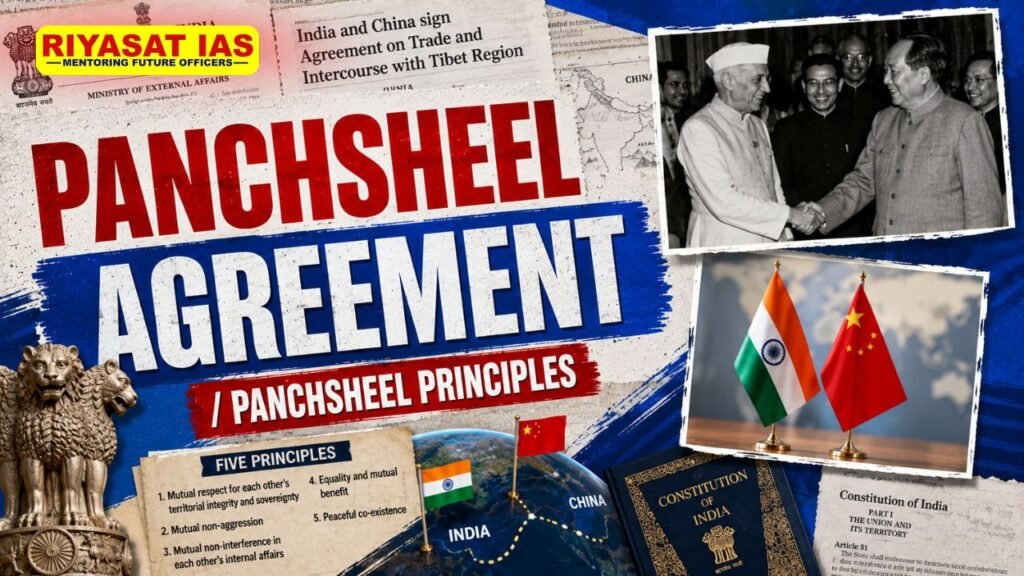
· Panchsheel, or the Five Principles of Peaceful Coexistence, refers to five principles that were formally incorporated into the Agreement on Trade and Intercourse between the Tibet Region of China and India, signed on 29 April 1954. The agreement was signed by India and China during the period of Prime Minister Jawaharlal Nehru and Premier Zhou Enlai.
· The principles were intended to provide a normative framework for peaceful relations between India and China and subsequently acquired a wider significance in India’s foreign policy and international diplomacy.
Historical Evolution
The Panchsheel principles emerged in the context of the post-World War II international order, decolonisation and the Cold War. Newly independent Asian and African countries were seeking to protect their sovereignty and avoid becoming instruments of great-power rivalry.
Evolution of Panchsheel
- In December 1953, India and China began negotiations concerning relations relating to the Tibet region. During these negotiations, the five principles were proposed and accepted as the basis for the discussions.
- On 29 April 1954, India and China incorporated the principles into the Agreement on Trade and Intercourse between the Tibet Region of China and India.
- In 1954, during Premier Zhou Enlai’s visit to India, the principles were discussed as having wider application beyond India-China relations.
- The principles subsequently influenced the Bandung Conference of 1955, where a modified form of Panchsheel was incorporated into the broader principles governing Afro-Asian relations. Thus, Panchsheel evolved from a bilateral framework between India and China into a broader principle of international relations.
Five Principles of Panchsheel
· Mutual Respect for Each Other’s Territorial Integrity and Sovereignty: States should respect the territorial integrity and sovereignty of other countries and should not seek to undermine their independence.
· Mutual Non-Aggression: States should refrain from aggression against each other and should not use force to settle disputes.
· Mutual Non-Interference: States should avoid interference in the internal affairs of one another and respect each country’s right to determine its own political, economic and social system.
· Equality and Mutual Benefit: Relations between states should be based on sovereign equality and mutual benefit, rather than domination by stronger powers.
· Peaceful Coexistence: Countries with different political, economic and ideological systems should be able to coexist peacefully and cooperate with one another.
Objectives of Panchsheel Principles
· The central objective of Panchsheel was to establish a peaceful and mutually respectful framework for relations among sovereign states, particularly in a period characterised by Cold War rivalry and decolonisation.
· The principles sought to protect the sovereignty of newly independent countries, prevent external interference, reduce the possibility of armed conflict and encourage peaceful cooperation among states with different political systems.
· Panchsheel also provided developing countries with a diplomatic framework through which they could resist domination by powerful states while retaining their independent foreign-policy choices.
Connection with Non-Alignment
Panchsheel and Non-Alignment were closely connected but were not identical concepts. Panchsheel primarily provided principles for conducting relations among states, whereas Non-Alignment represented an approach to international politics in which newly independent countries sought to maintain independent judgement rather than joining either Cold War bloc.
India-China Relations After the Panchsheel Agreement



· Initially, Panchsheel generated considerable optimism about India-China relations. The 1950s witnessed increased political, cultural, educational and scientific exchanges, and the relationship was associated with the popular slogan “Hindi-Chini Bhai-Bhai.” However, the relationship subsequently deteriorated because of differences over the border, Tibet and wider strategic interests.
· 1962 India-China War: The 1962 India-China War represented a major setback to the expectations associated with Panchsheel. The conflict demonstrated that the existence of diplomatic principles alone could not eliminate territorial disputes and conflicting strategic interests.
o The MEA notes that India’s early outreach to China and recognition of China’s position regarding Tibet were followed by the political shock of the 1962 border conflict.
· Post-1962 Relations: Despite the conflict, India and China gradually sought to restore diplomatic engagement. The relationship improved significantly after Rajiv Gandhi’s 1988 visit to China, followed by various mechanisms for political dialogue and border management.
· Panchsheel did not prevent conflict, but its principles continued to provide a normative language for diplomatic engagement.
Panchsheel Doctrine and India’s Foreign Policy
· India’s broader foreign-policy approach incorporated principles such as peaceful coexistence, non-interference, peaceful settlement of disputes, multilateralism, anti-colonialism, anti-racism and strategic autonomy. The Ministry of External Affairs identifies Panchsheel as one of the important strands of India’s foreign-policy tradition.
· Strategic Autonomy: The principle of sovereign equality supports India’s long-standing preference for independent decision-making in international affairs.
· Peaceful Resolution of Disputes: India has consistently emphasised the peaceful settlement of international disputes and dialogue as an instrument of diplomacy.
· Non-Interference: The principle of non-interference has influenced India’s emphasis on respect for the sovereignty and internal affairs of other states.
· Multilateralism: Panchsheel’s emphasis on equality among states complements India’s support for multilateral institutions and a rules-based international order.
· South-South Cooperation: The principles also contributed to India’s engagement with developing countries and its advocacy of South-South cooperation and sovereign equality.
Global Influence of Panchsheel
· Bandung Conference, 1955: The principles influenced the Bandung Conference of Asian and African countries, where a modified version of Panchsheel became part of the broader principles guiding Afro-Asian cooperation.
· Influence on NAM: Panchsheel also became closely associated with the political thinking that later supported the Non-Aligned Movement, particularly its emphasis on sovereignty, peaceful coexistence, anti-colonialism and opposition to domination by great powers.
· Developing Countries: For newly independent countries, Panchsheel offered a framework based on sovereign equality rather than power hierarchy, making it particularly attractive to countries seeking greater autonomy in the international system.
Contemporary Relevance
· Panchsheel remains relevant because many of its principles continue to correspond with contemporary international challenges.
· Respect for Sovereignty: The principle of sovereignty remains central to debates over territorial disputes, intervention and international law.
· Non-Aggression: The continuing occurrence of interstate conflicts demonstrates the importance of restraint and peaceful dispute resolution.
· Non-Interference: In an era of cyber operations, political influence campaigns and external intervention, the principle of non-interference has acquired new dimensions.
· Equality of States; Panchsheel’s emphasis on equality remains relevant to India’s demand for reform of global governance institutions, including greater representation of developing countries.
· Multipolar World: In an increasingly multipolar world, peaceful coexistence among states with different political systems and strategic interests remains essential.
Criticism of Panchsheel
· Gap Between Principles and Power Politics: Critics argue that international relations are influenced heavily by power and national interests, and moral principles alone cannot guarantee peaceful behaviour by states.
· 1962 War: The most significant criticism arises from the 1962 India-China conflict, which demonstrated that adherence to principles such as peaceful coexistence does not necessarily prevent military confrontation.
· Security and Strategic Preparedness: The experience of 1962 highlighted the importance of combining diplomatic principles with adequate military preparedness and realistic assessment of strategic intentions.
· Ambiguity in Application: Some principles, particularly non-interference and sovereignty, can become difficult to apply when serious violations of human rights or international peace occur.
· Changing International Environment: Panchsheel emerged in a specific historical context of decolonisation and Cold War rivalry. Its contemporary relevance therefore requires adaptation to issues such as cybersecurity, terrorism, climate change, technology and economic interdependence.
Panchsheel: Idealism vs Realism
· Idealist approach: International relations can be governed by peaceful coexistence, sovereignty, equality and cooperation.
· Realist approach: States must also consider power, national interest, military capability and strategic intentions.
o The 1962 conflict demonstrated that principles cannot substitute for strategic preparedness. At the same time, the continued importance of dialogue and diplomatic mechanisms shows that principles remain useful in managing international relations.
Way Forward
· India can continue to uphold the core principles of Panchsheel while adapting them to contemporary geopolitical realities.
· India should combine respect for sovereignty and peaceful coexistence with stronger defence preparedness, effective border management and realistic strategic assessment.
· At the same time, Panchsheel can be updated to address emerging areas such as cyberspace, artificial intelligence, climate change, terrorism, critical technologies and global economic governance.
· India can also use these principles to strengthen Global South cooperation and advocate a more representative and equitable international order.
Conclusion
· Panchsheel represents an important contribution of India to the development of norms for peaceful international relations. Although the 1962 India-China conflict exposed the limitations of relying on principles without adequate strategic preparedness, it did not make the underlying values of sovereignty, non-aggression, non-interference, equality and peaceful coexistence irrelevant.
· The contemporary lesson of Panchsheel is therefore not that idealism should replace realism, but that principled diplomacy must be supported by strategic capability and realistic assessment of national interests.
FAQs
1. What is Panchsheel?
Ans: Panchsheel refers to the Five Principles of Peaceful Coexistence, which were formally incorporated into the India-China Agreement on Trade and Intercourse relating to the Tibet Region in 1954.
2. What are the five principles of Panchsheel?
Ans: The five principles are mutual respect for territorial integrity and sovereignty, mutual non-aggression, mutual non-interference in internal affairs, equality and mutual benefit, and peaceful coexistence.
3. What was the significance of Panchsheel for India’s foreign policy?
Ans: Panchsheel provided a normative foundation for India’s emphasis on peaceful coexistence, sovereignty, non-interference, strategic autonomy and peaceful settlement of international disputes.
4. How did the 1962 India-China War affect Panchsheel?
Ans: The 1962 India-China War exposed the limitations of relying solely on diplomatic principles to prevent conflict and highlighted the importance of combining principled diplomacy with strategic preparedness and realistic assessment of security threats.
5. Is Panchsheel relevant in the contemporary world?
Ans: Yes. Its principles remain relevant to issues involving sovereignty, non-aggression, peaceful dispute resolution, equality among states and peaceful coexistence, although they need to be adapted to contemporary challenges such as cybersecurity, terrorism, climate change and emerging technologies.




 Ravi Raaz
 Hassan Khan
 Shadab Ali