
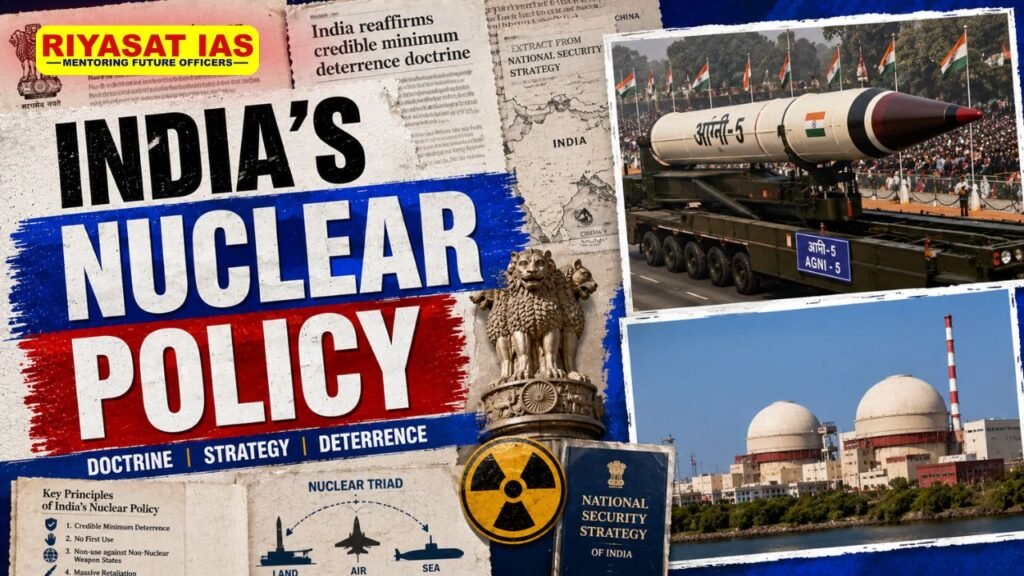
What is India’s Nuclear Policy?
· India’s nuclear policy refers to the principles and strategic approach through which India manages its nuclear weapons, nuclear deterrence, civilian nuclear energy, non-proliferation commitments and pursuit of global nuclear disarmament.
· India follows a distinctive approach that combines credible minimum deterrence, No First Use (NFU), civilian control of nuclear weapons, non-proliferation and commitment to universal, non-discriminatory and verifiable nuclear disarmament.
Evolution of India’s Nuclear Programme and Policy
India’s nuclear journey has evolved from an emphasis on the peaceful use of atomic energy to the development of a credible nuclear deterrent, while continuing to advocate global nuclear disarmament.
1948–1974: Peaceful Nuclear Programme
· India established the Atomic Energy Commission in 1948 under the guidance of Homi J. Bhabha and initially focused on the peaceful applications of nuclear technology for energy, agriculture, medicine and scientific development.
· India simultaneously advocated global nuclear disarmament. As early as 1948, India called for limiting atomic energy to peaceful purposes and eliminating nuclear weapons from national arsenals. In 1954, India became the first country to call for a ban on nuclear testing.
1974: Pokhran-I
· India conducted its first nuclear test at Pokhran, Rajasthan, in May 1974, describing it as a peaceful nuclear explosion.
· The test demonstrated India’s indigenous nuclear capability but also resulted in international restrictions on nuclear technology cooperation. The Nuclear Suppliers Group (NSG) emerged in the aftermath of the 1974 test, contributing to India’s technological isolation in the nuclear field.
1974–1998: Strategic Ambiguity
· Following the 1974 test, India maintained its nuclear option without openly declaring itself a nuclear-weapon state. During this period, India continued to advocate universal nuclear disarmament while developing indigenous nuclear capabilities.
· India’s position was shaped by its security environment, particularly the presence of nuclear-armed states in its neighbourhood.
1998: Pokhran-II
· India conducted five nuclear tests at Pokhran in May 1998, after which it openly declared itself a nuclear-weapon state.
· Following the tests, India announced a voluntary moratorium on further nuclear testing and articulated the principles of credible minimum deterrence and No First Use.
Integration with Global Nuclear Order
· The doctrine was formally adopted in January 2003 and provides that India would use nuclear weapons only in retaliation against a nuclear attack on its territory or on Indian forces anywhere.
· India’s nuclear diplomacy subsequently changed significantly. In 2008, the IAEA and NSG arrangements enabled India to access international civilian nuclear cooperation, effectively ending much of the nuclear isolation that followed the 1974 test.
Nuclear Principles of India
· Credible Minimum Deterrence: India seeks to maintain a credible minimum nuclear deterrent, meaning that its nuclear capability should be sufficient to deter nuclear coercion or attack without pursuing an unlimited nuclear arsenal.
· No First Use: India’s declared doctrine provides that nuclear weapons will be used only in retaliation against a nuclear attack on Indian territory or Indian forces anywhere. India has reiterated the NFU posture in recent official statements.
· Civilian Political Control: Nuclear retaliatory attacks can be authorised only by the civilian political leadership through the Nuclear Command Authority. This ensures that the use of nuclear weapons remains under democratic political control.



· Non-Use Against Non-Nuclear Weapon States: India’s doctrine includes a commitment to non-use of nuclear weapons against non-nuclear-weapon states, subject to the qualifications contained in India’s declared doctrine.
· Voluntary Restraint on Nuclear Testing: India announced a voluntary moratorium on further nuclear explosive testing after the 1998 tests and continues to support negotiations on a Fissile Material Cut-off Treaty (FMCT).
· Commitment to Nuclear Disarmament: India maintains that the ultimate objective should be universal, non-discriminatory and verifiable nuclear disarmament. India has historically supported multilateral negotiations towards eliminating nuclear weapons.
Treaty
· The Nuclear Non-Proliferation Treaty (NPT) was opened for signature in 1968 and entered into force in 1970. It seeks to prevent the spread of nuclear weapons, promote peaceful uses of nuclear energy and advance nuclear disarmament.
· India has not signed the NPT because it considers the treaty’s distinction between recognised nuclear-weapon states and non-nuclear-weapon states to be discriminatory and inconsistent with the principle of universal and non-discriminatory disarmament.
· The NPT has three core objectives: preventing the spread of nuclear weapons, promoting nuclear disarmament, and ensuring the peaceful use of nuclear technology.
· The Comprehensive Nuclear-Test-Ban Treaty (CTBT) seeks to prohibit all nuclear explosions. India has not signed the treaty, primarily because it does not provide a time-bound commitment to nuclear disarmament by the nuclear-weapon states.
· The Treaty on the Prohibition of Nuclear Weapons (TPNW) is the first legally binding international agreement to comprehensively prohibit nuclear weapons. India has not signed the treaty, as it does not consider the TPNW to contribute to the development of customary international law or establish new international standards.
· India is not a part of Nuclear Suppliers Groups(NSG) 1974.
Advantages of the No First Use Policy
· Reduces Nuclear Escalation: NFU reduces the possibility that India will initiate nuclear use during a conventional crisis, thereby lowering the risk of rapid nuclear escalation.
· Strengthens Strategic Stability: A declared NFU posture can provide greater predictability to adversaries because it communicates that India’s nuclear weapons are primarily intended for retaliatory deterrence rather than war-fighting.
· Supports India’s Responsible-Nuclear-State Image: NFU strengthens India’s image as a state that combines nuclear capability with strategic restraint and responsible nuclear behaviour.
· Reduces Accidental or Premature Use: A retaliatory posture provides greater space for political and military decision-makers to assess information before authorising nuclear use, reducing the risk of accidental or mistaken escalation.
· Supports India’s Disarmament Position: NFU is broadly consistent with India’s long-standing advocacy of reducing the role of nuclear weapons in international security and ultimately achieving nuclear disarmament.
Disadvantages / Challenges of No First Use
· Credibility Problem: The effectiveness of NFU depends on whether an adversary believes that India will maintain the policy even under extreme circumstances. If an adversary doubts India’s willingness or capability to retaliate, deterrence may weaken.
· Vulnerability to a First Strike: A strict NFU posture means India accepts the possibility of absorbing a first nuclear strike before responding. This places considerable importance on the survivability of India’s nuclear forces.
· Difficulties in Two-Front Deterrence: India’s security environment includes two nuclear-armed neighbours, creating complex deterrence requirements. Maintaining a credible retaliatory capability against multiple potential adversaries requires survivable and reliable forces.
· Conventional-Nuclear Threshold: A major challenge arises when conventional military conflict occurs below the nuclear threshold. An adversary may attempt to exploit the perceived restraint associated with NFU.
· Technological and Operational Demands: NFU requires highly survivable nuclear forces, secure command-and-control systems, reliable communication and effective early-warning capabilities to ensure that retaliation remains credible after a first strike.
What Would Abandoning NFU Imply?
Possible Advantages: Abandoning NFU could provide India with greater doctrinal flexibility by creating uncertainty about the circumstances under which India might use nuclear weapons.
o Such ambiguity could potentially strengthen deterrence if adversaries believe that India might undertake pre-emptive or first-use nuclear action in extreme circumstances.
Possible Risks
· It could increase crisis instability, because an adversary might fear that India could use nuclear weapons first and therefore feel pressure to launch its own forces before losing them.
· It could also increase the risk of miscalculation, accidental escalation and arms racing, particularly in the India-Pakistan strategic environment.
· Furthermore, abandoning NFU could weaken India’s image as a nuclear state committed to strategic restraint and responsible nuclear behaviour.
· Therefore, Abandoning NFU may increase short-term ambiguity but could reduce long-term strategic stability.
NFU: Should India Continue or Reconsider?
· The debate should not be framed simply as NFU versus no NFU. The effectiveness of NFU ultimately depends on the credibility and survivability of India’s retaliatory capability.
· India therefore needs to ensure that its nuclear deterrence remains credible by maintaining survivable nuclear forces, secure command-and-control systems, reliable communication networks, a robust second-strike capability and a policy of strategic restraint.
· At the same time, India should continuously assess changes in the strategic doctrines and capabilities of its nuclear-armed neighbours.
Way Forward
· Strengthen Credible Minimum Deterrence: India should maintain a credible but minimum deterrent rather than entering an unrestricted nuclear arms race.
· Enhance Second-Strike Capability: The credibility of NFU depends heavily on India’s ability to retaliate after suffering a first strike. Therefore, survivability and secure second-strike capabilities remain essential.
· Strengthen Nuclear Command and Control: India should continue improving secure communication, command-and-control systems, early-warning capabilities and safeguards against accidental or unauthorised use.
· Promote Nuclear Risk Reduction: India should strengthen dialogue with other nuclear-armed states on confidence-building measures, crisis communication and reducing the risk of accidental or unauthorised nuclear use.
· Continue Global Disarmament Efforts: India should maintain its commitment to universal, non-discriminatory and verifiable nuclear disarmament while supporting negotiations on measures such as the FMCT.
· Balance Security with Civilian Nuclear Energy: India should continue expanding peaceful nuclear cooperation for energy security, climate goals, scientific research and economic development, while maintaining strong safeguards and export controls.
Conclusion
India’s nuclear policy seeks to ensure that nuclear weapons remain instruments of deterrence rather than war-fighting, while simultaneously preserving India’s strategic autonomy and commitment to a future free of nuclear weapons.
FAQs
1. What are the main principles of India’s nuclear doctrine?
Ans: India follows credible minimum deterrence, No First Use, civilian control and strategic restraint, along with a commitment to nuclear disarmament.
2. Why has India not signed the NPT?
Ans: India considers the NPT discriminatory and supports universal and non-discriminatory nuclear disarmament.
3. What is India’s No First Use policy?
Ans: India has declared that it will use nuclear weapons only in retaliation against a nuclear attack on its territory or forces.
4. What are the advantages of NFU?
Ans: NFU promotes strategic stability, reduces escalation risks and strengthens India’s image as a responsible nuclear power.
5. What are the implications of abandoning NFU?
Ans: Abandoning NFU may provide greater flexibility but could increase arms racing, crisis instability and the risk of nuclear escalation.




 Ravi Raaz
 Hassan Khan
 Shadab Ali