
About
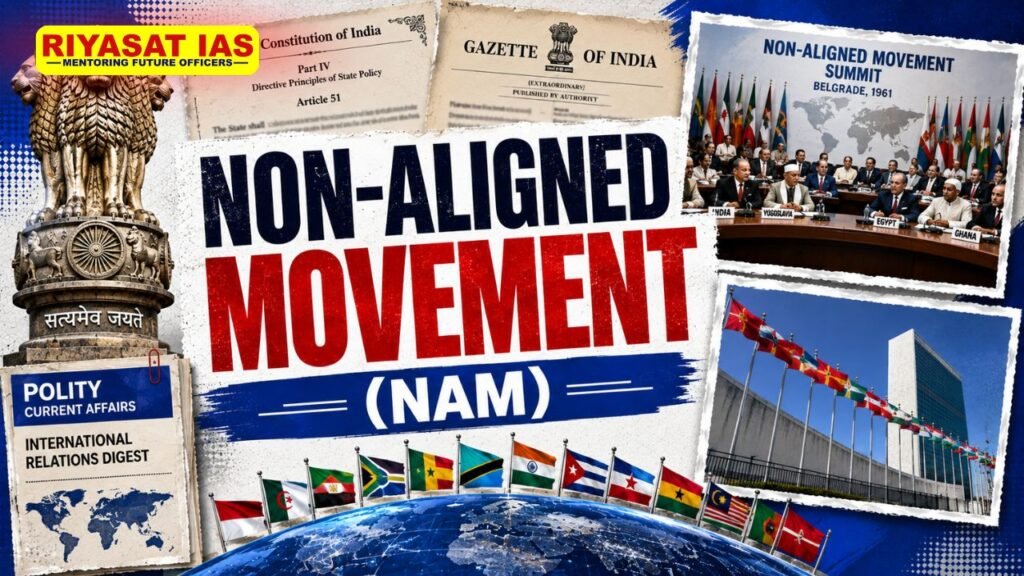
The Non-Aligned Movement (NAM) is a grouping of developing countries that sought to maintain an independent foreign-policy position rather than formally aligning with either of the two major Cold War blocs led by the United States and the Soviet Union. NAM also became an important platform for promoting peace, sovereignty, decolonisation, disarmament and the interests of developing countries.
NAM was formally established at the Belgrade Conference in 1961, although its intellectual and political foundations had emerged earlier through the Asian Relations Conference, Bandung Conference and cooperation among newly independent countries.
Historical Background
The emergence of NAM was closely associated with the decolonisation of Asia and Africa and the Cold War rivalry between the US and USSR. Newly independent countries wanted to protect their sovereignty and avoid becoming instruments of great-power rivalry.
Major Milestones
- The Asian Relations Conference (1947) provided an early platform for Asian solidarity and anti-colonial cooperation.
- The Bandung Conference (1955) held in Indonesia brought together Asian and African countries and provided the political foundation for later Non-Alignment.
- Leaders such as Jawaharlal Nehru of India, Josip Broz Tito of Yugoslavia, Gamal Abdel Nasser of Egypt, Sukarno of Indonesia and Kwame Nkrumah of Ghana played an important role in the emergence of the movement.
- The First NAM Summit was held in Belgrade in 1961, marking the formal establishment of the movement.
- As of August 2026, NAM comprised 120 member countries, including 53 from Africa, 39 from Asia, 26 from Latin America and the Caribbean, and 2 from Europe—Belarus and Azerbaijan. In addition, 18 countries and 10 international organisations held observer status.
Objectives of NAM
The primary objective of NAM was to protect the strategic independence and sovereignty of newly independent states in an international system dominated by competing superpowers.
NAM sought to:
- Support the right of peoples to self-determination and decolonisation.
- Oppose colonialism, imperialism and racial discrimination.
- Promote disarmament and reduction of international tensions.
- Protect the sovereignty and territorial integrity of member states.
- Strengthen economic cooperation among developing countries.
- Give developing countries a stronger collective voice in global governance and international institutions.
Principles of NAM
The principles of NAM were strongly influenced by the Five Principles of Peaceful Coexistence (Panchsheel) and the Bandung principles.
Note: Non-Alignment did not mean remaining neutral on every international issue. Rather, it meant maintaining the freedom to independently assess international issues and formulate positions according to national interests and principles.
Major Principles
- NAM emphasises respect for sovereignty and territorial integrity of all states.
- Member states support non-interference in the internal affairs of other countries.
- NAM advocates the peaceful settlement of international disputes.
- It opposes the use or threat of force in international relations.
- It supports the right of peoples to self-determination.
- It promotes equality among nations, irrespective of their size or power.
Organisational Structure
NAM does not function like a traditional military alliance or a highly centralised international organisation. It is primarily a political and diplomatic forum based on consultation and consensus.
· Summit of Heads of State/Government: The NAM Summit is the highest-level political forum and is generally held periodically in the country that assumes the chairmanship.



· Ministerial Meetings: Foreign Ministers and other ministers meet to discuss international political, economic and developmental issues.
· Coordinating Bureau: The Coordinating Bureau, based at the United Nations in New York, plays an important role in coordinating the positions and activities of NAM member states.
· Consensus-Based Approach: NAM generally operates through consultation, coordination and consensus rather than binding decision-making mechanisms.
NAM During the Cold War
· During the Cold War, NAM provided newly independent countries with an alternative to joining either the US-led or Soviet-led bloc.
· Political Role: NAM strongly opposed colonialism, apartheid, racial discrimination and foreign occupation and supported national liberation movements in Asia, Africa and other regions.
· During the Second NAM Conference held in Cairo, the South African government was condemned for its discriminatory apartheid policies, with NAM members calling for an end to racial discrimination.
· Peace and Security: The movement advocated disarmament, peaceful coexistence and reduction of Cold War tensions. It also sought to prevent developing countries from becoming theatres of superpower rivalry.
· Economic Role: NAM increasingly focused on economic inequality between developed and developing countries and demanded reforms in the international economic system.
o The movement therefore evolved from an emphasis on political independence towards a broader agenda of economic independence and development.
NAM in the Emerging Global Order
· The end of the Cold War in 1991 created questions about the relevance of NAM because the bipolar system that originally gave rise to the movement had disappeared. However, the emergence of a new international order has created new areas of relevance.
o From Bipolarity to Multipolarity: The contemporary world is characterised by multiple centres of economic and strategic power, increasing geopolitical competition and changing global alliances. In this environment, the original idea of strategic autonomy and independent decision-making continues to have relevance.
New Global Challenges
NAM’s agenda has increasingly expanded beyond Cold War issues to include:
- Global economic inequality.
- Climate change.
- Sustainable development.
- Food and energy security.
- Global health.
- Terrorism.
- Technology and digital inequality.
- Reform of global governance institutions.
India’s Position in NAM
· India was one of the founding members and principal architects of NAM, with Jawaharlal Nehru playing a central role in shaping its early philosophy. For India, Non-Alignment was closely connected with the objective of maintaining strategic autonomy in a bipolar international system.
· Economic liberalisation and growing strategic ties with the United States led India to place relatively less emphasis on traditional NAM diplomacy.
· India did not attend the 2016 NAM summit in Venezuela, marking 2nd instance of a head of state not participate in NAM conference.
· India simultaneously engages with different platforms and major powers, including BRICS + SCO + Quad + G20 + Global South
· India’s foreign policy has evolved considerably since the end of the Cold War. Rather than traditional bloc-based Non-Alignment, India increasingly follows a policy of strategic autonomy and multi-alignment.
· India used NAM as a platform to advocate reforms in global governance institutions and promote greater South-South cooperation among developing countries.
Relevance of NAM
· Strategic Autonomy: The principle of independent decision-making remains relevant in a world characterised by US-China competition, Russia-West tensions and shifting geopolitical alignments.
· Voice of the Global South: NAM provides developing countries with a platform to collectively raise concerns relating to development, debt, climate finance, technology access and global inequality.
· Reform of Global Governance: NAM continues to support greater representation of developing countries in international institutions, particularly through demands for reform of the United Nations Security Council and international financial institutions.
· Peace and Disarmament: The continuing existence of nuclear weapons, regional conflicts and arms races makes NAM’s emphasis on peaceful coexistence, disarmament and peaceful settlement of disputes relevant.
· New Forms of Inequality: Contemporary inequalities are not limited to military power. Developing countries also face gaps in technology, finance, digital infrastructure, health resources and climate resilience. NAM can therefore contribute to building greater cooperation among developing countries.
Challenges Before NAM
· Lack of Internal Cohesion: NAM consists of countries with different political systems, economic interests and strategic priorities, making consensus difficult on several issues.
· Changing Geopolitical Alignments: Many member countries maintain strong economic, military or strategic relationships with major powers, which can limit the movement’s ability to maintain a unified position.
· Weak Institutional Mechanism: NAM lacks strong institutional structures and binding enforcement mechanisms, which limits its ability to convert declarations into concrete outcomes.
· Question of Contemporary Identity: NAM must continuously redefine its role because the Cold War-era bipolar structure no longer exists.
Way Forward
· Strengthening South-South Cooperation: NAM should promote cooperation in health, education, agriculture, digital technology, renewable energy and capacity building.
· Addressing Global Inequality: The movement should develop stronger common positions on climate finance, debt sustainability, food security, energy security and access to critical technologies.
· Reforming Global Institutions: NAM should continue advocating for greater representation of developing countries in UN and international financial institutions.
· Technology and Digital Cooperation: The movement can become more relevant by promoting cooperation in digital public infrastructure, cybersecurity, AI, digital inclusion and technology transfer.
· Greater Institutional Effectiveness: NAM should strengthen its coordination mechanisms and focus on specific, measurable areas of cooperation rather than relying primarily on political declarations.
Conclusion
“NAM may have lost its original Cold War context, but its core principles of strategic autonomy, sovereign equality, peaceful coexistence and a stronger voice for the Global South remain relevant in an increasingly multipolar world.”
FAQs
1. What is the Non-Aligned Movement (NAM)?
Ans: NAM is a grouping of countries that sought to maintain independent foreign-policy choices rather than formally aligning with either of the major Cold War blocs. It was formally established at the Belgrade Summit in 1961.
2. What were the major objectives of NAM?
Ans: NAM aimed to promote peaceful coexistence, sovereignty, decolonisation, disarmament, opposition to imperialism and racial discrimination, and greater cooperation among developing countries.
3. How did NAM contribute during the Cold War?
Ans: During the Cold War, NAM provided newly independent countries with a platform to avoid bloc politics, protect their strategic autonomy, oppose colonialism and apartheid, and advocate peaceful resolution of international conflicts.
4. Is NAM still relevant after the end of the Cold War?
Ans: Yes. NAM remains relevant because issues such as global inequality, climate change, disarmament, development, technology gaps and the demand for greater representation of developing countries in global institutions continue to affect the Global South.
5. What is India’s present approach towards NAM?
Ans: India has moved from traditional Cold War-era Non-Alignment towards strategic autonomy and multi-alignment, while retaining the core principles of independent decision-making, peaceful coexistence and cooperation with developing countries.




 Ravi Raaz
 Hassan Khan
 Shadab Ali