
Defining Legal and Administrative Frameworks
1. Laws
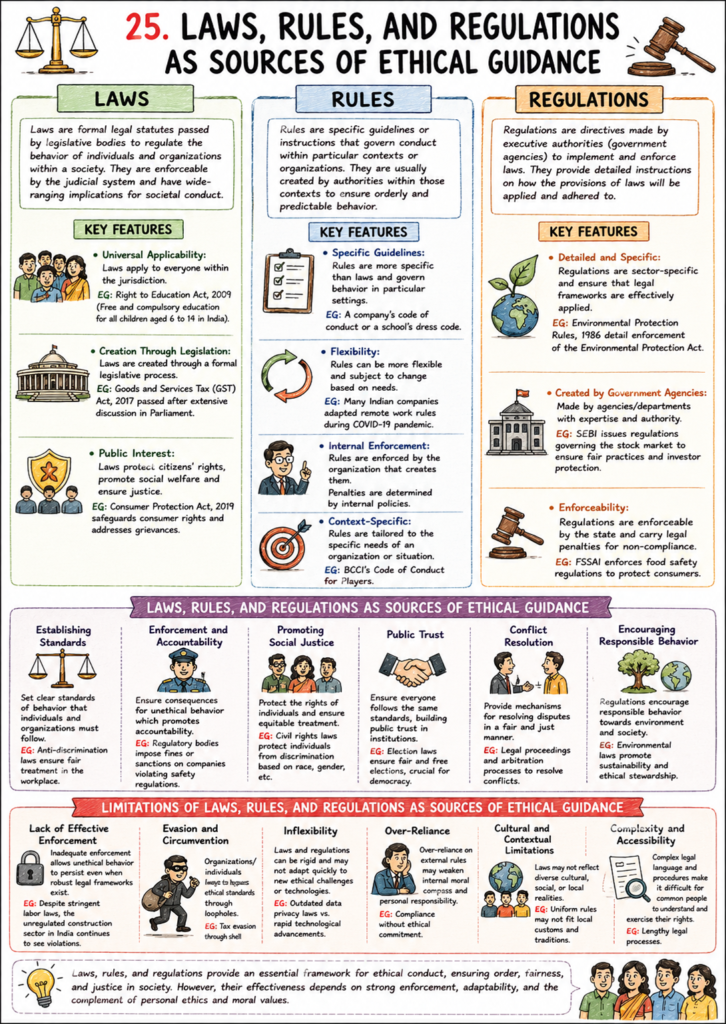
Laws are formal legal statutes passed by legislative bodies to regulate the behavior of individuals and organizations within a society. They are universally applicable to everyone within the jurisdiction of the enacting governing body, regardless of social status, occupation, or personal beliefs. Laws are created through a formal, structured legislative process involving multiple stages, including drafting, committee review, debate, amendments, and voting by elected representatives. Their ultimate objective is to protect citizens’ rights, promote social welfare, ensure justice, and preserve public order. They are fully enforceable by the sovereign judicial system and carry significant legal penalties, including fines or imprisonment, for non-compliance.
- Examples: The Right to Education (RTE) Act, 2009, the Goods and Services Tax (GST) Act, 2017, and the Consumer Protection Act, 2019.
2. Rules
Rules are specific, targeted guidelines or instructions that govern conduct within particular contexts, environments, or organizations. They are established by internal authorities within those specific settings to ensure orderly, safe, and predictable behavior on a day-to-day basis. Unlike statutory laws, rules are significantly more specific and exhibit operational flexibility, meaning they can be readily updated or modified by management to adapt to changing organizational needs. Rules rely on internal enforcement mechanisms within the institution that creates them, and any penalties for breaking them are determined strictly by internal disciplinary policies rather than the state judiciary.
- Examples: An enterprise’s workplace code of conduct, an educational institution’s dress code, or the BCCI’s Code of Conduct for Players.
3. Regulations
Regulations are specific directives and detailed instructions formulated by executive authorities and specialized government agencies to implement, clarify, and enforce broader legislative laws. They are highly sector-specific, focusing on ensuring that the macroscopic legal frameworks passed by parliament are effectively applied in practical, technical operations. Because they are issued by executive bodies possessing specialized domain expertise, they carry the full force of law, are enforceable by the state, and carry immediate legal or financial penalties for non-compliance.
- Examples: The Environmental Protection Rules, 1986 (detailing the enforcement of the parent Environmental Protection Act), or market compliance guidelines issued by the Securities and Exchange Board of India (SEBI) and the Food Safety and Standards Authority of India (FSSAI).
Functions as Sources of Ethical Guidance
Laws, rules, and regulations serve as essential objective pillars for guiding human behavior, helping public and private actors navigate ethical landscapes through five central mechanisms:
- Establishing Standards of Conduct: They set clear, unyielding baselines of acceptable behavior that individuals and corporate bodies must rigorously follow, providing a structured blueprint for daily ethical decision-making. For instance, anti-discrimination laws clearly define and forbid prejudice in the workplace.
- Enforcement and Systemic Accountability: These legal frameworks ensure that unethical behavior is met with swift, predictable institutional consequences. The existence of punitive sanctions deter potential wrongdoers and hold actors directly accountable for their actions. For example, independent regulatory bodies can impose severe financial fines or shut down factories that intentionally violate public safety regulations.
- Promoting Social Justice and Equity: Statutory instruments are frequently drafted to protect the fundamental rights of marginalized or vulnerable individuals, ensuring equitable treatment and dismantling historic structural inequalities. Civil rights protections serve as a prime example, shielding citizens from arbitrary discrimination based on race, gender, or caste.
- Preserving and Building Public Trust: By establishing a predictable framework where everyone—regardless of wealth or status—is bound by the identical set of rules, these codes foster public trust in institutional processes. For instance, transparent electoral laws guarantee free and fair elections, which are critical to sustaining democratic legitimacy.
- Providing Conflict Resolution Mechanisms: When moral perspectives clash, these frameworks offer highly structured, fair, and legally binding mechanisms—such as judicial proceedings, tribunals, and formal arbitration—to resolve disputes peacefully and equitably.
- Encouraging Socially Responsible Behavior: Stringent statutory frameworks encourage businesses and citizens to act as ethical stewards of public goods. For example, environmental regulations compel industrial units to internalize their pollution costs and adopt sustainable production models to preserve the ecosystem for future generations.
Limitations in Providing Ethical Guidance
While legal and administrative frameworks are essential to maintain order, an over-reliance on them can reveal distinct limitations, as laws frequently represent only the minimum ethical baseline of a society rather than its highest moral aspirations:
- Lack of Effective Enforcement: The existence of a robust legal framework is meaningless if the institutional machinery fails to enforce it effectively, allowing unethical practices to continue unchecked in unregulated sectors. For example, despite stringent labor laws in India, the unorganized construction sector continues to witness widespread violations, including unsafe working environments and delayed wage payments.
- Active Evasion and Circumvention: Sophisticated actors frequently exploit cross-border jurisdictions to bypass ethical standards entirely, rendering domestic laws ineffective. A notable manifestation is the Pandora Papers leak (2021), which exposed how wealthy individuals and multinational corporations utilize complex offshore accounts and shell companies to hide billions in assets and evade taxes globally.
- Exploitation of Legal Loopholes: Individuals can technically comply with the literal letter of the law while completely violating its underlying spirit, exploiting structural loopholes to facilitate highly unethical practices. In the Indian financial sector, the YES Bank crisis exposed how specific structural vulnerabilities in banking regulations were deliberately exploited, leading to catastrophic corporate mismanagement and systemic instability.
- Lagging Scope in Emerging Sectors: Statutory laws require extensive legislative time to draft and pass, meaning they frequently fail to adequately cover rapidly evolving modern sectors, leaving massive gaps in ethical oversight. For instance, the gig economy in India has grown exponentially, yet platforms like Uber, Ola, and Zomato have faced severe ethical criticism for exploiting regulatory vacuum zones to deny gig workers standard labor protections, minimum wages, and healthcare safety nets.
- Insufficient Guidance in Ethical Grey Areas: Complex modern advancements introduce deep dilemmas that cannot be resolved through literal legal compliance. The ongoing global debate over Artificial Intelligence (AI) ethics illustrates the limitations of rigid statutes in catching up with the profound ethical implications of algorithmic bias, automated deepfakes, job displacement, and predictive mass surveillance.
- Inflexibility and Anachronism: The inherent rigidity of the legislative amendment process makes laws exceptionally slow to adapt to contemporary ethical challenges. For example, India’s parent Information Technology Act, 2000, was drafted during the infancy of the internet and struggles to address modern threats like data harvesting, algorithmic manipulation, and advanced cybersecurity anomalies.
- Unintended Negative Consequences: Well-intentioned, top-down legal reforms can trigger deep social backlashes if they are introduced without broad-based consensus-building. The introduction of the Farm Laws in 2020, which intended to liberalize agricultural markets, triggered historic mass protests by agrarian communities who feared the reforms would dismantle the essential Minimum Support Price (MSP) safetynet, forcing an eventual repeal.
- Friction with Deep-Rooted Cultural Relativism: Universal ethical standards embedded in formal state laws often face severe resistance when they conflict with localized, deeply ingrained socio-cultural practices. For example, despite the clear statutory mandate of the Prohibition of Child Marriage Act, 2006, the practice of child marriage persists in multiple rural pockets due to poverty and traditional scripts.
- Lag in Societal Maturity and Readiness: The ultimate efficacy of a progressive law depends on the underlying readiness of the citizenry to accept it. The Supreme Court’s landmark 2018 ruling decriminalizing homosexuality under Section 377 was a historic legal milestone, yet grassroots social acceptance has lagged behind, leading to continued discrimination against the LGBTQ+ community.
- Reduction in Personal Moral Accountability: When an administration relies exclusively on legal rules, it can inadvertently reduce individual accountability, transforming ethics into a superficial checkbox exercise. For example, compliance with the Corporate Social Responsibility (CSR) mandates under the Companies Act, 2013, is routinely treated by corporations as a formal legal requirement to be met on paper, rather than an opportunity to foster a genuine internal culture of integrity and public service.



Examples
Example 1: Resolving Ethical Grey Areas in Modern Digital Offloads
State technology departments moving beyond obsolete legal baselines by integrating explainable AI architectures (XAI) and real-time deepfake tagging protocols within governance dashboards. This ensures that while digital platforms scale rapidly, public data safety and democratic discourse are actively insulated from synthetic misinformation, filling the lag in formal cybersecurity laws.
Example 2: Mitigating Checkbox Compliance in Public Deliveries
District administrations utilizing 360-degree civic feedback Loops and localized social audits alongside standard fiscal rules during welfare infrastructure execution. Moving past mere formal compliance ensures that public resources not only fulfill audit parameters on paper but achieve genuine, equitable development for the most vulnerable sections.
Case Study Analysis: Managing Greenwashing in Multinational Conglomerates
Context & Dilemma
A prominent Indian multinational conglomerate, Green Earth, has achieved a massive surge in sales and a glowing public reputation by aggressively marketing its new personal care brand, “PureGreen,” as “100% natural” and “carbon-neutral”. However, an internal sustainability audit has uncovered severe greenwashing: the active ingredients are heavily synthetic, the carbon-neutral claims rely on unverified carbon offsets, and the brand’s environmental certifications are issued by a for-profit body partially owned by Green Earth itself.
Furthermore, a leaked internal memo reveals that the factory line utilizes energy-intensive, non-renewable production methods that cause a higher net environmental footprint than traditional lines. Environmental NGOs are threatening public exposure, ethical investors are demanding verifiable metrics on pain of mass divestment, and the company risks facing heavy financial penalties and a total collapse of its lucrative joint venture with a government-backed sustainability initiative. As the Chief Marketing Officer (CMO), you face an intense ethical dilemma balancing immediate commercial profits and corporate reputation against the non-negotiable mandates of truth in advertising and ecological stewardship.
Ethical Implications of Green Earth’s Strategy
- Violation of Public Truthfulness and Honesty: Deliberately misleading consumers through deceptive marketing constitutes a direct breach of corporate honesty, transforming the brand’s value-expressive function into a tool of public deception.
- Severe Misuse of Corporate Power and Certification Fraud: Utilizing an internal, self-owned for-profit certification shell to validate ecological claims violates the principle of objective transparency and amounts to institutional fraud.
- Irresponsible Ecological Stewardship: Knowingly expanding high-emission, energy-intensive production methods while hiding behind a green veneer directly violates environmental ethics and accelerates ecological harm.
Immediate Tactical Action Plan for the CMO
- Immediate Halt of Deceptive Campaigns: Order an instant suspension of all active “PureGreen” marketing campaigns, digital advertisements, and influencer endorsements to prevent the continuous accumulation of deceptive public claims.
- Initiate an Independent Third-Party Audit: Hand over the complete “PureGreen” supply chain, formulation chemistry, and carbon offset data to a globally recognized, completely independent environmental auditing firm to verify the precise ecological footprint.
- Issue an Unvarnished Public Disclosure: Issue a transparent corporate statement acknowledging the internal data discrepancies, proactively detailing the corrective actions being deployed to rebuild fractured consumer trust.
Balancing Short-Term Profit with Long-Term Ethical Considerations
- Restructuring the Formulation Matrix: Direct the product development division to overhaul the chemical composition of the “PureGreen” line, systematically replacing synthetic compounds with verified organic ingredients to align the physical product with its marketing claims.
- Transitioning to Real Emission Reductions: Cease purchasing questionable carbon offsets and actively invest capital into installing on-site renewable energy systems across the manufacturing plants, shifting the company’s focus from superficial compliance to genuine sustainability.
Long-Term Preventive Measures for the Enterprise
- Institutionalizing Blockchain-Verified Supply Chains: Deploy decentralized ledger technology across the procurement network to enable consumers, auditors, and investors to scan QR codes and trace raw materials from source to shelf in real time, ensuring bulletproof accountability.
- Installing an Autonomous Ethics and Sustainability Board: Create a permanent internal committee composed of independent environmental scientists, legal compliance experts, and consumer rights advocates who possess veto power over all corporate product claims and marketing rollouts.
Expected Role of Regulatory Bodies and Industry Associations
- Codifying Stringent Advertising Standards: Statutory bodies like the Advertising Standards Council of India (ASCI) and SEBI must mandate standardized, clear metrics for what constitutes “green” or “carbon-neutral” labeling, establishing severe financial penalties for deviations.
- Enforcing Mandatory Independent Certification Protocols: Regulatory frameworks should legally forbid companies from utilizing self-owned or for-profit certification bodies, requiring all sustainability claims to be vetted exclusively by accredited, state-sanctioned environmental audit cells to safeguard market integrity.
Practice Questions
Question 1 “How can a balance be achieved between strict adherence to laws and regulations and the need for ethical flexibility based on conscience?” Discuss with examples from various public administration contexts. (10 Marks, 150 Words)
Question 2 The Rules and Regulations provided to all civil servants are the same, yet there is a distinct difference in their field performance. Positive-minded officers are able to interpret guidelines in favor of public welfare, whereas negative-minded officers leverage the same guidelines to delay justice. Discuss this asymmetry with suitable illustrations. (10 Marks, 150 Words)
Question 3 “The proliferation of corporate greenwashing and the exploitation of regulatory loopholes in modern marketing represent a fundamental collapse of institutional integrity, where short-term profit overrides fiduciary duty.” Critically evaluate this statement and suggest how statutory regulations can enforce authentic corporate social responsibility. (10 Marks, 150 Words)
UPSC Mentorship CTA
Prepare Smarter with UPSC Mentorship
Strengthen your Ethics preparation with personalized UPSC mentorship, expert guidance, answer-writing practice, case-study discussions, and structured feedback.
Join our UPSC Mentorship Program and take your UPSC Mains preparation to the next level.
👉 Enroll Now & Start Your UPSC Journey


 Ravi Raaz
 Hassan Khan
 Shadab Ali