
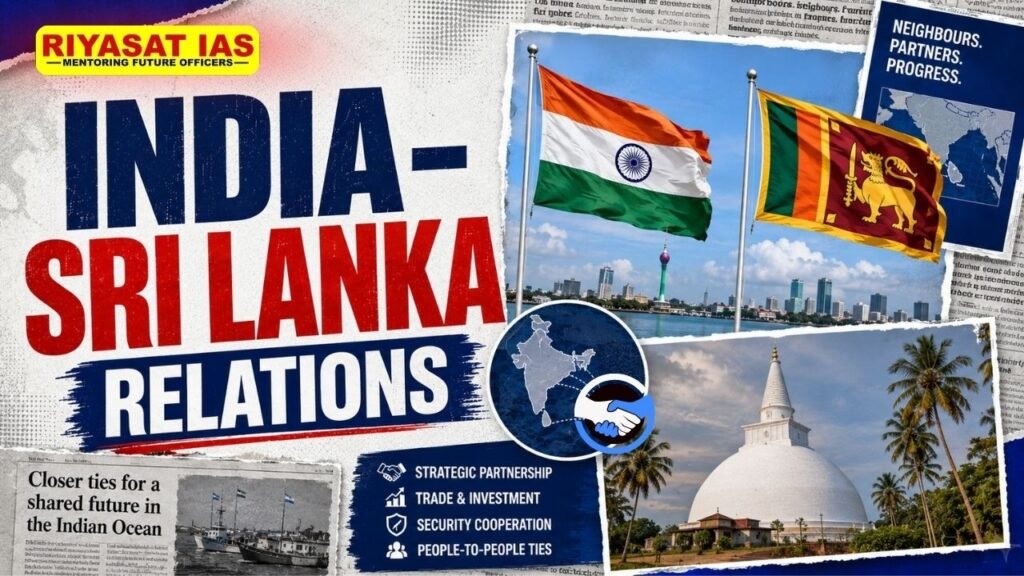
India and Sri Lanka share a civilisational, cultural and geographical relationship shaped by Buddhism, maritime links and close people-to-people contacts. In recent years, the relationship has expanded from traditional trade and development assistance to connectivity, energy, digital payments, maritime security and economic integration.
Commercial and Economic Relations
India is one of Sri Lanka’s largest trading partners. Bilateral merchandise trade reached US$5.54 billion in FY 2023–24, with Indian exports of US$4.11 billion and Sri Lankan exports of US$1.42 billion. India has also been a major investor in Sri Lanka, with cumulative Indian FDI of around US$2.25 billion up to 2023.
The two countries are also discussing the Economic and Technology Cooperation Agreement (ETCA) to expand trade in goods and services. Negotiations resumed in 2023 after a five-year gap, with the 14th round held in July 2024.
Recent Economic Developments
- UPI QR-based payments were launched in Sri Lanka in February 2024, strengthening digital economic connectivity.
- India and Sri Lanka are exploring energy connectivity, a multi-product petroleum pipeline and an Economic Land Corridor linking the two economies more closely.
- India has also supported Sri Lanka during its economic crisis and participated as Co-Chair of the Official Creditor Committee in the country’s debt-restructuring process.
Developmental Cooperation
· Development cooperation is an important pillar of India’s Sri Lanka policy and covers infrastructure, housing, health, education, agriculture, railways, energy and community development.
· India has extended more than USD 7 billion in credit lines and around USD 780 million in grants to support Sri Lanka’s development and infrastructure needs.
· During Sri Lanka’s 2022 economic crisis, India provided nearly USD 4 billion in financial and humanitarian assistance, helping the country meet its urgent economic and essential-import requirements.
· During the COVID-19 pandemic, India supported Sri Lanka by providing vaccines, medicines and other essential medical supplies.
· India’s assistance has increasingly focused on people-oriented and demand-driven projects, particularly in areas directly affecting livelihoods and social development.
Examples
- India has supported housing projects for vulnerable communities.
- India has assisted in railway and infrastructure development.
- India has supported agriculture, dairy development and education.
- India has provided assistance for the development of Point Pedro Fishing Harbour and rehabilitation of Karainagar Boatyard.
Connectivity and Energy Cooperation
Major Initiatives
- The Nagapattinam–Kankesanthurai passenger ferry service was resumed in 2024.
- Air connectivity between Chennai and Jaffna has continued.
- UPI payments have strengthened digital connectivity.
- India and Sri Lanka are discussing power-grid interconnection.
- A multi-product petroleum pipeline is being explored.
- India has provided a US$61.5 million grant for the development of Kankesanthurai Port.
Security and Maritime Cooperation
· Sri Lanka’s location in the Indian Ocean gives it major strategic importance for India’s maritime security.
· In June 2024, India and Sri Lanka commissioned the Maritime Rescue Coordination Centre (MRCC) in Colombo, strengthening maritime safety and coordination.



· In August 2025, the 8th High-Level Meeting between the Indian Coast Guard and Sri Lanka Coast Guard focused on maritime law enforcement, marine pollution response, search and rescue and capacity building.
· SLINEX (NAVY) and MITRA SHAKTI (ARMY), military exercise held alternately in both countries.
· India and Sri Lanka cooperate in Maritime surveillance and security, Counter-terrorism, Search and rescue, Humanitarian assistance and disaster relief, Defence training and exercises, Combating maritime crime.
Why India and Sri Lanka are important to each other:
- MAHASAGAR and Maritime Security: Sri Lanka occupies a strategically important position in the Indian Ocean and is therefore central to India’s MAHASAGAR (Mutual and Holistic Advancement for Security and Growth Across Regions) vision. Cooperation with Sri Lanka supports maritime security, safe sea lanes, capacity building and regional stability. The 2026 deployment of IOS SAGAR, including its port call at Colombo, is a recent example of this maritime cooperation.
- Hambantota Port and Strategic Location: Sri Lanka’s ports, particularly Hambantota, are strategically significant because of their location near major Indian Ocean shipping routes. For India, cooperation with Sri Lanka’s port infrastructure is important for maintaining a secure and open maritime environment and preventing developments that could adversely affect India’s strategic interests.
- Energy and Port Connectivity: India’s interest in Sri Lanka’s maritime infrastructure is also linked with emerging cooperation in energy connectivity, Trincomalee as a regional energy hub and maritime infrastructure, strengthening the broader India–Sri Lanka economic and strategic partnership.
- Civilisational and Cultural Linkages: Buddhism, Hinduism, Ramayana traditions and centuries-old maritime contacts provide a strong foundation for people-to-people relations.
- Fishermen and Coastal Livelihoods: Both countries share the Palk Bay marine ecosystem, making cooperation essential for protecting fishermen’s livelihoods while ensuring sustainable fisheries.
- Regional Stability: A peaceful and economically stable Sri Lanka supports India’s broader Neighbourhood First and SAGAR (Security and Growth for All in the Region) approaches.
Major Challenges in India–Sri Lanka Relations
· The fishermen issue remains one of the most sensitive aspects of India–Sri Lanka relations, particularly in the Palk Strait and Palk Bay. Indian fishermen, especially from Tamil Nadu, sometimes cross the International Maritime Boundary Line while fishing and are apprehended by Sri Lankan authorities.
· The two countries have established a Joint Working Group on Fisheries to address these concerns.
· The 6th meeting of the JWG was held in Colombo in October 2024, where the two sides reviewed issues concerning fishermen and fisheries.
· During Prime Minister Modi’s April 2025 visit to Sri Lanka, both sides agreed that fishermen’s concerns should be addressed in a humanitarian manner, while avoiding aggressive behaviour or violence. They also welcomed continued dialogue through the fisheries mechanism.
o Arrest and detention of fishermen.
o Seizure of fishing boats.
o Livelihood concerns of fishing communities.
o Use of bottom trawling, which Sri Lanka considers environmentally damaging.
o Ecological degradation of Palk Bay fisheries.
Why is the Fishermen Issue Difficult to Resolve?
o The problem cannot be addressed merely as a border-security issue because it involves livelihoods, traditional fishing rights and marine ecology.
o Tamil Nadu fishermen have historically operated in the Palk Bay, while Sri Lankan fishermen, particularly from the Northern Province, depend heavily on the same marine resources.
o Therefore, a sustainable solution requires Livelihood Protection, Ecological Sustainability, Maritime Law and Bilateral Cooperation.
- Katchatheevu and Maritime Boundary Concerns: The Katchatheevu issue continues to have political sensitivity in Tamil Nadu, particularly in the context of traditional fishing rights and access to fishing grounds.
- China’s Strategic Presence: China’s economic and strategic engagement in Sri Lanka, particularly around Hambantota Port, creates concerns for India regarding the possibility of increased Chinese strategic influence in India’s immediate maritime neighbourhood.
- Debt and Economic Vulnerability: Sri Lanka’s 2022 economic crisis highlighted its financial vulnerabilities and created concerns about the sustainability of major infrastructure and external-debt commitments, requiring India to balance development assistance with long-term economic cooperation.
- Tamil Ethnic Issue: The question of the political rights, rehabilitation and meaningful devolution of powers to Sri Lankan Tamils remains an important concern for India, particularly because of strong social and cultural linkages with Tamil Nadu.
- Port and Maritime Security: Sri Lanka’s strategic location near major Indian Ocean shipping routes means that developments involving Hambantota, Colombo and other ports have direct implications for India’s maritime-security interests.
- Political Instability and Domestic Politics: Changes in Sri Lanka’s domestic political landscape can influence its foreign-policy priorities, including its approach towards India, China and other external partners.
- Resource and Environmental Concerns: Competition over marine resources in the Palk Strait and Palk Bay, along with concerns over fishing practices and marine degradation, makes sustainable management essential.
Way Forward
· Shift from Arrest-Based Management to Cooperative Fisheries Management: India and Sri Lanka should strengthen joint fisheries management in the Palk Bay, including scientific assessment of fish stocks and coordinated conservation measures.
· Reduce Dependence on Bottom Trawling: India should accelerate the transition of affected fishermen towards deep-sea fishing, aquaculture and alternative livelihoods.
· Modernise Fishing Infrastructure: Infrastructure projects such as Point Pedro Fishing Harbour and Karainagar Boatyard, supported through Indian assistance, can help create sustainable fisheries opportunities in Sri Lanka.
· Strengthen Coast Guard Cooperation: The two countries should expand hotline mechanisms, coordinated patrolling, vessel tracking and rapid communication to prevent confrontations at sea.
· Strengthen Blue Economy Cooperation: India and Sri Lanka should cooperate in marine research, sustainable fisheries, marine pollution control, aquaculture and coastal economic development.
Recent Strategic Development – 2025
During Prime Minister Modi’s April 2025 state visit, India and Sri Lanka reaffirmed their commitment to a comprehensive partnership covering connectivity, development cooperation, economic relations, defence, reconciliation and fishermen issues. Sri Lanka also reiterated that its territory would not be used in a manner harmful to India’s security or regional stability.
This is important because it demonstrates India’s broader strategic objective Neighbourhood First, SAGAR and Indian Ocean Security.
FAQs
1. What is the significance of Sri Lanka for India?
Ans: Sri Lanka is strategically important because of its geographical proximity, Indian Ocean location, maritime routes, economic links and civilisational ties.
2. What is the current status of India–Sri Lanka trade?
Ans: Bilateral merchandise trade reached US$5.54 billion in FY 2023–24, with India remaining one of Sri Lanka’s largest trading partners.
3. What are the major areas of India’s development cooperation with Sri Lanka?
Ans: India’s cooperation covers housing, railways, health, education, agriculture, fisheries, infrastructure and community-development projects.
4. Why does the fishermen issue create tension between India and Sri Lanka?
Ans: The issue involves fishermen’s livelihoods, maritime-boundary violations, boat arrests and the ecological impact of bottom trawling in the Palk Bay.
5. How can the fishermen issue be resolved?
Ans: A sustainable solution requires joint fisheries management, reduced bottom trawling, alternative livelihoods, modern fishing infrastructure and stronger India–Sri Lanka maritime cooperation.




 Ravi Raaz
 Hassan Khan
 Shadab Ali