
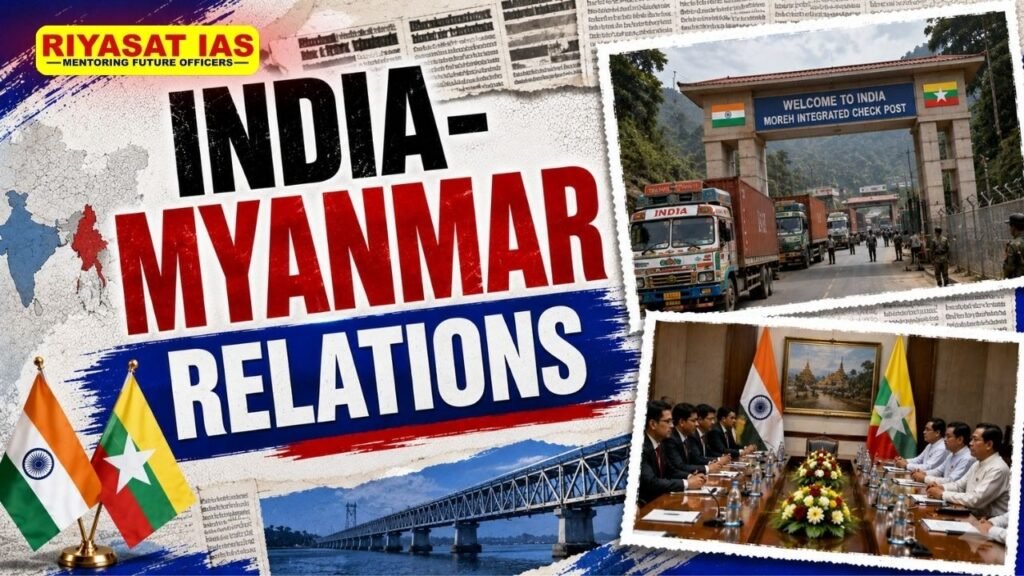
India–Myanmar relations are shaped by civilisational linkages, geographical contiguity, Northeast India’s security, Act East connectivity and Myanmar’s strategic location between South Asia and Southeast Asia. Myanmar is India’s only ASEAN country with which it shares a land border, making it indispensable for India’s eastern neighbourhood policy.
Historical Background
· India and Myanmar have centuries-old links through Buddhism, trade, migration and cultural exchanges. Myanmar’s proximity to India’s Northeast has historically facilitated movement of people, ideas and commerce.
· After Myanmar’s independence in 1948, India established diplomatic relations with the country and gradually developed cooperation in trade, development and security.
· India’s engagement became particularly important after the 1990s, when India moved from a predominantly pro-democracy-oriented approach towards greater pragmatic engagement with Myanmar’s military government, driven by the changing security environment and India’s Look East Policy.
· The relationship subsequently expanded into the present framework of Neighbourhood First + Act East + MAHASAGAR.
Geographical Equations
· Myanmar is strategically important because it connects India’s Northeast with Southeast Asia.
· India and Myanmar share a 1,643-km land border, running along Arunachal Pradesh, Nagaland, Manipur and Mizoram.
· Myanmar also provides India with access towards the Bay of Bengal and mainland Southeast Asia, making it important for both continental and maritime connectivity.
Strategic Geography
o Myanmar occupies a strategically important position between India and Southeast Asia, providing a land route from India through Myanmar and Thailand to the wider ASEAN region. It therefore acts as a crucial land bridge connecting India’s Northeast with Southeast Asia.
o For India, Myanmar is important for neighbourhood security, the development and connectivity of the Northeast, the implementation of the Act East Policy, access to ASEAN markets and India’s broader Bay of Bengal strategy.
Important Agreements and Institutional Mechanisms
India–Myanmar relations are not governed by one single comprehensive treaty comparable to India’s treaties with some other neighbours; rather, cooperation has developed through multiple agreements, MoUs and institutional mechanisms.
· 1951 Treaty of Friendship: The Treaty of Friendship between India and Burma established a formal framework for friendly relations between the two countries.
· Border Cooperation: The two countries have developed mechanisms for border demarcation, border trade and security cooperation.
· Border Trade Agreement: The India–Myanmar Border Trade Agreement, 1994 provided a framework for formalising border trade, particularly through designated trading points.
· Kaladan Framework: The Framework Agreement on the Kaladan Multi-Modal Transit Transport Project created the basis for India’s major connectivity project linking India’s eastern coast with the Northeast through Myanmar.
· Security Mechanisms: India and Myanmar maintain institutional mechanisms for cooperation against insurgency, narcotics trafficking, arms smuggling, human trafficking and other transnational crimes.
Why is Myanmar Important for India?
A. Gateway to Southeast Asia
o Myanmar is India’s geographical gateway to ASEAN and Southeast Asia.
o The country’s location makes it essential for India’s Act East Policy, particularly for integrating the Northeast with regional markets.
B. Northeast India’s Development
o Myanmar is directly connected to four Indian Northeastern states—Arunachal Pradesh, Nagaland, Manipur and Mizoram.
o Improved connectivity through Myanmar can transform the Northeast from a geographical periphery into a gateway to Southeast Asia.
C. Security and Insurgency
o Myanmar’s territory has historically been used by some Northeast insurgent groups for camps, movement and sanctuary.
o Therefore, cooperation with Myanmar is critical for preventing cross-border insurgency and militant movement.
D. Economic and Trade Interests
o Myanmar provides India with access to Southeast Asian markets and is an important source of commodities such as pulses, timber and agricultural products.
o According to the MEA Annual Report 2024, India–Myanmar bilateral trade stood at approximately US$1.74 billion in 2023–24, with India’s exports at around US$670 million. India was Myanmar’s 7th-largest trading partner.
E. Bay of Bengal and Indo-Pacific
o Myanmar’s coastline on the Bay of Bengal gives it significance for India’s maritime strategy, including SAGAR and MAHASAGAR.
o A stable Myanmar contributes to a more secure and connected Bay of Bengal region.
Major Areas of Cooperation
A. Connectivity Cooperation
Kaladan Multi-Modal Transit Transport Project
· The Kaladan Multi-Modal Transit Transport Project connects India’s eastern seaboard with Mizoram through Myanmar. It comprises maritime connectivity from Haldia to Sittwe, inland waterway connectivity from Sittwe to Paletwa, and road connectivity from Paletwa towards the India–Myanmar border, thereby creating the route Sittwe to Paletwa to Mizoram.



· The Sittwe–Paletwa waterway component was completed and inaugurated in May 2023. The remaining road component includes a 109-km two-lane highway from Paletwa to Zorinpui, Mizoram.
· Once fully operational, KMTTP will provide an alternative connectivity route to India’s Northeast, reducing dependence on the narrow Siliguri Corridor for certain trade flows.
B. India–Myanmar–Thailand Trilateral Highway
· The proposed India–Myanmar–Thailand Trilateral Highway seeks to connect Moreh in Manipur with Mae Sot in Thailand through Myanmar, thereby strengthening India’s connectivity with Southeast Asia.
· It is one of India’s flagship Act East connectivity projects.
· The project can eventually facilitate trade, tourism and movement of goods and people between India and Southeast Asia.
C. Trade and Investment
India’s development cooperation portfolio in Myanmar is approximately US$2 billion, with most projects undertaken through grants. India has also supported:
- Industrial Training Centres.
- Myanmar Institute of Information Technology.
- Agricultural research and education.
- Border-area development.
- Rakhine State development.
- Heritage conservation.
D. Defence and Security Cooperation
· Security cooperation between India and Myanmar focuses on counter-insurgency, intelligence sharing, border management, counter-terrorism and narcotics control, with both countries maintaining military-to-military interactions and coordinating efforts against insurgent groups operating along the border.
· The 23rd India–Myanmar National Level Meeting, held in New Delhi in July 2026, further strengthened cooperation against terrorism, insurgency, narcotics trafficking, arms smuggling, human trafficking, wildlife trafficking, cybercrime and organised crime.
· Both sides agreed to strengthen intelligence sharing, operational coordination and capacity building. Myanmar also assured that its territory would not be allowed to be used against India’s security interests.
Recent Policy Changes in India’s Approach
· India’s approach towards Myanmar has evolved from democracy-centric engagement to pragmatic, interest-based engagement, particularly after the military takeover in 2021.
· India therefore seeks to balance its security interests, humanitarian concerns and strategic engagement in its approach towards Myanmar.
· Post-2021 Approach: India has maintained communication with Myanmar’s authorities while continuing to support humanitarian assistance, a Myanmar-owned and Myanmar-led political process, border security, development projects and connectivity initiatives.
· Operation Brahma: Following the 28 March 2025 earthquake in Myanmar, India launched Operation Brahma, a major humanitarian assistance and disaster relief (HADR) operation to provide immediate relief and medical support. Under the operation, India deployed Indian Navy ships, NDRF search-and-rescue teams and Indian Army medical teams, along with field hospitals and essential humanitarian supplies.
· By mid-April 2025, India had provided approximately 750 tonnes of humanitarian assistance, while an Indian field hospital treated more than 2,500 patients.
· This strengthened India’s image as a First Responder in the neighbourhood.
India’s Current Three-Pronged Approach
1. Neighbourhood First: Myanmar’s stability directly affects India’s Northeast and border security.
2. Act East: Myanmar provides India’s land bridge to ASEAN and Southeast Asia.
3. MAHASAGAR: Myanmar’s Bay of Bengal location makes it important for India’s broader vision of security, connectivity and growth across the Indian Ocean and adjoining regions.
China Factor in India–Myanmar Relations
· China is a major strategic factor in Myanmar because it has significant economic, infrastructure and strategic interests in the country, including projects under the broader China–Myanmar Economic Corridor (CMEC).
· Myanmar’s geographical location gives China potential access to the Bay of Bengal, thereby providing Beijing with greater strategic depth beyond the Malacca Strait. China’s involvement includes investments in the Kyaukphyu deep-sea port, oil and gas pipelines connecting Myanmar with Yunnan, and various economic and infrastructure projects.
· This creates a strategic challenge for India because greater Chinese access to the Bay of Bengal could increase China’s maritime and economic presence in India’s immediate strategic neighbourhood.
· However, India should avoid viewing Myanmar solely through the lens of China containment. Instead, India should strengthen its own strategic attractiveness by ensuring faster project implementation, deeper development partnerships, stronger connectivity, greater capacity building and enhanced security cooperation with Myanmar.
Major Challenges
Northeast Insurgency
· This is perhaps the most immediate security challenge. Myanmar’s difficult terrain and porous border can facilitate movement of insurgent groups, weapons and narcotics. The presence of militant networks in border areas makes effective cooperation with Myanmar essential.
o For example: The 2026 India–Myanmar National Level Meeting specifically discussed insurgency, arms smuggling and terrorism, showing that this remains a current bilateral priority.
FMR and Border Management
· The traditional Free Movement Regime (FMR) allowed members of recognised hill tribes living within 16 km on either side of the border to cross with a border pass.
· India decided in February 2024 to scrap the FMR, citing concerns related to internal security and demographic changes in the Northeastern states.
o The border is not merely a security boundary; communities on both sides have ethnic, familial and cultural ties.
o Therefore, Security of border is not complete restriction of traditional cross-border communities India needs a balanced border-management system.
Border Fencing
o India has moved towards greater physical and technological surveillance of the Myanmar border.
o According to MHA data presented to Parliament in December 2025, the India–Myanmar border is 1,643 km, and 9.214 km of physical fencing had been completed at that stage.
o The challenge is to combine fencing with roads, surveillance technology, border posts and legitimate local movement.
Myanmar’s Internal Conflict
· The prolonged conflict between the military and various ethnic armed organisations has created an unstable security environment.This affects:
o Indian infrastructure projects.
o Border security.
o Trade.
o Refugee flows.
o Connectivity projects.
· India therefore needs a flexible policy that can work with multiple stakeholders while respecting Myanmar’s sovereignty
Refugee Inflows
· Political and ethnic violence in Myanmar has resulted in movements of people towards India’s Northeast.
· The influx of refugees creates challenges related to humanitarian protection, internal security, demographic pressures and the availability of local resources, particularly in Mizoram and Manipur, where strong ethnic and cultural linkages exist across the India–Myanmar border.
Way Forward
· Strengthen Border Security through Smart Management: India should adopt a smart and integrated border-management approach by combining fencing with drones, surveillance technologies, border roads, Border Out Posts and intelligence sharing, rather than relying solely on physical barriers. The objective should be to secure the border while facilitating legitimate movement and protecting the interests of local communities.
· Deepen Counter-Insurgency Cooperation: India should strengthen intelligence sharing and coordinated security operations with Myanmar to counter insurgent groups, arms smuggling, narcotics trafficking and human trafficking. The 23rd India–Myanmar National Level Meeting held in July 2026 provides an important institutional framework for strengthening such cooperation.
· Complete Connectivity Projects on Mission Mode: India should prioritise the timely completion of its major connectivity projects with Myanmar. Under the Kaladan Multi-Modal Transit Transport Project (KMTTP), the waterway component is operational, while the Paletwa–Zorinpui road component needs to be completed to make the entire corridor fully functional.
o Similarly, the India–Myanmar–Thailand Trilateral Highway should be completed and supported by an effective motor-vehicle and transit framework, so that physical connectivity can translate into actual trade and movement of people.
· Make the Northeast a Gateway, Not a Frontier: India should transform the Northeast into a gateway to Southeast Asia by developing border haats, Integrated Check Posts, logistics parks, warehousing facilities, tourism and manufacturing. Such measures can convert India’s geographical proximity to Myanmar into economic opportunities and employment for Northeastern states.
· Continue Humanitarian Diplomacy: Operation Brahma demonstrated India’s capacity to act as a first responder in the neighbourhood during the 2025 Myanmar earthquake. India should continue providing humanitarian assistance while also helping Myanmar strengthen its own disaster-management and reconstruction capabilities.
· Maintain Calibrated Political Engagement: India should maintain engagement with Myanmar’s authorities while supporting a Myanmar-owned, Myanmar-led and inclusive political process. During the April 2025 BIMSTEC Summit, India emphasised that Myanmar’s conflict has no military solution and that sustainable peace requires inclusive dialogue. This reflects India’s attempt to balance pragmatic engagement with democratic and humanitarian concerns.
· Engage ASEAN and Regional Partners: India should use platforms such as BIMSTEC, ASEAN-related mechanisms and other sub-regional frameworks to integrate Myanmar more closely with regional connectivity and economic networks. Such engagement can strengthen regional interdependence and reduce the possibility of Myanmar becoming excessively dependent on any single external power.
· Compete with China through Delivery, Not Rhetoric: India’s most effective response to China’s growing presence in Myanmar should be based on faster project implementation, better infrastructure, local employment opportunities, transparent financing and stronger development partnerships. With India’s development cooperation portfolio in Myanmar amounting to approximately US$2 billion, India already has a substantial foundation on which to build a more effective and credible partnership.
Conclusion
“For India, Myanmar is not merely a neighbouring country; it is the bridge between India’s Northeast and Southeast Asia. India’s challenge is therefore to secure the border without alienating border communities, engage Myanmar without compromising democratic values, and compete with China through credible connectivity and development delivery.”
FAQs
1. Why is Myanmar strategically important for India?
Ans: Myanmar is India’s land bridge to Southeast Asia, shares a 1,643-km border with India and is crucial for Northeast security, Act East connectivity and Bay of Bengal strategy.
2. What are India’s major connectivity projects with Myanmar?
Ans: The two flagship projects are the Kaladan Multi-Modal Transit Transport Project and the India–Myanmar–Thailand Trilateral Highway.
3. Why did India change the Free Movement Regime with Myanmar?
Ans: India decided to scrap the FMR in 2024, citing concerns regarding internal security and demographic changes in Northeastern states.
4. How does China’s presence in Myanmar affect India?
Ans: China’s infrastructure and strategic presence, including projects around Kyaukphyu, can increase Chinese influence in India’s immediate eastern maritime neighbourhood and create connectivity competition.
5. What is the current thrust of India–Myanmar relations?
Ans: The current focus is on border security, counter-insurgency, connectivity, development cooperation, humanitarian assistance and regional integration, with Myanmar positioned within India’s Neighbourhood First, Act East and MAHASAGAR frameworks.





 Ravi Raaz
 Hassan Khan
 Shadab Ali