
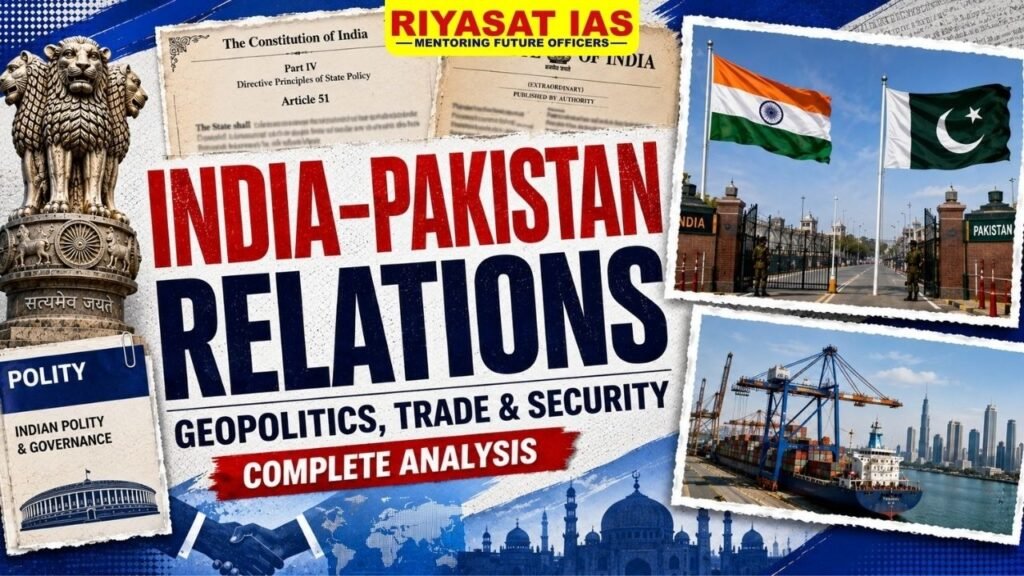
India–Pakistan relations are shaped by a combination of shared history, cultural linkages and people-to-people connections on the one hand, and terrorism, territorial disputes, strategic rivalry and mutual distrust on the other. Since 1947, wars, cross-border terrorism and the Kashmir dispute have repeatedly interrupted attempts to establish stable bilateral relations.
· India’s contemporary approach places national security and the prevention of cross-border terrorism at the centre of bilateral engagement, while maintaining limited humanitarian, religious and crisis-management channels.
Background of India–Pakistan Relations
· India and Pakistan became independent in August 1947 following the Partition of British India. Partition resulted in large-scale displacement and communal violence, creating a difficult foundation for the bilateral relationship.
· The accession of Jammu and Kashmir to India in 1947 was followed by the first India–Pakistan war, making Kashmir the principal territorial and political dispute between the two countries.
· Despite repeated conflicts, both countries have maintained certain institutional mechanisms for cooperation, including the Indus Waters Treaty, diplomatic channels, military communication mechanisms and arrangements for religious pilgrimages.
India–Pakistan Relations: key Timeline
· 1947–48: First India–Pakistan War: The accession of Jammu and Kashmir to India was followed by armed conflict between India and Pakistan. A UN-backed ceasefire came into effect in 1949, establishing the basis for the subsequent ceasefire line.
· 1965: Second India–Pakistan War: India and Pakistan fought another major war, with Jammu and Kashmir remaining a central issue. The conflict ended with the Tashkent Agreement of 1966.
· 1971: Bangladesh Liberation War: The 1971 conflict resulted in the creation of Bangladesh and fundamentally altered the strategic balance in South Asia.
· 1972: Shimla Agreement: India and Pakistan signed the Shimla Agreement in July 1972, under which both sides committed themselves to resolving differences through peaceful means and bilateral negotiations and agreed to respect the Line of Control without attempting to alter it unilaterally.
· 1984: Siachen Conflict: India launched Operation Meghdoot in 1984 and established control over strategically important positions in the Siachen Glacier region.
· 1999: Kargil War: Pakistani forces and infiltrators occupied strategic positions on the Indian side of the Line of Control, leading to the Kargil conflict. India subsequently regained the occupied positions.
· 1999: Lahore Declaration: The Lahore Declaration sought to strengthen confidence-building measures and reduce risks associated with the nuclear capabilities of both countries.
· 2001: Parliament Attack: The terrorist attack on the Indian Parliament resulted in a prolonged military mobilisation between India and Pakistan and severely damaged bilateral confidence.
· 2008: Mumbai Terror Attacks: The Mumbai attacks further weakened the bilateral dialogue process and intensified India’s concerns regarding terrorism originating from Pakistan.
· 2016: Uri Attack and Surgical Strikes: The 2016 Uri terrorist attack prompted India to conduct surgical strikes across the Line of Control targeting terrorist launch pads, marking a significant shift towards a more proactive and calibrated counter-terrorism approach.
· 2019: Pulwama Attack and Balakot Air Strike: The Pulwama terrorist attack was followed by India’s Balakot air strike on 26 February 2019, targeting a Jaish-e-Mohammed training facility in Pakistan.
· 2019: Constitutional Changes in Jammu and Kashmir: On 5 August 2019, India undertook constitutional and administrative changes relating to Jammu and Kashmir and subsequently reorganised the former state into the Union Territories of Jammu and Kashmir and Ladakh.
· 2019: Kartarpur Corridor: India and Pakistan concluded an agreement facilitating pilgrimage to Gurdwara Darbar Sahib at Kartarpur, providing an important channel for religious and people-to-people engagement.
· 2021: LoC Ceasefire Understanding: On 25 February 2021, the Directors General of Military Operations of India and Pakistan agreed to strictly observe the existing ceasefire arrangements along the Line of Control and other sectors.
· 2025: Pahalgam Terror Attack and Operation Sindoor: The terrorist attack at Pahalgam on 22 April 2025, in which 26 civilians were killed, was followed by India’s Operation Sindoor on 7 May 2025. India targeted nine terrorist sites in Pakistan and Pakistan-occupied Jammu and Kashmir.
Major Conflict Zones
A. Jammu and Kashmir: Jammu and Kashmir remains the principal territorial and security dispute between India and Pakistan. India maintains that Jammu and Kashmir is an integral part of India, while Pakistan continues to contest India’s position.
o The region has also been affected by cross-border terrorism, infiltration and periodic ceasefire violations.
B. Line of Control: The Line of Control separates the areas administered by India and Pakistan in Jammu and Kashmir. The Shimla Agreement provides the bilateral framework for respecting the LoC and resolving differences peacefully.
C. Siachen Glacier: The Siachen region is strategically important because of its location near the India-Pakistan-China tri-junction area. The military deployment in this extremely high-altitude region imposes significant human, logistical and financial costs.
D. Sir Creek: The Sir Creek dispute concerns the maritime boundary between Gujarat and Sindh. Its resolution has implications for maritime jurisdiction, fishing rights and access to potential offshore resources.
Cross-Border Terrorism
o Cross-border terrorism remains India’s most serious concern in its relations with Pakistan. India has repeatedly raised the issue of terrorist groups and infrastructure operating from Pakistani territory.
o Major terrorist attacks that have shaped bilateral relations include the 2001 Parliament attack, 2008 Mumbai attacks, 2016 Uri attack, 2019 Pulwama attack and 2025 Pahalgam attack.
o India’s response has progressively moved towards more proactive and calibrated counter-terrorism measures, including the 2016 surgical strikes, 2019 Balakot air strike and 2025 Operation Sindoor. Official government material describes this as an evolution towards swift, precise and proportionate responses to cross-border terrorism.
Water Dispute: Indus Waters Treaty
o The Indus Waters Treaty was signed on 19 September 1960, with the World Bank playing an important role in facilitating the agreement.
o The treaty allocated the eastern rivers—Ravi, Beas and Sutlej—primarily to India, while the western rivers—Indus, Jhelum and Chenab—were primarily allocated to Pakistan, subject to specified rights and restrictions provided to India under the treaty.
o The treaty survived several wars and prolonged periods of political hostility, making it one of the most important examples of institutionalised water cooperation between India and Pakistan.
o India placed the Indus Waters Treaty in abeyance with immediate effect after the 22 April 2025 Pahalgam terrorist attack, stating that it would remain suspended until Pakistan credibly and irrevocably ends its support for cross-border terrorism.
Trade and Commerce
· Economic relations between India and Pakistan remain significantly below their potential because of political tensions, security concerns and restrictions imposed by both sides.
· Pakistan unilaterally suspended bilateral trade with India in August 2019. The Ministry of Commerce has stated that India desires normal relations, including trade, with all countries, but Pakistan would need to review the unilateral measures it imposed on trade.



· The absence of strong economic interdependence has reduced the possibility of trade acting as a stabilising force in bilateral relations.
Major Constraints on Trade
o Political and security tensions have significantly restricted commercial engagement.
o Cross-border connectivity remains limited.
o Banking and financial linkages remain weak.
o Trade restrictions and non-tariff barriers constrain bilateral commerce.
o The absence of sustained political trust prevents long-term economic integration.
Areas of Cooperation
A. Indus Waters Treaty: The treaty created a permanent institutional framework for the management of the Indus river system and historically remained operational despite wars and political crises.
B. Military Communication: India and Pakistan maintain mechanisms such as the DGMO hotline and border flag meetings, which can help prevent misunderstandings and manage military tensions. The 2021 ceasefire understanding demonstrated the importance of such communication channels in reducing violence along the LoC.
C. Religious Pilgrimage: Both countries facilitate religious visits under bilateral arrangements, including pilgrimages to Sikh, Hindu and other religious sites.
D. Humanitarian Cooperation: The two countries continue to address humanitarian issues involving fishermen, prisoners, detainees and religious pilgrims, even when broader diplomatic relations remain strained.
Cultural and Sports Exchanges
o India and Pakistan share significant cultural, linguistic, artistic and sporting connections. Cricket, in particular, has historically served as an important channel of people-to-people interaction and sports diplomacy.
o However, bilateral sporting and cultural exchanges have been restricted during periods of heightened security tensions.
Religious Tourism
· Religious connections represent one of the most important remaining areas of people-to-people engagement.
Kartarpur Corridor
o The Kartarpur Corridor enables Indian pilgrims to visit Gurdwara Darbar Sahib in Kartarpur, one of the most significant Sikh religious sites associated with Guru Nanak.
o The corridor demonstrates how religious heritage and humanitarian considerations can create limited spaces for cooperation even when political relations remain difficult.
o Following the escalation in May 2025, the Kartarpur Sahib Corridor was suspended until further directions in view of the prevailing security situation. This illustrates how even humanitarian and religious channels can be affected by bilateral security crises.
Regional Cooperation
o India and Pakistan are both members of SAARC, but bilateral tensions have significantly weakened the organisation’s ability to promote regional integration.
o The India-Pakistan rivalry has therefore contributed to a broader regional cooperation deficit in South Asia, particularly in areas such as trade, connectivity and energy cooperation.
o India has increasingly focused on other regional frameworks such as BIMSTEC, where Pakistan is not a member.
India–Pakistan Trade Agreement
o It is important to avoid describing India and Pakistan as having a comprehensive bilateral free-trade agreement.
o Their trade historically operated through the SAFTA framework and other trade arrangements, but political tensions have severely restricted bilateral commerce. The Ministry of Commerce has stated that there was no bilateral trade agreement and that trade was primarily governed through SAFTA.
o Pakistan’s unilateral suspension of bilateral trade in August 2019 further weakened economic engagement.
Pulwama Attack and Balakot Air Strike
o On 14 February 2019, a suicide attack targeting a CRPF convoy at Pulwama killed 40 CRPF personnel.
o India responded on 26 February 2019 with a precision air strike against a major Jaish-e-Mohammed training facility at Balakot, Pakistan. Official government material describes the operation as an important evolution in India’s counter-terrorism doctrine, demonstrating India’s willingness to undertake pre-emptive action against terrorist infrastructure.
Revocation of Article 370
o On 5 August 2019, India undertook constitutional changes relating to Jammu and Kashmir and subsequently reorganised the former state into the Union Territories of Jammu and Kashmir and Ladakh.
o India has consistently maintained that these measures concern India’s internal constitutional and administrative arrangements.
o Pakistan strongly opposed the decision, and the issue became another major source of bilateral diplomatic tension.
Kartarpur Corridor
o India and Pakistan signed the Kartarpur Corridor Agreement in October 2019, facilitating pilgrimage to Gurdwara Darbar Sahib, Kartarpur.
o The corridor was inaugurated in November 2019 and created a dedicated mechanism for Indian pilgrims to visit the important Sikh shrine.
o The initiative demonstrated that religious diplomacy can provide limited avenues for cooperation even in a difficult bilateral relationship.
India–Pakistan Ceasefire Agreement – 2021
o On 25 February 2021, the DGMOs of India and Pakistan agreed to strictly observe all existing agreements and ceasefire arrangements along the LoC and other sectors, effective from midnight of 24–25 February 2021.
o The understanding contributed to a significant reduction in firing and civilian casualties along the LoC.
o Significance: The 2021 ceasefire demonstrates that military-to-military communication and crisis-management mechanisms can reduce escalation even when political relations remain strained.
o However, the underlying issue of cross-border terrorism remained unresolved.
Pahalgam Terror Attack – 2025
o On 22 April 2025, terrorists attacked civilians in Pahalgam, Jammu and Kashmir, killing 26 people, including 25 Indians and one Nepali citizen.
o The attack marked a major deterioration in India-Pakistan relations.
o India subsequently announced several measures, including placing the Indus Waters Treaty in abeyance, closing the Attari Integrated Check Post and taking diplomatic measures against Pakistan.
Operation Sindoor – 2025
o India launched Operation Sindoor on 7 May 2025 in response to the Pahalgam terrorist attack.
o The Indian Armed Forces targeted nine terrorist sites in Pakistan and Pakistan-occupied Jammu and Kashmir. The Ministry of Defence described the action as focused, measured and non-escalatory, and stated that Pakistani military facilities were not targeted in the initial strikes.
o The operation represented an important development in India’s counter-terrorism approach because India targeted terrorist infrastructure beyond the immediate Line of Control.
o Official government material subsequently described Operation Sindoor as an intelligence-led and calibrated response involving precision weapons, drones, loitering munitions and layered air-defence systems.
o Strategic Significance: Operation Sindoor demonstrated India’s increasing emphasis on swift, precise and proportionate responses to cross-border terrorism, while attempting to control the risk of wider military escalation.
Present Nature of India–Pakistan Relations
· India–Pakistan relations remain characterised by high strategic distrust, limited diplomatic engagement and a strong security-centric approach.
· Following the Pahalgam attack and Operation Sindoor, India’s position has emphasised that meaningful engagement cannot be separated from the issue of terrorism.
· At the same time, maintaining crisis-management mechanisms, military communication and humanitarian channels remains important because both countries are nuclear-armed states.
Treaties & Agreements between India and Pakistan
1. Karachi Agreement, 1949
- The Karachi Agreement of 1949 established the Ceasefire Line in Jammu and Kashmir under UN supervision after the first India–Pakistan war.
- It provided a framework for separating the military forces of India and Pakistan in Jammu and Kashmir.
2. Liaquat–Nehru Pact, 1950
- The Liaquat–Nehru Pact was signed to address the protection of minorities in India and Pakistan following the communal tensions and displacement associated with Partition.
- Both countries committed themselves to ensuring equality of citizenship, freedom of movement and protection of minority rights.
3. Indus Waters Treaty, 1960
- The Indus Waters Treaty was signed in 1960 with the World Bank as a facilitator to establish a framework for sharing the waters of the Indus river system.
- The eastern rivers—Ravi, Beas and Sutlej—were primarily allocated to India, while the western rivers—Indus, Jhelum and Chenab—were primarily allocated to Pakistan, subject to specified rights under the treaty.
4. Tashkent Declaration, 1966
- The Tashkent Declaration was signed after the 1965 India–Pakistan War with Soviet mediation.
- Both countries agreed to withdraw their forces to pre-war positions, restore diplomatic relations and pursue peaceful resolution of disputes.
5. Shimla Agreement, 1972
- The Shimla Agreement was signed after the 1971 India–Pakistan War and established bilateralism as a key principle for resolving outstanding issues.
- Both countries agreed to resolve differences through peaceful means and bilateral negotiations and to respect the Line of Control.
6. Non-Nuclear Aggression Agreement, 1988
- The Agreement on the Prohibition of Attacks against Nuclear Installations and Facilities was signed in 1988 and entered into force in 1991.
- It requires both countries to refrain from undertaking, encouraging or participating in attacks against each other’s nuclear installations and facilities.
- The two countries also exchange lists of their nuclear installations annually.
7. Lahore Declaration, 1999
- The Lahore Declaration was adopted following the 1998 nuclear tests by India and Pakistan.
- It aimed to strengthen nuclear risk-reduction measures, confidence-building and peaceful dialogue between the two countries.
8. Kartarpur Corridor Agreement, 2019
- The Kartarpur Corridor Agreement facilitates pilgrimage by Indian pilgrims to Gurdwara Darbar Sahib, Kartarpur, Pakistan.
- The corridor represents an important example of religious diplomacy and people-to-people engagement despite broader political tensions.
Major Challenges
· Cross-Border Terrorism: The continued threat from terrorist organisations and cross-border infiltration remains India’s principal security concern. Repeated terrorist attacks have prevented the establishment of sustained political trust.
· Jammu and Kashmir Dispute: The Kashmir issue continues to influence almost every aspect of India-Pakistan relations and remains closely connected with the LoC, terrorism and competing territorial claims.
· Nuclear Deterrence and Escalation: The presence of nuclear weapons creates a deterrence relationship but also produces a stability–instability paradox, in which the fear of full-scale war can coexist with the possibility of limited conventional or proxy conflict.
· Water Security: The Indus river system is critical for both countries. India’s decision to hold the Indus Waters Treaty in abeyance after the Pahalgam attack has introduced a new and sensitive dimension to the relationship.
· Weak Economic Interdependence: Limited bilateral trade means that there are relatively few economic constituencies with a strong interest in maintaining peaceful relations.
· China–Pakistan Strategic Partnership: Growing strategic cooperation between China and Pakistan, including the China-Pakistan Economic Corridor, adds another layer to India’s security calculations.
· Deep Trust Deficit: Repeated wars, terrorist attacks, diplomatic breakdowns and hostile political narratives have created a deep-rooted lack of trust between the two countries.
Way Forward
· Adopt a Zero-Tolerance Approach towards Terrorism: India should continue to demand credible, verifiable and irreversible action against terrorist infrastructure and organisations before considering comprehensive normalisation of relations.
· Preserve Crisis-Management Mechanisms: Even during periods of severe political tension, India and Pakistan should maintain DGMO hotlines, border flag meetings and other military communication channels to prevent accidental escalation. The 2021 ceasefire understanding demonstrates the value of such mechanisms.
· Prevent Nuclear Escalation: Both countries should strengthen communication and confidence-building mechanisms that reduce the possibility of miscalculation, accidental escalation and uncontrolled military confrontation.
· Keep Humanitarian Channels Separate from Political Disputes: Issues concerning fishermen, prisoners, detainees and religious pilgrims should continue to receive humanitarian consideration even during periods of political tension.
· Preserve Religious and Cultural Diplomacy: Initiatives such as the Kartarpur Corridor demonstrate that limited people-to-people engagement remains possible despite political differences. Such channels should be protected whenever security conditions permit.
· Manage Water Issues through Institutions: India’s current position on the Indus Waters Treaty must be understood in the context of national-security concerns following the Pahalgam attack. At the same time, long-term water security requires scientific water management, institutional dialogue and careful consideration of international obligations.
· Restore Economic Engagement When Conditions Improve: If the security environment improves, India and Pakistan could gradually explore limited trade in essential commodities, humanitarian goods and other mutually beneficial sectors. Economic engagement could eventually create constituencies favouring stability.
· Strengthen Regional Alternatives: India should continue strengthening BIMSTEC, BBIN, Indian Ocean cooperation and other regional platforms so that South Asian connectivity and economic integration do not remain completely dependent on India-Pakistan relations.
Conclusion:
“A durable peace between India and Pakistan cannot be achieved through dialogue alone or deterrence alone. It requires credible action against terrorism, effective crisis-management mechanisms, preservation of humanitarian channels and, when conditions become conducive, gradual economic and peopleto-people engagement.”
FAQs
1. What are the major issues affecting India–Pakistan relations?
The principal issues include cross-border terrorism, Jammu and Kashmir, the Line of Control, Siachen, Sir Creek, water-related concerns, strategic rivalry and weak economic relations.
2. What was the significance of the 2021 India–Pakistan ceasefire understanding?
The February 2021 understanding between the two DGMOs strengthened observance of the ceasefire along the LoC and other sectors, thereby reducing border violence and creating a limited space for stability.
3. What was Operation Sindoor?
Operation Sindoor was India’s 7 May 2025 military response to the Pahalgam terrorist attack, during which Indian forces targeted nine terrorist sites in Pakistan and Pakistan-occupied Jammu and Kashmir.
4. What happened to the Indus Waters Treaty after the Pahalgam attack?
India announced in April 2025 that the Indus Waters Treaty would be held in abeyance until Pakistan credibly and irrevocably abjures support for cross-border terrorism.
5. What should be India’s long-term approach towards Pakistan?
India should combine credible counter-terrorism deterrence with crisis management, humanitarian engagement and calibrated economic and people-to-people interaction whenever the security environment becomes conducive to such engagement.




 Ravi Raaz
 Hassan Khan
 Shadab Ali