
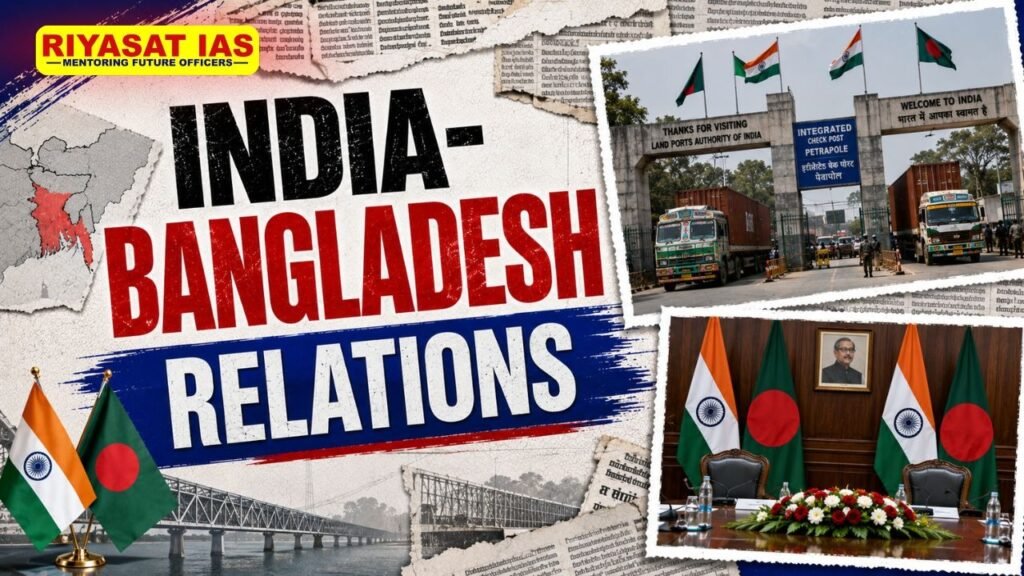
India and Bangladesh share a deeply interdependent relationship based on history, language, culture, geography and the shared experience of the 1971 Liberation War. In recent years, the relationship has expanded into connectivity, trade, energy, security and development cooperation, although political changes in Bangladesh since 2024 have introduced new sensitivities.
Background of Relations
India played a decisive role in supporting Bangladesh during the 1971 Liberation War, which laid the foundation for modern bilateral relations. The two countries share extensive linguistic, cultural and civilisational linkages, particularly in the Bengal region.
Geography further strengthens their interdependence: Bangladesh shares a 4,096-km international border with India through West Bengal, Assam, Meghalaya, Tripura and Mizoram., while the two countries also share 54 transboundary rivers.
Recent Context (2024–26)
- Sheikh Hasina’s government was replaced following major political upheaval in August 2024, after which an interim government under Muhammad Yunus assumed office.
- This political transition introduced new sensitivities in India–Bangladesh relations, particularly concerning border management, minority-related concerns, trade and political trust.
- India has nevertheless maintained diplomatic engagement and continued to emphasise constructive and mutually beneficial relations.
- In April 2026, India appointed Dinesh Trivedi as its next High Commissioner to Bangladesh, indicating continued diplomatic engagement.
India’s Development Partnership with Bangladesh
· Development partnership is a major pillar of bilateral relations. India has supported Bangladesh through Lines of Credit, grants, infrastructure projects, capacity building and community-development initiatives.
· India has extended US$7.862 billion in Lines of Credit to Bangladesh, according to the MEA’s latest available LOC data, making Bangladesh the largest recipient of India’s concessional development financing.
Major Areas
o India has supported projects involving roads, railways, ports, shipping and other infrastructure.
o The Akhaura–Agartala railway link has strengthened connectivity between Bangladesh and India’s Northeast.
o India has supported skill development, education, healthcare and community projects.
o Bangladesh participates significantly in India’s ITEC capacity-building programme.
Trade and Economic Cooperation
· Bangladesh is India’s largest trading partner in South Asia, while India is one of Bangladesh’s major trading partners.
· According to the MEA’s bilateral brief, bilateral trade was around US$15.9 billion in FY 2022–23, with Bangladesh exporting approximately US$2 billion worth of goods to India.
· However, the relationship has also been marked by a significant trade imbalance in India’s favour, which remains a concern from Bangladesh’s perspective.
· In May 2025, India imposed port restrictions on certain imports from Bangladesh, including ready-made garments and selected processed food, cotton and plastic products through specified land ports. The restrictions did not apply to goods merely transiting India for Nepal and Bhutan.
· The Land Port Management System (VINIMAY), launched in June 2026, aims to integrate land-port operations, reduce paperwork and cargo dwell time, and improve the ease of doing business across the India-Bangladesh border.
Connectivity Cooperation
· Bangladesh is strategically important for India because it can provide the shortest and most efficient connectivity routes between mainland India and the Northeastern Region.
· Bangladesh can therefore serve as a strategic bridge connecting mainland India with the Northeast, the Bay of Bengal and Southeast Asia, thereby supporting India’s Act East Policy, Neighbourhood First Policy and broader Indo-Pacific vision.
Major Connectivity Initiatives
o The Akhaura–Agartala cross-border railway link has strengthened India–Bangladesh and Northeast connectivity.
o Chattogram and Mongla ports provide transit opportunities for movement of goods to and from India’s Northeast.
o Cooperation through Inland Water Transit and Trade provides an alternative to road-based transportation.
o Restoration of pre-1965 rail links has strengthened cross-border connectivity.



Power and Energy Cooperation
· Energy cooperation has emerged as an important pillar of bilateral relations.
· Bangladesh has been importing electricity from India, while India and Bangladesh have developed cross-border transmission infrastructure.
Major Initiatives
o Bangladesh has been importing approximately 1,160 MW of electricity from India under established bilateral arrangements.
o The 1320 MW Maitree Super Thermal Power Plant has become operational.
o The India-Bangladesh Friendship Pipeline provides a dedicated mechanism for transporting High-Speed Diesel from India to Bangladesh, with a capacity of 1 million metric tonnes per annum.
o A major development in regional energy cooperation was the first electricity export from Nepal to Bangladesh through the Indian grid, demonstrating the potential for sub-regional energy integration.
Security and Counter-Terrorism Cooperation
· The 4,096-km India-Bangladesh border makes coordinated border management essential.
· India also extended a US$500 million defence Line of Credit to Bangladesh for defence equipment, reflecting the growing defence dimension of bilateral relations. Security cooperation has improved substantially over the years. The two countries cooperate in:
o Counter-terrorism and intelligence sharing.
o Border management.
o Combating drug trafficking and human trafficking.
o Preventing cross-border crime.
o Security cooperation between defence forces.
Land Boundary Agreement
· The India-Bangladesh Land Boundary Agreement (LBA) and its 2011 Protocol were landmark achievements in bilateral diplomacy. The agreement addressed:
o Enclaves.
o Adverse possessions.
o Boundary demarcation.
o Humanitarian problems affecting residents of disputed territories.
Water Cooperation
India and Bangladesh share 54 transboundary rivers, making water management a crucial component of bilateral relations.
o Ganga Water Treaty, 1996: The treaty provides a framework for sharing the waters of the Ganga during the dry season and remains an important institutional mechanism for bilateral water cooperation.
o Teesta River Dispute: The Teesta water-sharing issue remains the most prominent unresolved water dispute.
o Bangladesh seeks a predictable and equitable share of Teesta waters, particularly during the dry season, while India’s federal structure makes the issue more complex because the concerns of West Bengal must also be accommodated.
o During the 2024 India-Bangladesh engagement, India announced that technical-level discussions would begin on the conservation and management of the Teesta in Bangladesh, while discussions were also proposed for the renewal of the 1996 Ganga Water Treaty.
India’s Look East / Act East Policy
· Bangladesh is central to India’s Look East and Act East policies because of its geographical location between India’s mainland, Northeast and Southeast Asia.
· Bangladesh’s ports and waterways can reduce the geographical isolation of India’s Northeast and strengthen India’s access to Bay of Bengal and Southeast Asian markets. The relationship also complements regional frameworks such as:
o BIMSTEC
o BBIN
o Bay of Bengal regional cooperation
o Indo-Pacific connectivity
People-to-People and Cultural Relations
· Shared Bengali language, literature, music, food, cultural traditions and historical memories create a strong social foundation for bilateral relations. India and Bangladesh also cooperate through:
o Educational exchanges.
o Cultural programmes.
o Tourism and pilgrimage.
o Skill development.
o Youth exchanges.
o Historical and cultural heritage initiatives.
Major Challenges in India–Bangladesh Relations
· Teesta Water Dispute: The absence of a final Teesta water-sharing agreement remains a major bilateral issue.
o Domestic political considerations in West Bengal have complicated the conclusion of a comprehensive agreement.
o India should pursue basin-level scientific assessment, data sharing and benefit-sharing, while taking state-level concerns into account.
· Political Transition and Trust Deficit: The political transition in Bangladesh after August 2024 has created a more sensitive diplomatic environment.
o India has to maintain engagement with the government of the day while protecting its long-term interests and avoiding excessive dependence on any particular political leadership.
o India should pursue institution-to-institution engagement rather than relying excessively on government-to-government political relationships.
· Border Management: The long border creates challenges involving Smuggling, Human Trafficking, Narcotics, Illegal Cross-Border Movement, Border Incidents. The objective should be to maintain security without undermining legitimate movement and trade.
· Trade Imbalance and Market Access: Bangladesh has concerns regarding its trade deficit with India and access to the Indian market.: The issue became more visible after India’s 2025 port restrictions on selected Bangladeshi imports.
o India should encourage greater Bangladeshi exports, value-chain integration and investment, while ensuring that trade restrictions remain transparent and rules-based.
· China’s Growing Presence: China has become an important economic and infrastructure partner for Bangladesh. India must ensure that Chinese economic engagement does not undermine India’s strategic interests in the Bay of Bengal and Northeast, while avoiding a zero-sum approach.
o India should compete through better connectivity, faster project execution, affordable financing and quality infrastructure, rather than relying only on geopolitical arguments.
· Domestic Political Sensitivities: Issues involving migration, border fencing, minorities and water sharing can become politically sensitive within India and Bangladesh. The challenge is to prevent domestic political narratives from unnecessarily damaging long-term bilateral relations.
Way Forward
· Move from Political Trust to Institutional Trust: India should strengthen Joint Rivers Commissions, border mechanisms, trade forums and security dialogues so that bilateral cooperation remains resilient even during political transitions.
· Resolve Teesta through Cooperative Federalism: A sustainable Teesta solution requires cooperation between India, Bangladesh and relevant Indian states, particularly West Bengal.
o The approach should be based on scientific river-basin management rather than merely political water allocation.
· Build a Regional Energy Grid: India should expand electricity trade with Bangladesh and use the Indian grid to facilitate Nepal-Bangladesh and Bhutan-Bangladesh energy cooperation.
o The Nepal-to-Bangladesh electricity flow through the Indian grid is already an important precedent.
· Make Bangladesh a Connectivity Hub: India should accelerate Railways, Inland Waterways, Ports, Roads and Digital Connectivity. This would integrate India’s Northeast with Bangladesh and the wider Bay of Bengal and Southeast Asian economy.
· Promote Balanced Trade: India should facilitate greater Bangladeshi access to Indian markets while encouraging joint manufacturing, textiles, pharmaceuticals, food processing and regional value chains.
· Strengthen Border Security without Militarising the Border: India and Bangladesh should expand joint patrolling, intelligence sharing, technology-based surveillance and coordinated action against trafficking and organised crime.
· Adopt a Sensitive Approach after the 2024 Political Transition: India should engage with Bangladesh on the basis of sovereign equality and mutual interests, while maintaining communication with all relevant political and institutional stakeholders.
· Compete through Development Delivery: India’s best response to external influence should be faster and better delivery of infrastructure and development projects.
o India already has approximately US$7.862 billion in Lines of Credit committed to Bangladesh, so improving project implementation can generate substantial strategic goodwill.
Conclusion:
“The future of India-Bangladesh relations lies in converting geographical interdependence into strategic interdependence—through water cooperation, connectivity, energy integration, balanced trade and mutual respect for sovereignty.”
FAQs
1. Why is Bangladesh strategically important for India?
Ans: Bangladesh is crucial for India’s Northeast connectivity, Act East Policy, Bay of Bengal strategy, trade and energy cooperation.
2. What was the significance of the Land Boundary Agreement?
Ans: The LBA resolved long-standing issues involving enclaves, adverse possessions and boundary demarcation, demonstrating successful bilateral conflict resolution.
3. What is the Teesta dispute?
Ans: The Teesta dispute concerns the sharing and management of Teesta river waters, particularly during the dry season, and remains unresolved.
4. What is the latest important development in India-Bangladesh energy cooperation?
Ans: The export of electricity from Nepal to Bangladesh through the Indian grid demonstrated the potential for wider sub-regional energy integration.
5. What should be India’s approach towards Bangladesh after the 2024 political transition?
Ans: India should pursue pragmatic institutional engagement, economic integration, connectivity and security cooperation while respecting Bangladesh’s sovereignty and managing differences through dialogue.





 Ravi Raaz
 Hassan Khan
 Shadab Ali