
About
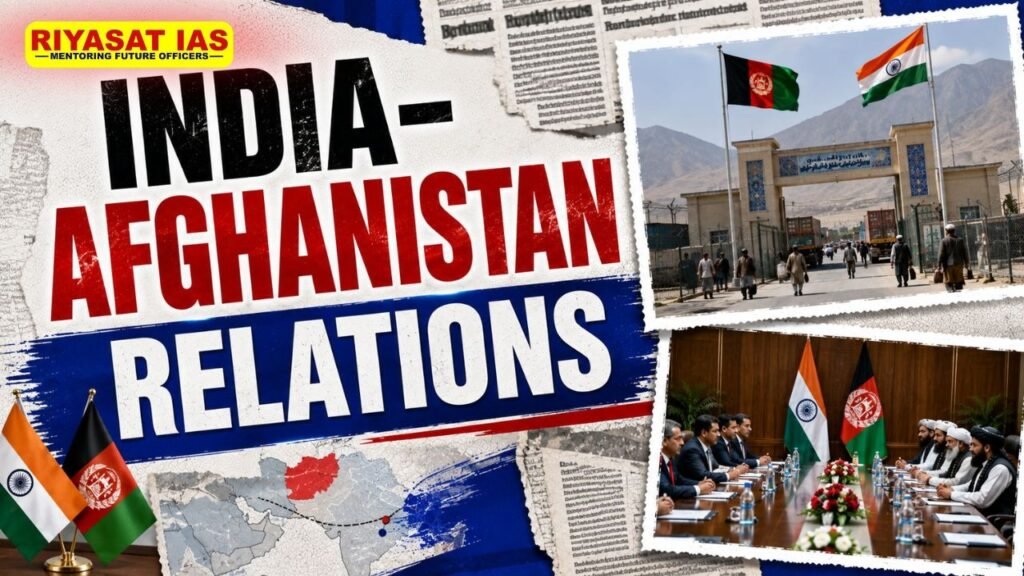
o India and Afghanistan share a relationship rooted in ancient civilisational links, historical contacts, cultural exchanges and strong people-to-people ties. India has consistently supported a peaceful, sovereign, united, stable and prosperous Afghanistan, considering stability in Afghanistan important for India’s own security as well as regional peace.
o India’s engagement has particularly focused on development partnership, humanitarian assistance, capacity building and regional connectivity, rather than seeking a direct military role in Afghanistan.
Historical Background
o India-Afghanistan relations have deep historical foundations because the two regions have been connected through trade routes, Buddhism, cultural exchange and movements of people and ideas for centuries.
o The relationship acquired a modern diplomatic dimension after India’s independence. During the post-2001 period, India emerged as one of Afghanistan’s important development partners and supported the country’s reconstruction, institution-building and socio-economic development.
o Strategic Partnership: India and Afghanistan established a Strategic Partnership in 2011, which expanded cooperation in areas including political relations, security cooperation, economic development and capacity building.
India’s Development Partnership with Afghanistan
Development cooperation has been the core pillar of India’s engagement with Afghanistan. India has generally followed a demand-driven approach, supporting projects that respond to the priorities of the Afghan people and government.
Major Areas of Cooperation
- Infrastructure development, including roads, bridges and public buildings.
- Education and scholarships, including opportunities for Afghan students to study in India.
- Healthcare, through hospitals, clinics and medical assistance.
- Agriculture and irrigation, including assistance for rural development.
- Power and water projects, including major infrastructure initiatives.
- Capacity building, including training of Afghan civil servants and security personnel.
- Community development, through small and high-impact community projects.
Major Projects
o The Zaranj–Delaram Highway is an important example of India’s infrastructure partnership with Afghanistan. It provides connectivity towards the Iranian border and has strategic significance for India’s access to Afghanistan and Central Asia.
o India has also supported the Afghan Parliament building, the India-Afghanistan Friendship Dam (Salma Dam) and several community-level development projects.
Humanitarian Assistance
o India has continued humanitarian assistance to the Afghan people even after the political changes of August 2021.
o According to the MEA Annual Report 2024, India had supplied 50,000 metric tonnes of wheat and 300 tonnes of medicines and medical/surgical supplies to Afghanistan since August 2021. India also supplied 40,000 litres of Malathion pesticide to help address the locust threat and supported vulnerable Afghan communities through cooperation with the United Nations Office on Drugs and Crime (UNODC).
o This demonstrates India’s attempt to maintain people-centric engagement even amid political uncertainty.
Strategic Importance of Afghanistan for India
Afghanistan is strategically important for India because of its location at the intersection of South Asia, Central Asia and West Asia.
o Security: A peaceful Afghanistan is important for preventing the expansion of terrorist networks, extremism, drug trafficking and transnational crime that could affect India and the wider region.
o Regional Connectivity: Afghanistan can provide India with a potential geographical link towards Central Asia, particularly through Iran and the Chabahar connectivity route.



o Countering Strategic Isolation: India’s engagement with Afghanistan also helps prevent the emergence of an environment in which India’s security interests could be adversely affected by hostile external actors.
o Regional Stability: India considers a stable, sovereign and peaceful Afghanistan important for broader regional stability.
Connectivity: Chabahar and Afghanistan
o India’s engagement with Afghanistan is closely connected with its Chabahar strategy in Iran.
o The Chabahar Port provides India with an alternative route to Afghanistan and Central Asia that does not depend entirely on transit through Pakistan.
o This connectivity route can facilitate the movement of goods and services from India through Chabahar Port and Afghanistan to the markets of Central Asia. The India–Central Asia Dialogue has also recognised Chabahar Port as an important link connecting the markets of South Asia and Central Asia.
Afghanistan After NATO Withdrawal
· The withdrawal of US and NATO forces in 2021 fundamentally changed the strategic environment in Afghanistan.
· The Taliban returned to power in August 2021, bringing an end to the previous Islamic Republic of Afghanistan. For India, this created several challenges because the new political situation raised concerns regarding:
o Terrorism and extremist networks.
o The possibility of Afghan territory being used against India.
o The future of development projects.
o Rights and welfare of the Afghan population.
o India’s diplomatic and strategic space in Afghanistan.
· India subsequently adopted a cautious and calibrated engagement approach, while continuing humanitarian assistance to the Afghan people. India’s post-August 2021 approach has been guided, among other things, by UN Security Council Resolution 2593.
Presence and Role of the Taliban
o The Taliban’s return to power changed the nature of India’s engagement with Afghanistan.
o India has not treated the Taliban relationship simply as a traditional bilateral partnership; instead, its approach has focused on pragmatic engagement while maintaining its core security concerns.
o India’s key expectations include ensuring that Afghan territory is not used for terrorism against India, protecting the interests of the Afghan people and maintaining space for humanitarian and developmental engagement.
o The Taliban’s control has therefore created a diplomatic dilemma for India:
o Engage with the de facto authorities without compromising India’s security interests and core concerns.
Major Challenges in India–Afghanistan Relations
Terrorism and Security
o The possibility of Afghan territory being used by terrorist organisations or extremist networks remains India’s most important security concern.
o India is particularly concerned about the presence and activities of groups that could have implications for Indian security and regional stability.
Taliban Governance
o The Taliban’s political system and policies create challenges for India’s engagement, particularly concerning political inclusivity, human rights and women’s education and participation.
o India must balance humanitarian engagement with its broader diplomatic and security interests.
Pakistan Factor
o Afghanistan’s geographical position between India and Pakistan makes the India-Pakistan strategic rivalry an important factor in India’s Afghan policy. Pakistan’s Inter-Services Intelligence (ISI) has historically Influence in Afghanistan and supported Taliban.
o India also faces the challenge of maintaining engagement with Afghanistan without allowing its policies to become trapped in a purely India-Pakistan strategic framework.
China’s Growing Role
o China’s growing engagement with Afghanistan introduces another strategic dimension. The emerging China-Afghanistan-BRI nexus a significant strategic challenge for India.
o India must monitor developments involving China, Afghanistan and the wider Central Asian region, particularly where they intersect with security, infrastructure and connectivity.
Connectivity Constraints
o India does not share a direct land border with Afghanistan. The absence of direct territorial connectivity makes India’s access to Afghanistan more dependent on Iranian connectivity and regional transit arrangements.
Humanitarian and Economic Crisis
o Afghanistan continues to face serious economic, humanitarian and developmental challenges.
o This creates a difficult situation in which India needs to support the Afghan population while carefully managing its engagement with the authorities in Kabul.
Drug Trafficking: Afghanistan’s role as a major source of opium production within the Golden Crescent (Afghanistan, Iran and Pakistan) has contributed to the growth of regional narcotics trafficking and instability. The illegal drug trade poses a security and social challenge for India, particularly in regions such as Punjab, while also generating funds that can support terrorist and organised criminal networks.
Way Forward
· Maintain Calibrated Engagement: India should continue engaging with the de facto authorities in Afghanistan to protect its security interests and maintain channels for humanitarian and developmental assistance.
o India adopted a pragmatic “engage but not recognise” approach after the Taliban takeover in 2021 and subsequently upgraded its technical mission in Kabul to a full-fledged embassy in 2025.
· Prioritise Counter-Terrorism: India should strengthen intelligence cooperation, regional security mechanisms and diplomatic coordination to ensure that Afghan territory is not used for terrorism against India.
· Continue Humanitarian Assistance: India should maintain humanitarian support in areas such as food security, healthcare, medicines, education and livelihood assistance, keeping the welfare of ordinary Afghans at the centre of its engagement.
o India’s foreign policy frameworks, particularly the “Act East” and “Neighbourhood First” policies, emphasise the importance of strengthening regional engagement and cooperation.
· Strengthen Chabahar Connectivity: India should continue developing Chabahar Port and associated connectivity to improve access to Afghanistan and Central Asia.
· Preserve Development Partnership: India should continue its tradition of demand-driven development cooperation, particularly in education, healthcare, agriculture, capacity building and community-level projects.
· Coordinate with Regional Powers: India should work with Iran, Central Asian countries and other regional stakeholders to promote stability and connectivity in Afghanistan.
o India should work through platforms such as the Heart of Asia, SCO, Moscow Format and the United Nations, to coordinate humanitarian assistance, counter-terrorism efforts and reconstruction initiatives in Afghanistan.
· Support an Inclusive and Stable Afghanistan: India should support an Afghanistan that is sovereign, united, peaceful, inclusive and free from terrorism, while encouraging political dialogue and respect for the welfare of its people.
Conclusion
“For India, Afghanistan is not merely a strategic space but a civilisational and developmental partner. The way forward lies in combining strategic caution with humanitarian commitment and connectivity, ensuring that Afghanistan emerges as a bridge for regional cooperation rather than a source of instability.”
FAQs
1. Why is Afghanistan important for India?
Ans: Afghanistan is important for India’s regional security, counter-terrorism, connectivity with Central Asia and broader strategic interests.
2. What is the major pillar of India’s engagement with Afghanistan?
Ans: Development partnership and humanitarian assistance are major pillars, covering infrastructure, education, healthcare, capacity building and food assistance.
3. How has the Taliban’s return affected India-Afghanistan relations?
Ans: The Taliban’s return in 2021 created security and diplomatic challenges, leading India to adopt a cautious and calibrated engagement approach while continuing humanitarian assistance.
4. Why is Chabahar Port important for India-Afghanistan relations?
Ans: Chabahar provides India with an alternative connectivity route to Afghanistan and Central Asia, reducing dependence on transit through Pakistan.
5. What should be India’s approach towards Afghanistan?
Ans: India should pursue pragmatic engagement, counter-terrorism cooperation, humanitarian assistance and regional connectivity while supporting a peaceful, stable and inclusive Afghanistan.




 Ravi Raaz
 Hassan Khan
 Shadab Ali