
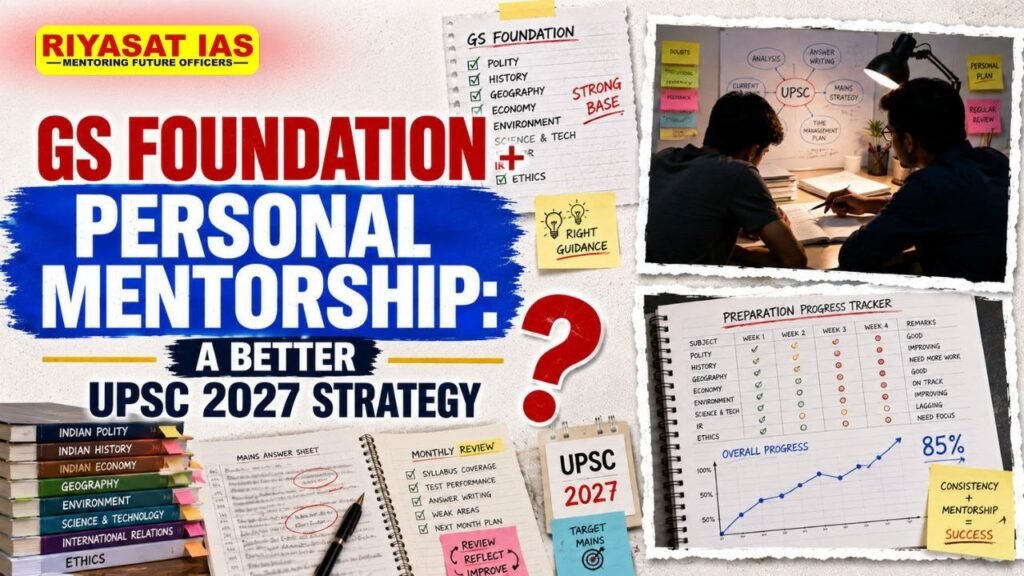
GS Foundation courses and personal mentorship are frequently positioned as alternatives in the UPSC preparation market — aspirants are asked to choose between structured content delivery and individual guidance. This positioning is a false choice. A GS Foundation course and personal mentorship are not alternatives; they serve fundamentally different functions in the preparation ecosystem, and the most effective UPSC 2027 preparation combines both.
This guide explains specifically what each provides, what each cannot provide, and why the combination produces preparation quality that neither achieves independently.
What a GS Foundation Course Provides
A well-structured GS Foundation course provides three specific preparation services:
- Coverage architecture: A sequenced, prioritised reading framework across GS Papers 1–4 — which subjects in which order, at what depth, with what primary sources. For a first-time aspirant without prior UPSC preparation experience, this architecture is valuable; building it from scratch through self-research is slower and less calibrated than receiving it from a programme with UPSC-specific expertise.
- Conceptual foundation: Structured explanation of foundational GS concepts — the institutional framework of Indian government for Polity, the economic policy mechanisms for Economy, the physical processes for Geography — that are more efficiently absorbed through structured delivery than through self-reading of dense primary sources for the first time.
- Peer and accountability environment: The discipline of a structured programme — sessions, deadlines, peer co-aspirants — that provides external accountability for preparation regularity in the early months when self-discipline has not yet developed into a consistent habit.
What a GS Foundation Course Cannot Provide
A GS Foundation course — even an excellent one — cannot provide three specific services that are essential for competitive Mains performance:
- Individual answer evaluation: No batch delivery format can read your specific submitted answer and provide sentence-level feedback on your specific demand fulfilment, your specific missing evidence, and your specific conclusion’s quality. This is structurally impossible with batch sizes of 30–200 aspirants. It requires one reader, one answer, one specific response.
- Personalised preparation plan: A Foundation course delivers the same sequence and source framework to everyone in the batch, regardless of academic background, available hours, or Optional Subject direction. The engineer and the historian receive the same Polity reading rate; the working professional and the full-time aspirant receive the same daily schedule. Individual calibration cannot exist at batch scale.
- Longitudinal quality tracking: A Foundation course tracks batch progress. Personal mentorship tracks your progress — your PYQ accuracy trajectory, your answer quality trend, your mock test error patterns, your Optional development status. These are different things.
| Ready to combine GS Foundation coverage with personal mentorship for 2027? → Apply for Riyasat IAS Mentorship |



What Personal Mentorship Provides That the Foundation Course Cannot
| Preparation Dimension | GS Foundation Course | Personal Mentorship (Riyasat IAS) |
| Preparation plan | Same for all aspirants in the batch | Built from diagnostic of this aspirant’s background, hours, Optional, and medium; adjusted monthly from preparation data |
| Answer evaluation | Model answers and batch rubric scores | Riyasat Ali Sir reads each submitted answer completely; specific written feedback on your sentences, your missing evidence, your conclusion’s quality |
| Retention tracking | Batch coverage tracking — chapter completed or not | Per-subject PYQ accuracy, answer quality trajectory, current affairs integration score — tracked individually week by week |
| Optional guidance | Generic Optional preparation advice | Optional answer quality assessed alongside GS in every session; coverage and answer depth tracked individually |
| Feedback honesty | Commercially incentivised toward positive feedback to maintain retention | Honest assessment when preparation is off track; specific correction plan when approach needs to change |
How to Combine GS Foundation and Personal Mentorship for UPSC 2027
The combination is structured around complementary functions, not overlapping ones:
- GS Foundation course: provides the coverage architecture, conceptual delivery, and peer environment. Attend sessions for the structured content delivery. Use the foundation course’s source recommendations and coverage sequence as the input framework.
- Personal mentorship: takes the foundation course’s output (covered content) and tests it against examination standards through individual answer evaluation, PYQ accuracy checking, and preparation quality assessment. The mentorship adds the quality dimension that the foundation course’s batch delivery cannot.
- Weekly integration: each mentorship session reviews the previous week’s foundation course content from an examination-performance perspective — not whether it was covered (the foundation course tracks this) but whether it is retained and expressible analytically (the mentorship checks this).
- No duplication: the mentorship does not re-deliver foundation course content. It evaluates the aspirant’s specific performance on that content and provides individual corrective feedback. These are distinct services that do not overlap.
Frequently Asked Questions
Can I benefit from personal mentorship without doing a GS Foundation course?
Yes — mentorship provides the personalised source framework and coverage architecture directly when a Foundation course is not being used. The mentorship’s initial diagnostic session produces the preparation plan that a Foundation course would otherwise provide. The mentorship then tracks the quality of preparation built against that plan. Many Riyasat IAS Mentorship aspirants prepare entirely through mentorship without a separate Foundation course, receiving both the architectural direction and the individual quality assessment from the mentorship programme.
What if my Foundation course and the mentorship provide conflicting advice?
Evaluate the conflict specifically: is it a disagreement about sources (which primary reference to use), about sequence (which subject to cover first), or about method (how to practise answer writing)? Source and sequence disagreements should be resolved by PYQ analysis — which approach more directly addresses what UPSC actually tests. Method disagreements (answer writing format, revision approach) should generally defer to the mentorship’s individual-specific guidance over the course’s batch-generic recommendation, because the mentorship has read your specific answers and the course has not.
At what stage of the Foundation course should I join personal mentorship?
From the beginning — not after the Foundation course ends. The value of personal mentorship in the Foundation phase is highest when it can influence how the covered content is being prepared: ensuring PYQ practice follows each chapter, introducing timed answer writing in Month 3, establishing the current affairs note system from Day 1. Beginning mentorship after the Foundation course ends means the mentorship starts from a legacy preparation that may already have built some incorrect habits — which takes longer to correct than building correctly from the start.
Conclusion
GS Foundation course and personal mentorship are complementary, not competing, preparation services. The Foundation course provides coverage architecture, conceptual delivery, and peer accountability. Personal mentorship provides individual answer evaluation, personalised preparation planning, longitudinal quality tracking, and honest corrective feedback. Together, they address all five preparation dimensions that competitive Mains performance requires. Separately, each addresses some and leaves others under-served. For aspirants targeting UPSC 2027 who have the option to combine both, the combination is consistently the superior strategy.
| Riyasat IAS Mentorship — Personal Guidance for UPSC CSE Direct mentorship from Riyasat Ali Sir │ Hindi & English Medium │ 100% Online — Apply Now |


 Ravi Raaz
 Hassan Khan
 Shadab Ali