
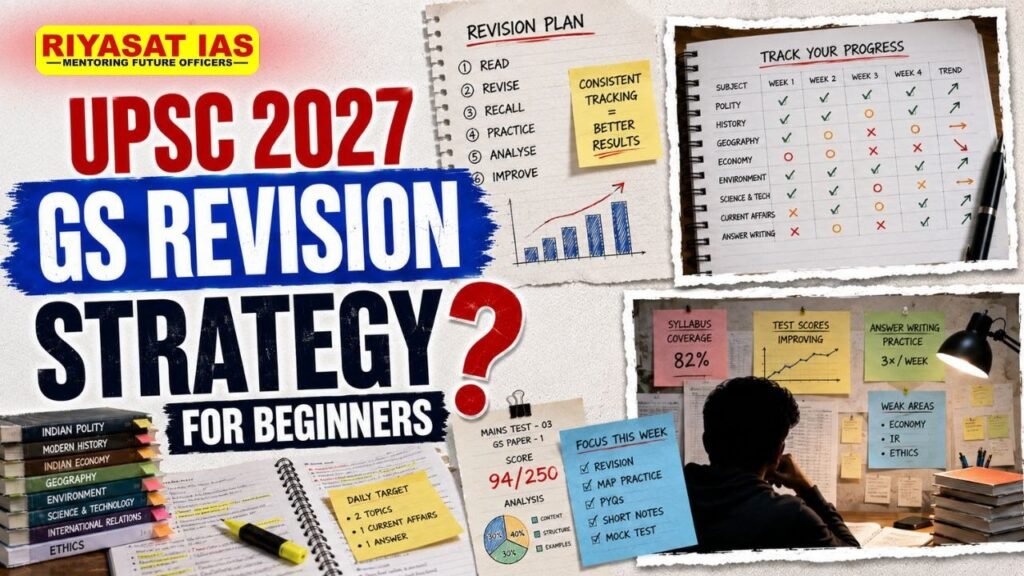
The biggest preparation mistake that UPSC 2027 beginners make is treating revision as something that happens after the syllabus is covered — a separate phase that begins in Month 8 or 9 when the reading is ‘done’. This sequential model produces the most consistently described UPSC preparation experience: ‘I covered everything but forgot most of it by the time the exam arrived.’
The correct revision strategy for UPSC 2027 beginners is not a sequence that follows coverage — it is an architecture that runs simultaneously with coverage, from Day 1. This guide builds that architecture specifically for aspirants who are beginning UPSC 2027 preparation now.
The Core Principle: Revise Immediately, Not Eventually
Human memory does not preserve information because it was once understood. It preserves information that is actively recalled at regular intervals. The first revision of any covered topic must happen within 48 hours of initial coverage — before the steepest memory decay occurs. An aspirant who reads Chapter 5 of Laxmikanth on Monday and does not revise it until the following Sunday has already lost 70% of its content to the forgetting curve. The same aspirant who actively recalls the chapter on Wednesday retains approximately 85–90% — and that retention is strengthened rather than starting over with each subsequent revision cycle.
The practical implication for beginners: revision begins on Day 2 of preparation, not in Month 8. The daily preparation schedule includes revision from the first week — 15–20 minutes of active recall on the previous day’s covered material.
The Beginner’s Revision Toolkit: Three Essential Formats
Format 1: Active Recall (The Primary Revision Method)
Active recall is the most research-validated learning technique available: close the notes or book, attempt to recall from memory everything you can about the topic, then open and check what was missing. The act of attempting retrieval — even when it fails — strengthens the memory trace more than re-reading does.
For UPSC GS, active recall looks like: close Laxmikanth, write down from memory the constitutional provisions for appointment of the Election Commission, then open and check. The gaps between what was recalled and what the source contains are the preparation targets for the next revision cycle — not the entire topic, just the specific gaps.
Format 2: PYQ Practice (The Depth Test)
PYQ practice (attempting previous year UPSC questions on the topic without opening notes) tests whether the active recall produced exam-level retention or merely familiarity. If a topic passes the active recall check but fails the PYQ test — the aspirant can recall general points but cannot accurately answer UPSC’s specific, precise questions from that topic — the revision needs to go deeper on the specific precision that UPSC tests.



For UPSC 2027 beginners: 5 PYQs per major topic, attempted after the active recall revision, provides an immediate exam-level retention check. Accuracy above 70% — exam-reliable. Below 70% — one more Cycle 2 revision targeted at the specific gaps the PYQs revealed.
Format 3: Revision Capsule Scan (The Speed Revision Tool)
A revision capsule is a one-page condensed summary of the highest-priority content from one major GS topic. Built from the primary source notes and updated after each PYQ practice session, the capsule becomes the tool for Cycles 3, 4, and 5 — the faster revision passes that maintain retention without requiring full note reviews.
Building capsules as you go, rather than building them all at the end of the coverage phase, distributes the work and produces an immediately usable revision tool. A Polity capsule built the week after covering the Election Commission is more accurate and more useful than one built 8 months later when the details have faded.
| Want your revision system built and tracked by a mentor from Day 1? → Explore Foundation Mentorship at Riyasat IAS |
The UPSC 2027 Beginner’s Revision Schedule
| Time in Preparation | Daily Revision Activities | Weekly Revision Activity | Monthly Activity |
| Month 1–3 (Foundation) | 15–20 min: Active recall of yesterday’s GS coverage | Sunday: Review the week’s active recall gaps; begin building capsules for this week’s covered topics | End-of-month: PYQ check on all topics covered in the month; update capsules with missed items |
| Month 4–6 (Development) | 30–40 min: Cycle 1 on yesterday’s topic; Cycle 2 capsule review on last week’s topic | Sunday: Paper-wise current affairs organisation + capsule scan of 2–3 topics from Month 1–2 (beginning Cycle 3) | End-of-month: Full PYQ check on all 4 GS papers’ covered topics; mock test and error categorisation |
| Month 7–10 (Intensification) | 45–55 min: Cycle 1 on new coverage; Cycle 2 on last week; Cycle 3–4 capsule scans on older material | Sunday: Full capsule set scan for one GS paper (rotating across papers each week); current affairs capsule review | End-of-month: 2 full GS mock tests with per-subject error analysis; any declining subjects get Cycle 2 targeted sprint |
| Month 11–12 (Pre-exam) | 55–65 min: Cycle 4–5 capsule-only passes across all GS papers; no new source reading | Sunday: Complete one full pass through all GS capsules + current affairs monthly capsule review | Final month: 3 complete capsule passes through all GS papers; current affairs 12-month archive two full passes |
Frequently Asked Questions
As a beginner, when should I start PYQ practice?
From the end of the first chapter you cover — not from the end of the syllabus. Attempting 5 PYQs on the Election Commission the week after covering it in Laxmikanth tells you immediately what examination-level retention looks like for that topic, calibrates what depth the next chapter needs, and begins building the test-taking familiarity with UPSC’s specific question formats that accumulates valuable value across 12 months of practice. Beginning PYQ practice from Chapter 1 produces a qualitatively different and better preparation than beginning it from Chapter 40.
I am a beginner and don’t yet have capsules for any GS topic. How do I start building them?
Build the first capsule after covering the first chapter. It does not need to be perfect. The process of deciding what belongs in the capsule (high-frequency facts, article numbers, landmark judgments, key scheme names) and what stays in the full notes (detailed explanations, historical context, examples) is itself preparation — it forces prioritisation between what UPSC tests and what you read. An imperfect first capsule, updated after the PYQ practice, is more useful than waiting until a theoretical capsule-building skill is developed.
How much time should a beginner allocate to revision versus new coverage per day?
In Month 1, when little has been covered, the revision time is small (15–20 minutes) because only one chapter needs Cycle 1 revision. By Month 4, revision has grown to 30–40 minutes as multiple cycles run simultaneously. The new coverage time remains approximately 2–3 hours throughout; revision grows alongside it rather than replacing it. A Month 4 day looks like: 2.5 hours of new primary source reading + 35 minutes of revision (Cycle 1 on yesterday, Cycle 2 on last week, Cycle 3 capsule scan on Month 1 material).
Conclusion
A UPSC 2027 GS revision strategy for beginners is not a plan for Month 8 onwards — it is an architecture that begins on Day 2 of preparation and runs continuously alongside coverage for 12 months. The three revision formats (active recall, PYQ practice, capsule scan), applied in the cycle schedule above, produce the multi-cycle retention that converts covered knowledge into exam-reliable retrieval. A beginner who builds this architecture in Month 1 arrives at UPSC 2027 with material from Month 1 having been revised 4–5 times — qualitatively different from the aspirant who reads everything once and ‘revises’ in a panicked final-month sprint.
| Riyasat IAS Mentorship — Personal Guidance for UPSC CSE Direct mentorship from Riyasat Ali Sir │ Hindi & English Medium │ 100% Online — Apply Now |


 Ravi Raaz
 Hassan Khan
 Shadab Ali