
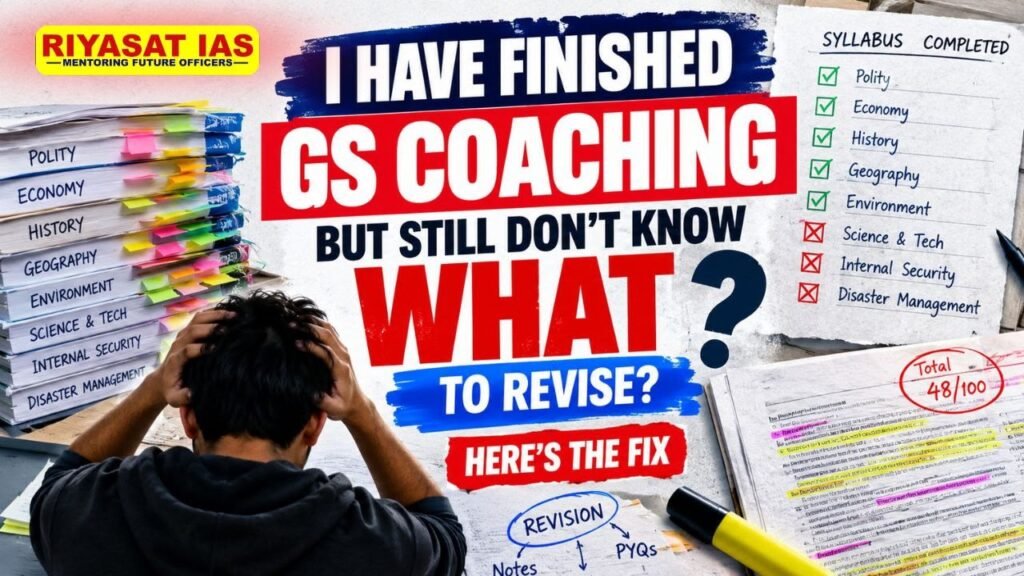
Completing GS coaching produces a specific and surprisingly common disorientation: the structure that coaching provided — fixed class timings, topics covered week by week, materials delivered in sequence — is gone, and what remains is an enormous pile of coaching notes, an incompletely internalised syllabus, and no clear direction for what to do with it. The coaching covered everything; the aspirant has not retained everything; and the question ‘what should I revise?’ has no obvious answer.
This guide gives you a specific, actionable three-step framework for what to do after completing GS coaching — one that prioritises revision based on evidence (PYQ frequency and mock test performance) rather than on syllabus position, note density, or how recent a topic feels.
Why the Question ‘What Should I Revise?’ Is Harder After Coaching Than Before
Before coaching, the syllabus is the guide: cover it in sequence. During coaching, the structure is provided: the teacher’s schedule dictates what to study. After coaching, the syllabus has been covered and the external structure is gone — and most aspirants discover that ‘covered in coaching’ and ‘retained for examination’ are significantly different states.
The specific problem: coaching delivery is optimised for comprehensive coverage, not for individual retention calibration. A topic delivered well in class may have been retained strongly or weakly by any given aspirant, with no mechanism to identify the difference. After coaching ends, the aspirant has notes on everything and reliable retention of something — but no systematic way to know which topics fall into which category.
Step 1: Take a Full Mock Test Within the First Week After Coaching Ends
The fastest, most accurate diagnosis of revision priorities is a full GS mock test taken immediately after coaching ends — before any revision, before any targeted review, before any instinct-based priority-setting. The mock test produces subject-wise and topic-wise performance data that is more precise than any self-assessment.
Do not defer this test until after ‘a little revision first’. The purpose is diagnostic, not performance. A mock taken before revision tells you which topics are actually retained and which have faded — data that a post-revision mock cannot provide because it would conflate pre-existing retention with recently revised knowledge.
Within 48 hours of the mock test: categorise every wrong answer by subject and error type. The subjects with the most errors, and the error type that dominates (knowledge gap vs recall failure vs technique error), become the Week 1–2 revision priorities.
Step 2: Build a PYQ-Priority Revision List — Not a Syllabus-Sequence Revision List
The instinct after coaching is to revise in the same order that coaching delivered: start from the beginning of GS Paper 1, work through to GS Paper 4. This syllabus-sequence approach produces comprehensive revision at the cost of time efficiency — many hours spent on low-frequency topics that rarely appear in UPSC examinations.



The alternative: a PYQ-priority revision list built from analysis of the previous 10–15 years of UPSC Prelims and Mains papers. Topics that have appeared frequently across multiple years are the highest-return revision priorities — they are both more likely to appear in the coming examination and more commonly tested from multiple angles.
| GS Paper | Highest-Frequency PYQ Topic Clusters (Revise First) | Lowest-Frequency Topics (Revise Last or via Capsule Only) |
| GS Paper 1 | Indian Polity (constitutional provisions, amendments, emergency), Modern History (freedom movement, colonial economy), Indian Society (caste, gender, tribal issues), Physical Geography (monsoon, earthquakes) | Medieval History (detailed administrative history), Ancient India (specific dynasty details beyond major periods), World History (less-tested periods) |
| GS Paper 2 | Fundamental Rights and Duties (Articles 12–35 specifically), Constitutional Bodies (Election Commission, CAG, UPSC, Finance Commission), Centre-State relations, Social Sector schemes | Specific bilateral treaty details (beyond India’s major relationships), detailed comparative constitutional provisions across countries |
| GS Paper 3 | Indian Economy (Fiscal Policy, Monetary Policy, Agriculture, Banking), Environment (Biodiversity, Climate change, Pollution legislation), Infrastructure (Energy, Transport) | Internal Security theoretical frameworks (beyond LWE, Cyber, Border management), detailed S&T beyond ISRO/DRDO/Health/Agriculture |
| GS Paper 4 | Ethics thinkers (Kant, Mill, Aristotle, Gandhi, Ambedkar, Rawls) and case study structure | Historical ethical controversies with low direct examination application |
| Want a post-coaching revision plan built specifically from your mock test data? → Apply for Riyasat IAS Mentorship |
Step 3: Build Revision Capsules — Not from Coaching Notes, but from Memory First
The most common post-coaching mistake is re-reading coaching notes as the primary revision activity. Coaching notes are records of what was taught; they are not revision tools. Effective revision requires active retrieval — reconstructing what you know from memory, then checking and filling the gaps.
Build revision capsules in this specific sequence for each high-priority topic:
- First: close all notes and write down everything you can recall about the topic (3–5 minutes). This active retrieval reveals exactly what is retained and what has faded — data that reading notes cannot produce.
- Second: open the coaching notes and compare your recalled content against what the notes contain. The gaps between your recall and the notes are your actual revision priorities within this topic.
- Third: build a one-page revision capsule from this gap analysis — not a copy of the coaching notes, but a condensed, personally-meaningful summary of exactly what was missing from your recall. This capsule is your actual revision tool; the coaching notes become an archive.
A revision capsule built through this three-step process typically takes 20–30 minutes per topic and produces a significantly more effective revision tool than a direct summary of coaching notes, because it is specifically calibrated to your individual retention gaps rather than to the generically delivered coaching content.
Frequently Asked Questions
Should I continue with the same coaching notes or look for additional study material after coaching ends?
Stick with the coaching notes for now — adding new material after coaching ends compounds the ‘too much content, unclear what to revise’ problem rather than solving it. The coaching notes have already covered the syllabus; what is needed is revision architecture (capsules built from active recall), PYQ practice, and timed answer writing — not additional source material. A second source is worth considering only if a specific topic consistently performs poorly in mock tests despite revision, and the coaching notes demonstrably lack coverage of that specific topic’s UPSC-tested dimensions.
I have 3 months before Prelims and have just finished coaching. Is there enough time?
Yes — 3 months is sufficient for a well-structured post-coaching phase if used correctly. Week 1: mock test + error categorisation. Weeks 2–4: highest-priority PYQ topics (revision capsule + PYQ practice). Month 2: second-priority topics + second mock test + error-driven revision. Month 3: full revision through all capsules + 2–3 mock tests per week + current affairs final revision. This 3-month plan treats coaching as the completed coverage phase and the remaining time as the consolidation and performance-building phase.
My coaching notes are very extensive. How do I avoid spending all my revision time on them?
Use the active recall process above: never open a coaching note until you have first written down everything you remember about the topic. The active recall step tells you exactly which parts of the coaching notes are already retained (no need to re-read) and which are genuinely missing from your memory (the actual revision need). This process typically reduces the coaching notes you need to actively re-engage with to 30–40% of their total volume — because the remaining 60–70% is already retrievable from memory and only needs capsule confirmation.
Conclusion
Finishing GS coaching and not knowing what to revise is a structural problem, not an intellectual one. The three-step framework — immediate mock test for diagnostic data, PYQ-priority revision list built from frequency analysis, and revision capsules built through active recall rather than note re-reading — gives you a specific, evidence-based answer to ‘what should I revise?’ that is more precise and more efficient than any syllabus-sequence or instinct-based approach. The coaching gave you coverage; the three steps above convert that coverage into examination-ready retention.
| Riyasat IAS Mentorship — Personal Guidance for UPSC CSE Direct mentorship from Riyasat Ali Sir │ Hindi & English Medium │ 100% Online — Apply Now |


 Ravi Raaz
 Hassan Khan
 Shadab Ali