
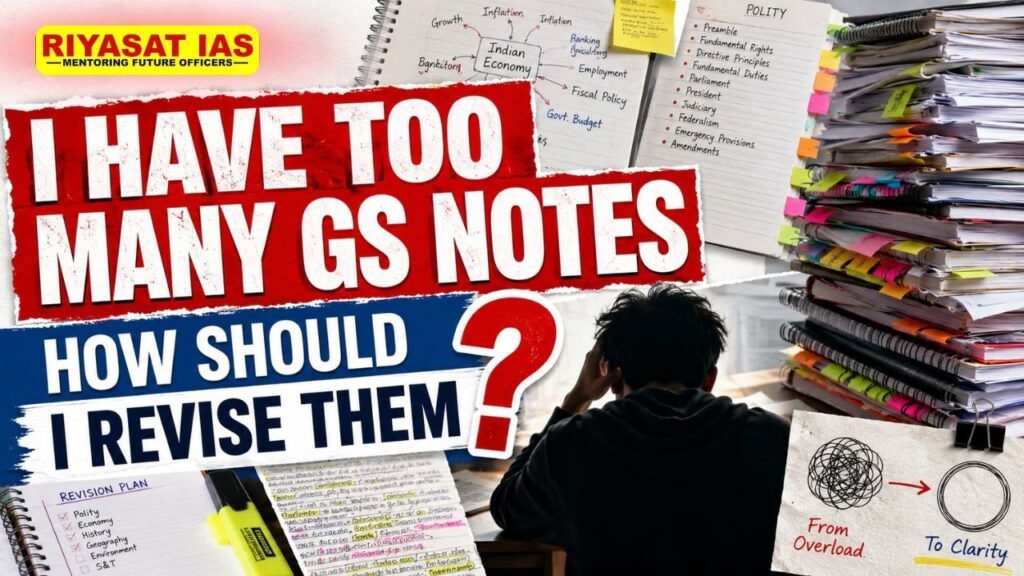
‘I have so many notes I don’t know where to begin revising’ is one of the most frequently heard expressions of UPSC preparation anxiety — and one of the most practically solvable preparation problems. Having extensive GS notes is not a problem in itself. The problem is a specific architectural gap: having notes as records of what was read rather than as tools for what needs to be revised.
Notes that are records of reading are comprehensive but slow to revise — they require the same time as the original reading to review. Notes that are revision tools are condensed, structured, and scannable — they enable multiple revision passes in the time a single reading would take. The solution to too many notes is not reading all of them faster; it is converting the most important subset into revision tools that work.
Why the Volume of Notes Is Not the Problem
Voluminous notes feel overwhelming because the instinct is to revise them by re-reading them — the same activity that produced them. If a set of GS notes took 3 months to produce through reading, re-reading them comprehensively before the examination would take 3 months. This is the impossibility that creates the ‘too many notes’ anxiety.
The insight that resolves this: you do not revise GS notes by re-reading them. You revise GS content by using revision capsules — condensed, active-recall-friendly summaries — that were built from the notes. The notes are the source; the capsules are the revision tool. If capsules have not been built, the post-coaching task is to build them from the existing notes. If they have been built, the notes are largely done their job.
The Three-Stage Note Conversion Process
Stage 1: Sort and Prioritise Before You Condense
Before condensing any notes, sort the entire notes archive by GS paper and subject. Within each subject, identify the high-frequency PYQ topics — the areas where UPSC has consistently asked questions across the last 5–10 years. These are Tier 1 for capsule building. Low-frequency topics — those that appear rarely or only in tangential ways in PYQs — are Tier 3; their notes are acknowledged and filed, but capsule building for them is deferred until the high-frequency work is complete.
This prioritisation prevents the most common note-revision trap: spending equal time condensing a low-frequency Art and Culture topic and a high-frequency Polity constitutional body topic, when the mark-return per capsule-building hour is radically different between them.
Stage 2: The Capsule Standard — What Makes a Revision Tool
A revision capsule for one GS topic (e.g., Article 356 and its constitutional safeguards) should meet three criteria: scannable in under 7 minutes; contains only the highest-frequency facts, constitutional provisions, judgment names, data points, and analytical angles from the notes; and is written in your own condensed language, not copied from the source material.
| What Goes Into a Revision Capsule | What Does Not Go Into a Revision Capsule |
| Constitutional article number + one-line provision description | Extended explanation of the constitutional basis from the source material |
| 2–3 landmark judgment names with the specific principle each established | Detailed description of each judgment’s historical background or case facts |
| 1–2 committee recommendations most likely to appear in PYQs | All committee recommendations regardless of PYQ frequency |
| 1 current affairs hook (recent relevant development from the current affairs archive) | Extended current affairs narration |
| Key data points that differentiate India’s position or specific scheme metrics | General trend descriptions without specific numbers |



Stage 3: Build Capsules in Batches by GS Paper
Build revision capsules paper by paper, not topic by topic across papers simultaneously. Complete all Tier 1 GS Paper 2 (Polity) capsules before beginning GS Paper 3 (Economy). This paper-wise approach prevents the disorientation of having partially completed capsule sets across all four papers without having a revision-ready archive for any of them.
Capsule building rate: approximately 20–30 minutes per major topic from existing notes. A GS Paper 2 capsule set covering the highest-frequency Polity topics (approximately 30–35 topics) can be built in 10–12 focused hours over 4–5 days.
| Want a mentor to review your note organisation and capsule quality? → Apply for Riyasat IAS Mentorship |
The Revision Schedule After Capsules Are Built
Once capsules exist, the revision schedule becomes both possible and efficient:
- Daily revision slot (45–60 minutes): scan 10–12 capsules using active recall — cover the capsule, recall from memory, check gaps
- Weekly rotation: rotate through all four GS paper capsule sets across the week, covering each paper’s capsule set in roughly 2 sessions
- Monthly pass: complete one full pass through all capsules once per month, supplementing with PYQ practice on topics where recall was weak
- Pre-examination: final 2-week capsule-only revision, 2–3 passes through the complete set, no new content
At this schedule, an aspirant with capsule sets for all four GS papers can complete one full revision pass across all subjects in approximately 6–8 hours — making 3–4 complete passes feasible in the final month before the examination. This is what revision efficiency looks like when notes have been converted into revision tools.
What to Do with Notes That Cannot Be Converted
Some notes — detailed case studies, extended historical narratives, comprehensive scheme lists — are useful reference material but too detailed for capsule conversion without losing the content that makes them valuable. These notes are filed as reference rather than revised directly: they are consulted when a specific PYQ or mock test error points to that topic, not included in the regular revision cycle.
The practical rule: if a note set cannot be condensed to a revision capsule without losing what makes it examination-useful, it is reference material. Reference material is looked up when needed; it is not in the revision cycle. Only capsules are revised regularly.
Frequently Asked Questions
How many revision capsules should I have for each GS paper?
25–40 capsules per GS paper covers the highest-frequency PYQ topics comprehensively. More than 50 per paper typically indicates that lower-frequency topics are included alongside high-frequency ones, increasing the revision workload without proportional examination benefit. The capsule count should be driven by PYQ frequency analysis, not by the desire for comprehensive coverage — comprehensive coverage belongs in the reference notes, not in the revision capsule set.
Should I keep my existing notes or discard them once capsules are built?
Keep them as reference material. The notes remain valuable as: the source for re-reading when a revision capsule reveals a gap too large to close with active recall; the historical record of your understanding at the time of reading; and the source for any capsule updates needed when new current affairs developments are relevant. They are just no longer the tool you use for regular revision — that is what the capsules are for.
Is there a faster way to build revision capsules than going through my existing notes?
Yes — PYQ-first capsule building. Rather than reading through your existing notes and condensing them, approach each topic’s capsule by first attempting to answer 5 PYQs from that topic. The process of attempting and checking PYQs immediately shows you exactly what needs to be in the capsule: the provisions you missed, the judgments you could not recall, the schemes you approximated. This PYQ-driven approach builds capsules that are directly calibrated to examination requirements rather than to the comprehensiveness of your notes.
Conclusion
‘Too many notes’ is not a preparation problem — it is a preparation architecture gap. The notes are records of reading; revision capsules are tools for revision. The three-stage note conversion process (sort and prioritise by PYQ frequency, build capsules to the specific standard, complete paper by paper) converts an overwhelming archive of preparation records into a structured, efficient revision system. Once capsules are built, the daily revision slot, weekly rotation, and monthly complete pass produce the multiple revision cycles that transform covered knowledge into examination-day-retrievable knowledge.
| Riyasat IAS Mentorship — Personal Guidance for UPSC CSE Direct mentorship from Riyasat Ali Sir │ Hindi & English Medium │ 100% Online — Apply Now |


 Ravi Raaz
 Hassan Khan
 Shadab Ali