
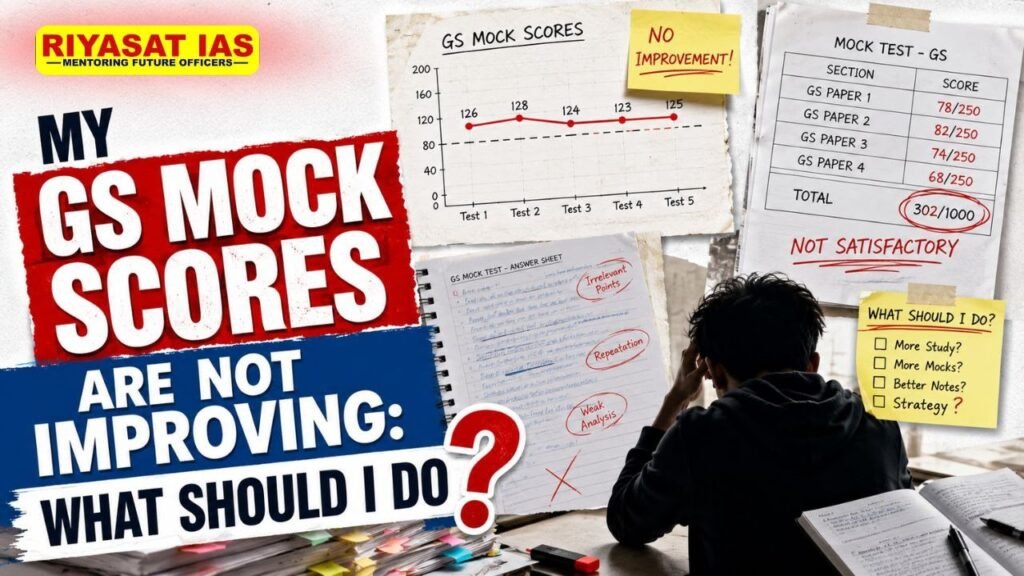
A mock test score that does not improve across consecutive tests — despite continued preparation effort — is one of the most concrete and most actionable signals in UPSC preparation. Unlike the vague sense that preparation is insufficient, a flat mock test trajectory is specific: something in the preparation is not producing examination-level performance, and a systematic analysis of the mock data will tell you what.
The mistake almost every aspirant makes when scores plateau is trying the same approach with more intensity — studying the same material more, taking more tests, reading more. This instinct fails because it does not address the underlying cause of the plateau. The right response is always diagnosis first, intensification second.
Step 1: Error Categorisation — The Non-Negotiable First Action
Within 48 hours of each mock test, categorise every wrong answer into one of five types. Do not proceed to any other preparation change until this categorisation is complete:
| Error Category | What It Means | Targeted Action — NOT ‘Study More’ |
| Knowledge gap | The topic was never covered, or covered so superficially that the answer was unknown | Targeted re-read of the specific topic in the primary source; then PYQ practice on that topic; then capsule update — for this specific topic only, not the broader subject area |
| Recall failure | The content was covered and was understood at the time, but was not retrievable under test conditions | Run an additional revision cycle on this specific topic — active recall from capsule, not re-reading the source. The issue is retention, not knowledge. |
| Reasoning error | The content was known but the question format confused the application (statement questions, ‘which of the following is correct’ multi-part) | Technique training on the specific question format that produced the error — 10 targeted questions of that type per day for one week |
| Current affairs gap | A recent development was tested that is not in the current affairs notes | Update the current affairs archive for the specific development; review the monthly capsule to confirm similar gaps are caught |
| Careless error | Knew the correct answer but selected the wrong option (misread, time pressure, distraction) | Time management practice — timed MCQ sets of 20 questions in 13 minutes; deliberate slow-down before final selection of each answer |
The distribution of error types across your categorised mock test tells you specifically what is causing the score plateau. If 60% of errors are recall failures, the primary fix is revision cycles, not more reading. If 30% are reasoning errors, the primary fix is technique training, not content coverage. The categorisation drives the intervention; the categorisation is the work.



Step 2: Cross-Test Pattern Analysis
A single mock test’s error categorisation is a data point. Two or three consecutive tests’ error categorisations are a pattern. After three categorised mock tests, examine the patterns:
- Are the same subjects generating the most errors across all three tests? If Polity generates the most errors in all three tests despite some Polity revision between tests, the revision approach for Polity specifically is not working. Change the method (if re-reading, switch to active recall + PYQ) not the volume.
- Are the same error types dominant across all three tests? If recall failures dominate all three tests across multiple subjects, the revision architecture broadly is insufficient — the spaced revision cycles are not running or are not frequent enough for the material being tested.
- Is improvement visible in some areas but not others? This is the most useful pattern: if History scores have improved but Economy scores are flat despite similar preparation, the Economy-specific approach needs adjustment regardless of what is working in History.
| Want a mentor to analyse your mock test trajectory and identify the specific fix? → Apply for Riyasat IAS Mentorship |
Step 3: The Three Most Common Plateau Causes and Their Specific Fixes
Plateau Cause 1: Reading Without Revision — The Forgetting Curve in Action
If the mock test error analysis reveals predominantly recall failures across multiple subjects, the preparation is reading new material without maintaining what was read earlier. The Ebbinghaus forgetting curve takes material read 6–8 weeks ago and not revised to approximately 15% retention under test pressure. Adding new reading without revision cycles compounds the retention problem with each new month of preparation.
Specific fix: allocate 40% of daily preparation time to revision (active recall from capsules, PYQ practice on covered material) for the next 6 weeks. Do not add any new source or topic during this period. The mock test score in Week 6 will show whether revision is addressing the retention gap.
Plateau Cause 2: Technique Gap in Specific MCQ Formats
If 25–35% of errors are reasoning errors concentrated in specific question formats (statement-type questions, ‘which pair is correctly matched’, ‘which of the following is incorrect’), content knowledge is not the issue — the logical framework for eliminating options in those specific formats has not been developed.
Specific fix: 15 targeted MCQs of the specific format per day for 10 days. The technique for statement-type questions (eliminating on the basis of the statement most confidently known to be wrong, rather than finding the statement most likely correct) improves quickly with deliberate format-specific practice. Test score improvement on that format is typically visible within 10–14 days of targeted practice.
Plateau Cause 3: Current Affairs Coverage Gap
If current affairs questions consistently produce a high error rate despite a daily current affairs habit, the issue is usually note quality rather than coverage — notes record what happened without the static connection that makes current affairs recall exam-reliable. A daily news reader who has not maintained a GS-tagged, revision-ready current affairs archive will struggle to recall current developments under test pressure even when those developments were read on the day they were published.
Specific fix: review the current affairs note format. Switch to the four-part Mains-oriented format (event, GS tag, static connection, analytical angle). Retrospectively apply this format to the past 4–6 weeks of notes. The impact on current affairs question accuracy is typically visible within 4 weeks of maintained format application.
Frequently Asked Questions
How many mock tests should I be taking per month?
Two to three full GS mock tests per month — with one week between each test for error-driven targeted revision. Taking mock tests more frequently than weekly reduces the revision time between tests, making each test a performance check rather than a preparation diagnostic. The gap between tests is where the preparation improvement happens; the test is the measurement tool, not the preparation activity.
My score fluctuates significantly between tests rather than plateauing. What does this mean?
Score fluctuation across tests typically reflects question set variability rather than preparation quality inconsistency. If the subjects tested heavily in one mock (History, Environment) are different from those tested heavily in the next (Polity, Economy), and your preparation in those subjects is at different depth levels, the score will fluctuate. The appropriate response: track performance per subject across tests (not overall score) to identify subject-specific improvement or decline patterns beneath the surface fluctuation.
My error categorisation shows improvement in most categories but one. Should I focus entirely on that one?
Not entirely — but disproportionately. If 4 of 5 error categories are improving and one is not, the remaining category deserves 40–50% of the focused revision effort for the next 4 weeks. The other categories receive maintenance revision; the persistent category receives targeted intervention. After 4 weeks, re-assess whether the intervention produced improvement in that category before adjusting the focus ratio.
Conclusion
A plateauing mock test score is specific preparation information, not a vague signal that more effort is needed. The five-category error analysis converts that score into actionable diagnostic data. The cross-test pattern analysis identifies which subjects and error types are structurally resistant to the current preparation approach. And the three most common plateau causes — reading without revision, technique gap in specific MCQ formats, current affairs coverage without retention — each have specific, targeted fixes that produce measurable score improvement within 4–6 weeks of consistent implementation.
| Riyasat IAS Mentorship — Personal Guidance for UPSC CSE Direct mentorship from Riyasat Ali Sir │ Hindi & English Medium │ 100% Online — Apply Now |


 Ravi Raaz
 Hassan Khan
 Shadab Ali