
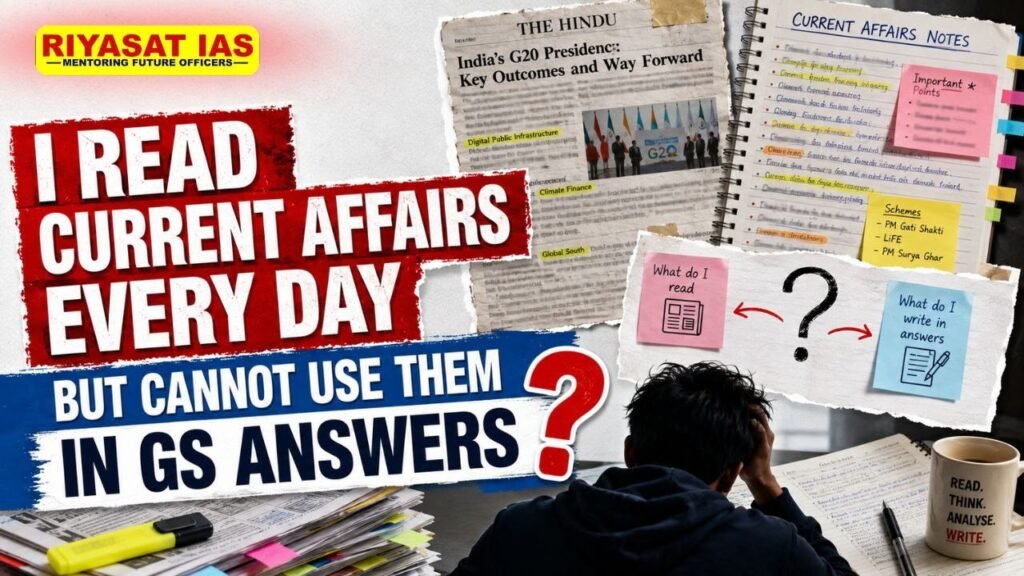
A daily current affairs habit is one of the most valued and most frequently maintained preparation activities across serious UPSC aspirants. Yet many aspirants who have maintained this habit for 10–12 months discover during GS Mains answer writing practice — or from evaluation feedback on their answers — that they cannot cite current affairs specifically in their answers despite having read about the relevant developments when they occurred.
This is one of the most precisely diagnosable preparation gaps: the inability to use current affairs in GS answers is almost always caused by the same structural issue regardless of how much current affairs was read. Understanding the specific mechanism produces a specific fix that typically shows results within 3–4 weeks of implementation.
The Specific Diagnosis: Why Current Affairs Reading Does Not Become GS Answer Evidence
Current affairs reading and current affairs integration in GS answers are not the same activity. Reading produces familiarity — the sense of having encountered a development. Integration produces evidence — the ability to cite a specific development, name its specific GS connection, and use it to advance an analytical argument in a specific answer.
The gap between familiarity and evidence is caused by what happens (or more precisely, does not happen) between reading the development and writing the answer. Three specific things must occur between reading and answer-integration for current affairs to become usable evidence:
- The development must be noted with a GS paper tag and sub-topic label: A development read and not noted is gone within 48 hours for most people. A development noted with a label (‘GS II → Polity → Centre-State relations → Article 356’) is findable and revisable. Without the note and the label, 12 months of daily reading leaves no organised, accessible archive — only a vague sense of familiarity with the year’s events.
- The note must include the analytical GS angle: A note that records what happened (‘Supreme Court ruled on RTI exemptions’) without recording what it means for GS answers (‘This qualifies the transparency principle — relevant to any GS II answer on RTI or governance accountability as a contemporary boundary on RTI’s scope’) is a fact record, not an evidence tool.
- The note must be organised for retrieval during answer writing: Current affairs notes that are chronological (all January notes together, all February notes together) cannot be efficiently retrieved by GS paper topic during answer writing. Notes organised by GS paper and sub-topic can be retrieved in seconds when writing an answer on Article 356 or RTI.
The Four-Step Fix: Converting Daily Reading into GS Answer Evidence
Step 1: Switch to the Four-Part Note Format from Today
For every significant current affairs development from today forward, write a four-part note: (1) Event in one line, precisely; (2) GS Paper and sub-topic tag at the required precision — ‘GS II → Governance → Transparency and Accountability’ not ‘GS II’; (3) Static connection — which constitutional article, Act, or policy framework does this engage?; (4) Analytical GS angle — 2 sentences in answer-language describing what this development means for GS Mains answers on the relevant topic.



This note takes 3–5 minutes per significant development. Three to five minutes is the investment that converts daily reading from familiarity-building into evidence-building. Without it, an hour of daily reading produces no usable GS Mains evidence.
Step 2: Weekly Paper-Wise Organisation
Once per week, sort the week’s four-part notes by GS paper. All GS II notes in one section, all GS III notes in another. Within each paper, group by sub-topic. The weekly organisation (45–60 minutes on Sunday) produces a searchable, paper-wise archive. When writing a GS II answer on Centre-State financial relations, this archive can be searched in under 30 seconds for all relevant current developments.
Step 3: Retrospective Conversion of Recent Notes
The most recent 6–8 weeks of current affairs notes that are not in four-part format should be retrospectively converted in a dedicated 3–4 hour session. This one-time investment brings the most immediately relevant current developments into the usable archive. Notes older than 8 weeks without the four-part format can be batch-sorted by GS paper (a faster, lower-fidelity version of the full conversion) to make them partially retrievable.
Step 4: Practise Integration in Every Answer Writing Session
From now, every GS Mains practice answer must include at least one specific current affairs citation with the three-step integration: name the development precisely, connect it to the static framework of the answer, draw the analytical implication. This deliberate practice builds the integration habit under the time pressure that examination writing requires — the habit cannot be assumed to transfer automatically from note quality to answer writing quality.
| Want your current affairs integration in GS answers evaluated weekly? → Explore Answer Writing Mentorship at Riyasat IAS |
How Long Before the Fix Produces Results
Aspirants who implement all four steps consistently typically see measurable improvement in their ability to cite current affairs in GS answers within 3–4 weeks. The improvement appears in a specific sequence: first, they can cite developments from the past 2–3 weeks (the most recently organised notes); then, within 6–8 weeks, they can retrieve developments from across the past 2–3 months; and after completing the retrospective conversion of older notes, they have access to the full 12-month archive.
The improvement in GS answer quality from this change is typically the most immediately visible of any single preparation adjustment — because current affairs integration is so visually apparent in an answer (specific named developments with analytical connections) that its presence or absence is obvious to both the writer and the evaluator.
Frequently Asked Questions
How much time should the four-part note-making take per day?
The full daily current affairs slot (reading + note-making) should take 45–60 minutes — hard stop. This includes approximately 30–35 minutes of reading and 15–20 minutes of four-part note-making on the 3–5 most significant developments. Aspirants who try to apply the four-part format to every development they read will find the session expanding beyond 60 minutes; the discipline of selecting only the most GS-significant developments for full four-part notes (and making brief one-part notes on less significant ones) maintains the time limit.
My current affairs notes are entirely digital. Does the four-part format work digitally?
Yes — and digital notes have an advantage for the weekly paper-wise organisation: tagging or labelling each note with its GS paper allows automatic sorting. A digital note in Notion, OneNote, or a simple Google Document with each entry tagged ‘GS II’ or ‘GS III’ can be sorted by tag within minutes for the weekly organisation session, taking less time than the paper-based equivalent.
I follow a daily current affairs app or YouTube channel rather than a newspaper. Does the four-part format still apply?
Yes — the format applies to the source, not to the medium. Whatever source produces the current affairs reading, the four-part note is made for each significant development encountered. The only limitation with compiled sources (apps, YouTube channels) rather than primary newspapers is that the analytical depth available for the ‘analytical GS angle’ component may be less rich — compiled current affairs tend to report facts rather than analysis. Supplementing compiled sources with one quality editorial or analytical piece per week helps maintain the analytical angle quality.
Conclusion
The inability to use current affairs in GS answers despite daily reading is caused by one specific structural gap: reading without the three activities that convert familiarity into evidence (GS-tagged notes with analytical angles, paper-wise organisation, and deliberate integration practice in answer writing). The four-step fix — switching to the four-part note format, weekly paper-wise organisation, retrospective conversion of recent notes, and mandatory current affairs integration in every practice answer — addresses this structural gap directly and produces measurable improvement within 3–4 weeks of consistent implementation.
| Riyasat IAS Mentorship — Personal Guidance for UPSC CSE Direct mentorship from Riyasat Ali Sir │ Hindi & English Medium │ 100% Online — Apply Now |


 Ravi Raaz
 Hassan Khan
 Shadab Ali