
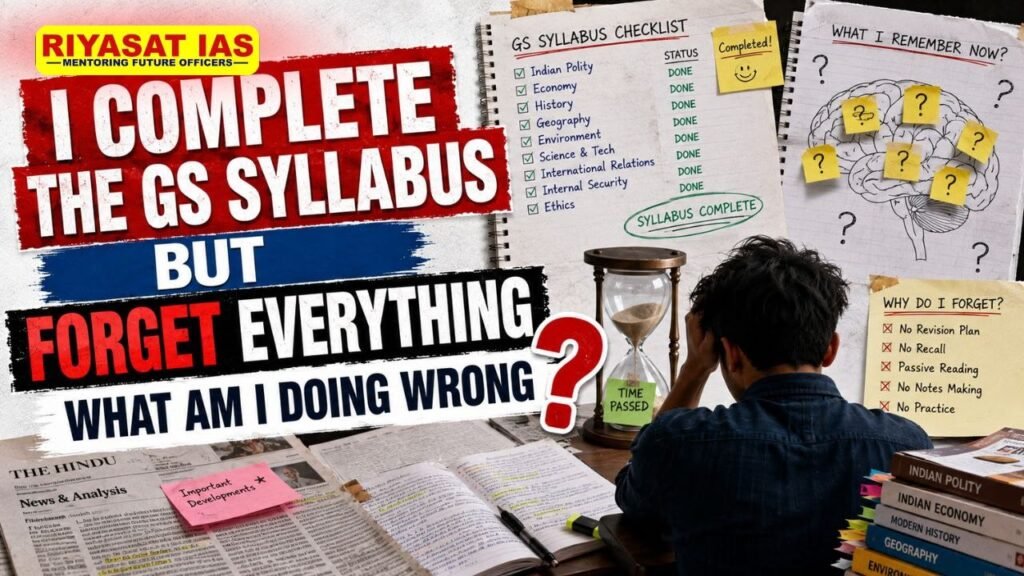
‘I covered everything but when the exam arrives, I can’t remember what I studied in the first few months’ — this is one of the most consistently described experiences by UPSC aspirants who have worked hard and still underperformed. It is not an intelligence problem, not a memory problem, and not a diligence problem. It is a preparation architecture problem with a specific, well-understood cause and a specific, implementable fix.
The Cause: You Are Covering Without Preserving
Human memory does not preserve information at full fidelity simply because it was once understood. Without revision at specific intervals, retention decays rapidly and predictably — to approximately 70% at 24 hours, 50% at one week, and 15–20% at one month after initial learning. This is the Ebbinghaus forgetting curve, and it applies to every aspirant regardless of intelligence, background, or effort.
An aspirant who covers Polity in Month 2, Economy in Month 3, History in Month 4, and Geography in Month 5 — and does not revise any of these while covering subsequent topics — arrives at Month 10 with approximately 15–20% of the Month 2 Polity content in reliably retrievable form. The other 80–85% was covered, understood at the time, and subsequently lost to the forgetting curve.
This is not failure. It is the normal operation of human memory without a revision architecture. The solution is not to study the material more carefully the first time — it is to build the revision architecture that interrupts the forgetting curve before it erases what was learned.
The Five-Cycle Revision Architecture That Prevents Forgetting
| Revision Cycle | When | Format | Time per Topic | What It Does |
| Cycle 1 | 24–48 hours after first coverage | Active recall: close notes, recall from memory, check gaps, note what was forgotten | 15–20 minutes | Catches the sharpest initial drop; material that would fall from 100% to 70% is maintained at 85–90% with this single intervention |
| Cycle 2 | 7–10 days after Cycle 1 | Active recall from the Cycle 1 gap notes + 5 PYQs on the topic | 20 minutes | Builds the first durable memory trace; PYQs test UPSC-specific retention depth specifically |
| Cycle 3 | 3–4 weeks after Cycle 2 | Revision capsule review (one scannable page) + active recall + 3 PYQs | 12–15 minutes | Transitions material toward long-term, exam-reliable retention; capsule review replaces full notes scan |
| Cycle 4 | 6–8 weeks after Cycle 3 | Capsule review only — no full notes, no PYQs unless recall is very weak | 7–10 minutes | Consolidation pass — confirms material is exam-day reliable without re-engaging primary source |
| Cycle 5 (Pre-exam) | Final 2 weeks | Rapid capsule scan only — 5–7 minutes per topic | 5 minutes | Activation pass — loads recently-revised material into exam-day working recall without adding any new cognitive load |



An aspirant running all five cycles across a 10-month preparation arrives at the examination with material from Month 2 having been revised four times — each revision cycle strengthening the memory trace until the content is reliably retrievable under examination pressure. This is qualitatively different from covering material once and hoping to ‘revise before the exam’.
| Want a mentor to build your revision architecture and track it weekly? → Apply for Riyasat IAS Mentorship |
What Happens to Time When Revision Is Added
The most common objection to the five-cycle revision architecture: ‘If I add revision cycles, I will not have time to cover new material.’ This concern reflects a misunderstanding of how the cycles work in practice:
In Month 2, when only a small amount of material has been covered, the daily revision time commitment (running Cycle 1 on yesterday’s material) is 15–20 minutes. In Month 5, with more material in the cycle, the total daily revision time (a mix of Cycle 1 on yesterday’s topic, Cycle 2 on last week’s topic, and a Cycle 3 capsule review) is approximately 45–60 minutes. By Month 8, the daily revision architecture is running at 60–75 minutes of structured revision across multiple cycles.
This 60–75 minutes of daily revision replaces what would otherwise be 3–4 weeks of ‘revision phase’ cramming before the examination — the panicked, inefficient, single-pass revision that most aspirants with no revision architecture attempt. The total time investment is similar; the examination performance is not comparable.
Starting the Revision Architecture When Material Has Already Been Covered
If you have already covered significant GS material without a revision architecture running, do not attempt to run all five cycles retrospectively on everything that was covered. This would take as long as the original coverage and is not feasible. Instead:
- Take a full GS mock test this week — the results identify which months’ material has retained well and which has fallen below exam-reliable retention
- For topics where the mock test shows poor recall: run an urgent Cycle 2 (active recall + PYQs) — this is faster than re-reading and confirms whether recall failure or knowledge gap is the issue
- For topics where mock test shows reasonable recall: enter these directly into the Cycle 3 schedule — capsule review, not re-reading
- From today: begin the five-cycle architecture on new coverage and high-priority previously covered topics simultaneously
The mock test serves as the diagnostic that replaces a full retrospective retention audit — it tells you where the forgetting curve has done the most damage and where it has been least destructive.
Frequently Asked Questions
Is it normal to forget GS material that was covered months ago?
Completely normal — and not an intelligence or diligence failing. Forgetting is the brain’s default behaviour without revision. The human memory system is optimised for efficiency, not permanence: it discards information that has not been recently accessed because it infers that information is not needed. The revision architecture tricks the memory system into treating UPSC GS content as recently and frequently accessed — and therefore preserving it at examination-reliable retention levels.
What if I start the revision architecture but a chapter’s material was not understood well enough to recall from memory?
An active recall attempt that produces poor recall (below 40%) on a topic is the signal that a re-read of that specific topic is needed before the Cycle 2 revision can work. Re-read the specific weak sections of the primary source (not the whole chapter — the specific sections that the active recall attempt shows were not understood), then run the Cycle 1 active recall again. This targeted re-read is fundamentally more efficient than a whole-chapter re-read because it focuses only on the actual retention gaps.
My examination is 3 months away and I have no revision architecture. What should I do?
Triage immediately. Three months is sufficient for 3 revision cycles on high-frequency material if the cycles begin today and run consistently. The priority sequence: (1) Build revision capsules for the 20 highest-frequency PYQ topics in each GS paper — this is the most urgent activity, before any new coverage or revision; (2) Run Cycle 2 and Cycle 3 on capsulised topics simultaneously — each capsule that is built goes directly into the revision cycle; (3) Continue new coverage only for genuinely uncovered high-frequency topics — at this stage, revision of covered material is significantly higher priority than new coverage.
Conclusion
Covering the GS syllabus and forgetting it before the examination is a preparation architecture problem, not a memory or intelligence problem. The five-cycle revision architecture — Cycle 1 at 48 hours, Cycle 2 at 7–10 days, Cycle 3 at 3–4 weeks, Cycle 4 at 6–8 weeks, Cycle 5 pre-exam — interrupts the forgetting curve at each critical decay point and builds the multi-cycle retention that produces exam-day reliable recall. Starting the architecture from today, using a mock test to identify where retrospective recovery is most urgent, and building revision capsules for high-frequency topics before anything else are the specific actions that convert a forgotten preparation into a preserved one.
| Riyasat IAS Mentorship — Personal Guidance for UPSC CSE Direct mentorship from Riyasat Ali Sir │ Hindi & English Medium │ 100% Online — Apply Now |


 Ravi Raaz
 Hassan Khan
 Shadab Ali