
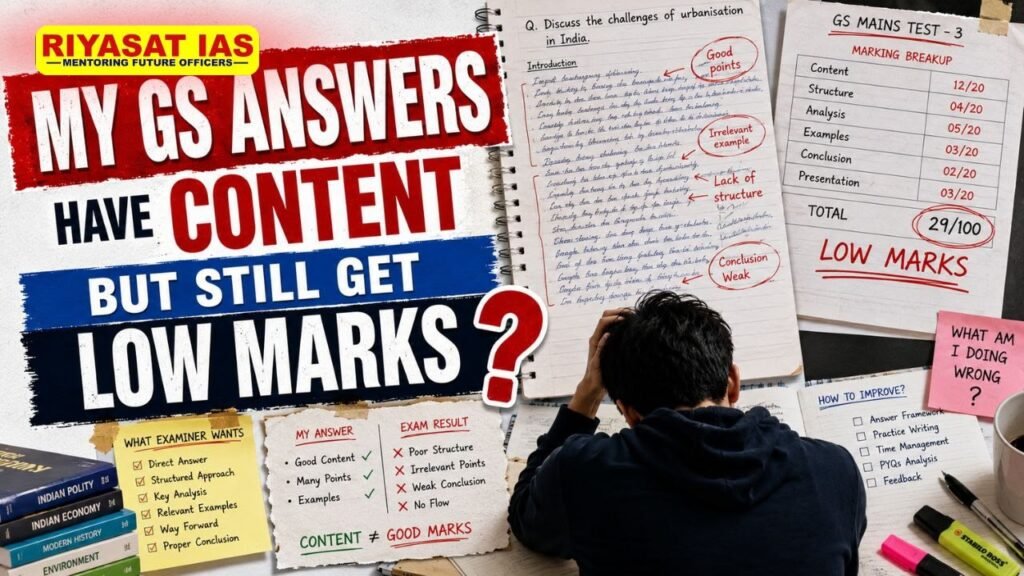
Content-rich GS answers that score below expectations are the most frequently discussed and most specifically addressable answer quality problem in UPSC Mains preparation. The aspirant who has covered the GS syllabus, who knows the constitutional provisions, the landmark judgments, and the policy frameworks, but whose GS answers consistently score 6–8/15 rather than 10–12/15 is not suffering from a knowledge problem. The problem is always in one or more of five specific dimensions of how the knowledge is expressed in the answer.
This guide identifies those five dimensions precisely — with the diagnostic test for each and the specific correction that addresses it.
Reason 1: The Answer Addresses the Topic, Not the Question
The most consistent reason for low GS marks despite strong content: the answer covers the topic generally rather than addressing the specific dimension the question asked about. A question asking to ‘critically examine the limitations of Article 356’ receives a thorough answer about Article 356 — its provisions, its history, its judicial interpretations, its use and misuse — with limitations as one of many covered dimensions rather than as the primary analytical focus.
This answer demonstrates content knowledge. It does not meet the specific demand of the question. UPSC marks primarily for demand fulfilment: an answer that covers the specific asked dimension thoroughly scores higher than an answer that covers the general topic comprehensively.
Diagnostic test: read one of your recent practice answers without looking at the question. Write one sentence describing what the answer is about. Then look at the question. If your sentence describes the topic (Article 356 in Indian federalism) rather than the question’s specific demanded dimension (the limitations of Article 356), this reason applies.
Correction: underline the specific demanded dimension in every question before planning the answer. Write the demanded dimension at the top of your planning space. Every paragraph you write must explicitly address that demanded dimension — not the general topic.
Reason 2: Content Is Present but Not Analytically Expressed
The second reason: the answer contains the right information but presents it descriptively rather than analytically. ‘Article 356 has been misused by central governments to dismiss state governments of opposing political parties, as seen in various instances throughout Indian history’ is a content-present, descriptive statement. It tells the evaluator that the aspirant knows misuse occurred. It earns factual marks.
‘Article 356’s misuse — illustrated by pre-Bommai cases where dismissals occurred without floor tests, documented in the Sarkaria Commission’s finding that it had been invoked 39 times in 40 years — reveals a structural accountability gap: the constitutional safeguards were aspirational rather than enforceable until the Supreme Court’s 1994 intervention’ is the same content expressed analytically. It does not merely state that misuse occurred; it evaluates why it was possible, what mechanism enabled it, and how the constitutional framework failed. This is what the ‘critically examine’ directive asks for.
Diagnostic test: take one body paragraph from a recent answer and ask: does this paragraph evaluate, weigh, analyse, or draw an implication — or does it describe what exists? If it only describes, it is content-present but analytically absent.
Correction: every body paragraph must include one explicit analytical move — an evaluation, a comparison of competing considerations, an implication drawn, or a constitutional/theoretical framework applied to the specific case. No paragraph should be purely descriptive.
| Want specific feedback on whether your answers are analytical or descriptive? → Explore Answer Writing Mentorship at Riyasat IAS |



Reason 3: Evidence Is Present but Generic
The third reason: the answer contains evidence but at a generic level that does not distinguish between an aspirant who knows the specific material and one who is guessing plausibly. ‘The Sarkaria Commission recommended reforms in Centre-State relations’ is evidence of awareness. ‘The Sarkaria Commission (1988) specifically recommended that Article 356 should be invoked only as a matter of last resort, after all other constitutional alternatives have been exhausted — a recommendation that the S.R. Bommai judgment (1994) gave partial constitutional force’ is evidence of knowledge.
The specificity of the evidence — the year, the specific recommendation, the downstream constitutional consequence — is what earns evidence marks rather than awareness marks.
Diagnostic test: count the number of named, specific evidence items in one recent answer — article numbers, judgment names with years, committee recommendations with specific findings, data points with sources. If fewer than two specific items appear in a 15-mark answer, evidence is present at generic level only.
Correction: build a subject-wise evidence bank — 20–30 high-frequency named items per GS paper, each with the year or metric that makes the citation specific rather than vague. Deploy two named specific evidence items per 250-word answer, every answer.
Reason 4: The Conclusion Restates Rather Than Synthesises
The conclusion is the last thing an evaluator reads — and has disproportionate influence on the final impression of the answer. A restatement conclusion (‘In conclusion, therefore, Article 356 has both been used appropriately and misused, and reforms are needed’) adds nothing to the evaluator’s understanding and leaves the answer’s intellectual work incomplete.
A synthesising conclusion (‘While the Bommai judgment significantly reduced Article 356’s misuse potential by making Presidential Rule subject to a floor test, the Governor’s discretion in recommending Presidential Rule remains constitutionally under-constrained — a gap that a further amendment along the lines of the Punchhi Commission’s 2010 recommendation on a mandatory consultation with the state cabinet could specifically address’) reaches a qualified judgment, cites a forward-looking recommendation, and demonstrates that the analysis arrived at a specific, reasoned destination. This is what conclusions earn marks for.
Diagnostic test: read only your conclusions from your last five answers. Does any conclusion contain something that the introduction did not already state? If most are restatements, this reason is costing marks on every answer.
Correction: plan the conclusion before writing the body. Before the first word of the answer is written, decide: what is the answer’s final, synthesised judgment? Write that as the conclusion — a resolution or qualified judgment based on the analysis, not a summary of what the analysis covered.
Reason 5: Current Affairs Is Absent or Incidentally Mentioned
For GS Papers 2 and 3, the absence of specific current affairs integration in answers — or the presence of current affairs mentioned incidentally without analytical connection to the answer’s argument — consistently reduces scores relative to answers with the same static content but specific, analytically integrated current affairs.
‘The RTI Act has been subject to amendments in recent years’ is incidental mention. ‘The RTI (Amendment) Act 2019, which shifted the service tenure and salary determination of Central Information Commissioners from statute to government discretion, has been criticised for reducing the institutional independence that gives RTI its oversight function — a concern directly relevant to the accountability question this answer addresses’ is analytical integration. The same current development produces awareness marks in the first form and evidence marks in the second.
Diagnostic test: in each recent GS Paper 2 or 3 answer, identify whether any current affairs development was cited. If none: current affairs is absent. If cited: was it connected analytically to the answer’s argument, or mentioned and then abandoned?
Correction: mandatory one current affairs citation per GS Paper 2 and 3 answer, with the three-step integration (name precisely, connect to static framework, draw analytical implication). Pre-build this integration in the current affairs note-taking system rather than constructing it from scratch during the answer.
Frequently Asked Questions
My answers have all five of these problems simultaneously. Where do I start?
Start with Reason 1 (demand fulfilment) because it is the most foundational. An answer that does not address the specific demanded dimension will score below its content quality regardless of how well the other four dimensions are addressed. Spend 2–3 weeks specifically on Reason 1 — the 30-second pre-writing planning exercise, the demanded dimension written at the top of every planning space — until demand fulfilment becomes more consistent. Then add Reason 4 (conclusion synthesis) as the second correction. These two together typically produce the most visible immediate score improvement.
How do I know if my correction is working?
External evaluation is the most reliable indicator. Submit two answers per week to a mentor or evaluator with the specific request to check whether the targeted correction (demand fulfilment, analytical expression, specific evidence, synthesising conclusion, or current affairs integration) is present in each answer. After 4 weeks of this specific feedback, the pattern will be visible: either the correction is consistently present (working) or inconsistently present (needs more deliberate practice).
Is it possible to get 12+ out of 15 on GS Mains answers with strong content but mediocre writing skill?
Yes — but ‘mediocre writing skill’ typically means something more specific than it sounds. An aspirant who addresses the specific demanded dimension, expresses their points analytically, cites two named evidence items, and closes with a synthesising conclusion can score 11–12/15 with straightforward prose that is not eloquent but is analytically purposeful. The five reasons in this article are the specific writing skill dimensions that produce the difference between mediocre and competitive answers — they are learnable and improvable regardless of natural writing ability.
Conclusion
GS Mains answers that have content but score low are almost always failing on one or more of five specific dimensions: addressing the topic rather than the question; describing rather than analysing; citing generic evidence rather than named specifics; restating the introduction in the conclusion; or omitting current affairs integration. Each dimension has a specific diagnostic test and a specific, immediately applicable correction. Identifying which of the five applies to your answers — through honest self-diagnostic or external evaluation — and applying the targeted correction consistently across the next 20 practice answers will produce measurably higher scores from the same content you already have.
| Riyasat IAS Mentorship — Personal Guidance for UPSC CSE Direct mentorship from Riyasat Ali Sir │ Hindi & English Medium │ 100% Online — Apply Now |


 Ravi Raaz
 Hassan Khan
 Shadab Ali