
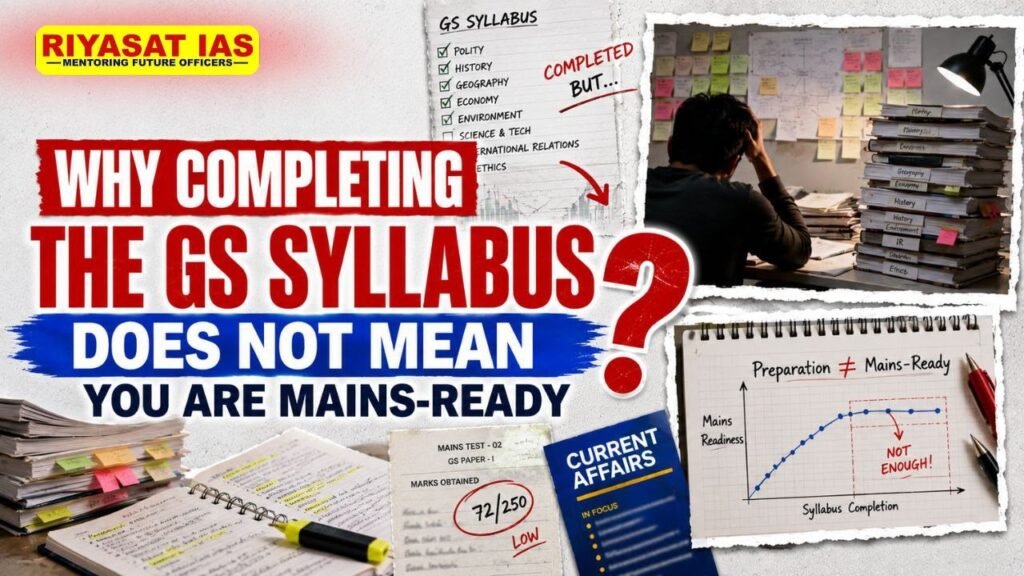
Completing the GS syllabus is the most significant milestone most UPSC aspirants track — and the milestone most frequently mistaken for examination readiness. Every year, aspirants who have genuinely covered the GS syllabus across all four papers arrive at Mains and are surprised by the gap between how prepared they felt and how their answers actually performed under examination conditions.
The gap is not mysterious. It is caused by four specific, identifiable differences between ‘syllabus covered’ and ‘Mains-ready’ — and each difference requires a specific preparation activity that syllabus coverage alone does not provide.
Gap 1: Knowing Information vs Being Able to Retrieve It Under Pressure
Understanding Article 356’s constitutional history, its misuse pattern, and the S.R. Bommai judgment at the end of a reading session is one cognitive state. Being able to accurately retrieve the same information under 9-minute examination time pressure, while simultaneously organising it into a specific analytical argument addressing the question’s demanded dimension, is an entirely different and separately developed cognitive skill.
Syllabus coverage builds the first state. The second state is built by one activity that syllabus coverage cannot substitute: timed answer writing practice. An aspirant who has covered the entire GS syllabus but has never written timed answers on it is in a preparation state analogous to someone who has read extensively about swimming and has never entered a pool. The knowledge is present; the exam-condition performance is not.
What closes this gap: timed answer writing from Month 3 of preparation, on topics covered each week, with the strict time limit enforced from the beginning. Every untimed practice answer is preparation for a different, more comfortable examination than UPSC Mains actually is.
Gap 2: Covered Material vs Retained Material
The Ebbinghaus forgetting curve erases approximately 80–85% of once-understood information within one month without revision. An aspirant who covered Polity in Month 2 and has not revised it by Month 10 has approximately 15–20% of that content in reliably exam-retrievable form. The syllabus was ‘covered’ in a meaningful sense at the time of coverage; by examination time, the coverage has largely become familiarity — the recognition that this topic was once studied, not the reliable recall of its specific content.
What closes this gap: a functioning spaced revision architecture — the five-cycle system (Cycle 1 at 48 hours, Cycle 2 at 7–10 days, Cycle 3 at 3–4 weeks, Cycle 4 at 6–8 weeks, Cycle 5 pre-exam) that interrupts the forgetting curve at each critical decay point. Without this architecture, ‘covering the syllabus’ produces a preparation that feels complete at completion and is largely forgotten by examination day.
Gap 3: Knowing What to Write vs Knowing How to Write It Analytically
UPSC Mains GS papers test analytical expression, not factual recall. The question ‘critically examine the limitations of cooperative federalism in India’ rewards an answer that evaluates, weighs competing considerations, draws implications, and reaches a principled qualified judgment — not an answer that describes what cooperative federalism is and lists its challenges in bullet points. The distinction between these two answer types is not content; it is analytical structure.



Syllabus coverage builds content knowledge. The analytical expression skill — the specific ability to evaluate, weigh, and draw principled implications — is built by written answer practice evaluated by someone who reads answers as an examiner reads them. This skill cannot be developed through reading, through watching lectures, or through self-evaluation. It requires production (writing) and feedback (evaluation).
What closes this gap: biweekly external evaluation of GS answers by a mentor or evaluator who identifies which specific analytical moves the answer made and which it missed — with specific correction illustrations from the aspirant’s own submitted work.
| Want a Mains-readiness assessment that identifies your specific gaps? → Apply for Riyasat IAS Mentorship |
Gap 4: Covering GS vs Developing Optional and Essay
UPSC Mains is not only GS. Optional Subject (500 marks) and the Essay paper (250 marks) together equal the entire GS Papers 1–4 combined in mark weight. An aspirant who has covered the GS syllabus but whose Optional Subject is at 6-month preparation depth and whose Essay paper has received 3 evaluated practices is not Mains-ready — because 750 of the 1,750 Mains written marks are substantially under-prepared.
The most common form of this gap: GS coverage received 10 months of preparation attention; Optional received 4 months; Essay received 2 months; Ethics case study practice received 6 weeks. GS knowledge is solid; Optional, Essay, and Ethics are at the early-development stage when Mains arrives.
What closes this gap: an integrated preparation architecture from Month 1 that allocates a protected daily slot to Optional, introduces Essay practice from Month 4, and begins Ethics case study practice from Month 5–6 — so that all three components develop in parallel with GS coverage rather than sequentially after it.
The Mains-Readiness Checklist: How to Assess Where You Actually Stand
| Mains-Readiness Dimension | Not Yet Ready | Approaching Ready | Mains-Ready |
| Timed answer writing | No timed practice; answers written with unlimited time | Regular timed practice but no external evaluation; writing improves slowly | Biweekly external evaluation; specific corrections applied; measurable analytical depth improvement visible across consecutive answers |
| GS retention | Covered topics from Month 1–3 cannot be recalled accurately under PYQ testing | Retention of 50–60% of early material; revision cycles running but inconsistent | 70%+ PYQ accuracy on material from all months; five-cycle revision architecture running consistently |
| Current affairs integration | Cannot cite specific current developments in GS answers; notes are chronological and untagged | Some GS-tagged notes; can cite some developments but inconsistently | Four-part Mains-oriented notes; paper-wise archive; at least one specific current affairs citation per GS Paper 2 and 3 answer |
| Optional Subject | Coverage incomplete or at 6 months only | Coverage of one or both Optional papers complete; answer quality developing | Both Optional papers covered with multiple revision cycles; answer writing at analytical depth; evaluated submissions showing quality improvement |
| Essay and Ethics | Fewer than 5 evaluated essays; Ethics case study practice at less than 30 submissions | 8–12 evaluated essays; 30–40 Ethics case studies | 15+ evaluated essays with consistent topic interpretation accuracy; Ethics case study structure automatic in 10–12 minutes |
Frequently Asked Questions
How much time after syllabus completion is needed to become genuinely Mains-ready?
3–5 months of post-completion output-intensive preparation — assuming the revision architecture and current affairs system were running during the coverage phase. If these were not running, the post-completion phase must address both the retention gaps from absent revision cycles and the output development gaps from absent timed writing practice simultaneously. This takes 5–6 months at quality. Which is precisely why the revision architecture and answer writing must begin during the coverage phase, not after it ends.
Can an aspirant be Mains-ready in their first attempt?
Yes — if the preparation architecture is built correctly from the beginning. The most consistent difference between aspirants who perform competitively in their first Mains attempt and those who treat it as a ‘learning experience’ is not intelligence or effort but whether the first attempt was preceded by integrated preparation (timed writing, revision cycles, Optional, Essay) or sequential preparation (coverage, then Mains activities).
Is it possible to check Mains-readiness before the examination?
Yes — using the checklist above. The most informative single check is timed answer writing: take 3 diverse GS Mains questions from recent previous years, write full answers under strict time limits (9 minutes per answer), and submit them for external evaluation. The quality of those 3 answers, assessed against examiner standards, tells you more about Mains-readiness than any other single data point.
Conclusion
Completing the GS syllabus does not mean you are Mains-ready because four specific gaps remain between coverage and examination performance: the exam-condition retrieval gap (closed by timed answer writing), the retention gap (closed by spaced revision architecture), the analytical expression gap (closed by externally evaluated answer writing), and the Optional-Essay gap (closed by integrated preparation from Month 1). The Mains-readiness checklist above tells you honestly where you stand on each dimension — and what specific preparation activity closes each gap that remains.
| Riyasat IAS Mentorship — Personal Guidance for UPSC CSE Direct mentorship from Riyasat Ali Sir │ Hindi & English Medium │ 100% Online — Apply Now |


 Ravi Raaz
 Hassan Khan
 Shadab Ali