
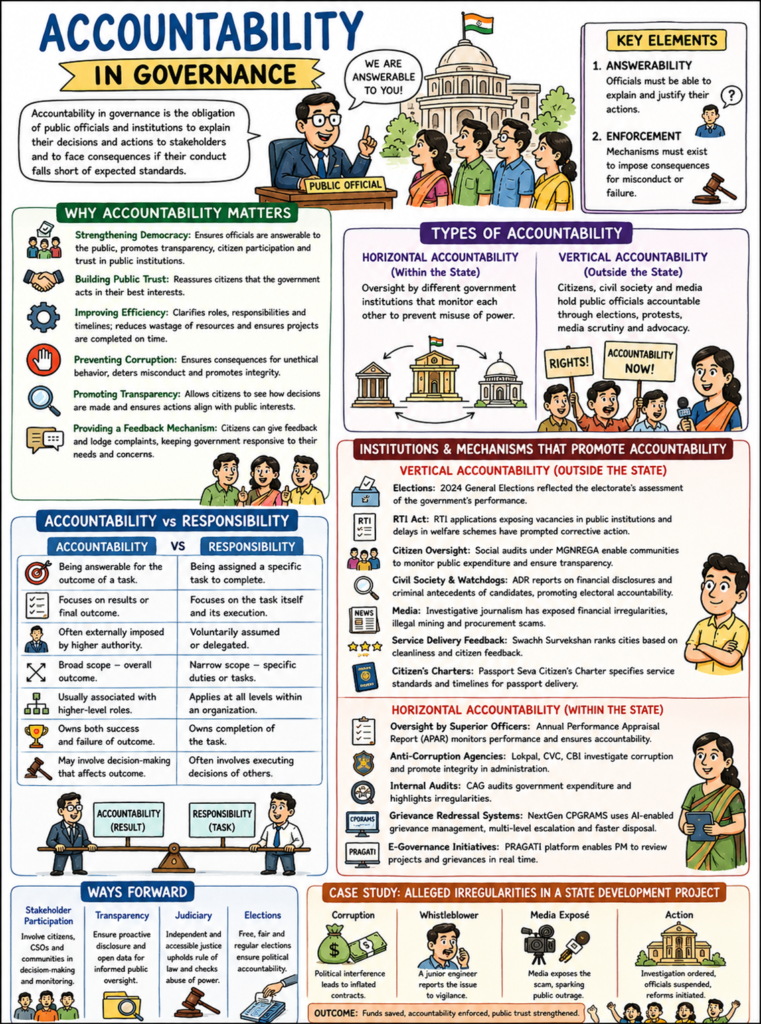
Accountability in governance refers to the obligation of public officials and institutions to explain their decisions and actions to stakeholders and to face consequences if their conduct falls short of expected standards. The key elements of Accountability are as follows:
- Answerability: Public officials must be able to explain and justify their actions and decisions. This aspect of accountability ensures that officials are transparent and open to scrutiny by the public and oversight bodies.
- Enforcement: Accountability also requires that there be mechanisms to enforce consequences when officials engage in misconduct or fail in their duties. This could include disciplinary action, legal penalties, and administrative sanctions.
Why Accountability Matters
- Strengthening Democracy: Accountability reinforces democratic governance by ensuring that officials are answerable to the public. It promotes transparency, citizen participation, and trust in public institutions.
- Building Public Trust: Effective accountability mechanisms help build and maintain public trust in government institutions. When officials are held responsible for their actions, it reassures citizens that the government is acting in their best interests.
- Improving Efficiency: Accountability ensures that governance is efficient by clarifying roles, responsibilities, and timelines. It reduces wastage of resources and ensures that projects are completed on time.
- Preventing Corruption: Accountability is crucial in preventing corruption, as it ensures that public officials know they will face consequences for unethical behavior. This deters misconduct and promotes integrity within the administration.
- Promoting Transparency: Transparency in decision-making is a key outcome of accountability. It allows citizens to see how decisions are made, why certain actions are taken, and ensures that these actions align with public interests.
- Providing a Feedback Mechanism: Accountability mechanisms should include channels through which citizens can provide feedback and lodge complaints. This ensures that the government remains responsive to the needs and concerns of its citizens.
Accountability vs. Responsibility: Key Differences
- Definition: Accountability is being answerable for the outcome of a task, while Responsibility is being assigned a specific task to complete.
- Focus: Accountability centers on the results or final outcome, while Responsibility focuses on the task itself and its execution.
- Nature: Accountability is often externally imposed by a higher authority, whereas Responsibility is voluntarily assumed or delegated.
- Extent: Accountability has a broad scope, encompassing the overall outcome, while Responsibility is narrower, focusing on specific duties or tasks.
- Level: Accountability is usually associated with higher-level roles or leadership positions, while Responsibility applies at all levels within an organization.
- Ownership: Accountability involves taking ownership of both successes and failures in the outcome, while Responsibility involves taking ownership of completing the task.
- Decision-Making: Accountability may involve making decisions that affect the outcome, while Responsibility often involves executing decisions made by others.
Types of Accountability
- Horizontal Accountability: This form of accountability involves oversight by different government institutions that monitor each other to prevent the misuse of power. It ensures that no single branch of government can act without checks from another.
- Vertical Accountability: Vertical accountability refers to the way citizens, civil society, and the media hold public officials accountable. This can happen through elections, public protests, media scrutiny, and advocacy.
Institutions and Mechanisms that Promote Accountability
Vertical Accountability (Outside the State)
Elections
- Elections serve as a direct mechanism for public accountability. For instance, the 2024 General Elections reflected the electorate’s assessment of the government’s performance over the previous term.



Right to Information (RTI) Act
- RTI continues to be a powerful tool for accountability. For instance, RTI applications exposing vacancies in public institutions and delays in welfare schemes have prompted greater transparency and corrective action.
Citizen Oversight
- Social Audits under MGNREGA enable local communities to monitor public expenditure and ensure transparency in the implementation of rural development programmes.
Civil Society and Watchdog Organizations
- Organizations like the Association for Democratic Reforms (ADR) publish reports on the financial disclosures and criminal antecedents of political candidates, promoting greater electoral accountability.
Media
- Investigative journalism has exposed financial irregularities, illegal mining, and procurement scams, strengthening public accountability and institutional oversight.
Service Delivery Feedback
- Swachh Survekshan ranks cities based on sanitation and citizen feedback, encouraging accountability among Urban Local Bodies.
Citizen’s Charters
- The Passport Seva Citizen’s Charter specifies service standards and timelines for passport delivery, enabling citizens to hold authorities accountable for delays.
Horizontal Accountability (Within the State)
Oversight by Superior Officers
- In the Indian Administrative Service (IAS), the Annual Performance Appraisal Report (APAR) serves as an important mechanism for monitoring performance and ensuring accountability.
Anti-Corruption Agencies
- Institutions such as the Lokpal, Central Vigilance Commission (CVC), and Central Bureau of Investigation (CBI) investigate corruption and promote integrity in public administration.
Internal Audits
- The Comptroller and Auditor General (CAG) regularly audits government expenditure and highlights irregularities, strengthening financial accountability.
Grievance Redressal Systems
- NextGen CPGRAMS has strengthened public grievance redressal through AI-enabled grievance management, multi-level escalation, and faster disposal timelines, enhancing administrative accountability.
E-Governance Initiatives
- The PRAGATI platform enables the Prime Minister to review major infrastructure projects and public grievances in real time, improving transparency and accountability.
Ways Forward
- Engagement of Stakeholders: Involving stakeholders in governance processes ensures accountability by allowing them to question and evaluate public officials. The Social Audit process under the Mahatma Gandhi National Rural Employment Guarantee Act (MGNREGA) involves local communities in assessing the performance and transparency of public works.
- Transparency and Proactive Disclosure: Promoting transparency through laws like the RTI Act helps ensure that public officials remain accountable. Proactive disclosure of data by government departments under Section 4 of the RTI Act empowers citizens to monitor and question the performance of those in power.
- Strengthening the Judiciary: An independent and effective judiciary is crucial for upholding the rule of law and ensuring that government actions remain legally and morally accountable.
- Regular Elections: Elections are a fundamental mechanism for ensuring accountability in a democracy. By participating in regular elections, citizens can express their satisfaction or dissatisfaction with the government’s performance.
Previous Year Questions
- Q. What does ‘accountability’ mean in the context of public service? What measures can be adopted to ensure individual and collective accountability of public servants? (15 Marks, 250 Words)
Practice Questions
Question 1 Discuss the challenges of enforcing accountability in public administration, particularly in the context of bureaucratic resistance and political interference. How can these challenges be overcome to ensure ethical governance? (10 Marks, 150 Words)
Question 2
“The transformation of public administration into a techno-bureaucracy through automated dashboards has enhanced formal accountability, yet it risks fostering a culture of superficial compliance while diminishing the role of individual administrative conscience.” Critically evaluate this statement with relevant contemporary illustrations. (10 Marks, 150 Words)
Case Study Analysis
Context & Dilemma
As the Chief Electoral Officer (CEO) managing a highly contentious state assembly election, you face systemic, competing ethical and operational pressures. Mr. Arjun Thakur, an opposition candidate, alleges a sudden, potentially fraudulent spike in voter registrations in the ruling party’s strongholds. He lacks concrete evidence but attempts to compromise your objectivity by offering a substantial “contribution” to a non-profit organization you support.
Concurrently, top officials from the ruling party pressure you to appoint their preferred candidates as Returning and Polling Officers to secure favorable strategic outcomes, directly conditioning your long-anticipated promotion and threatening punitive transfer or disciplinary actions if you refuse. Meanwhile, the media has begun scrutinizing your office, publishing investigative pieces hinting at potential political compromise, which risks shattering public trust. Finally, an internal whistleblower via an anonymous letter warns of institutional collusion with the ruling party and urges public exposure, highlighting grave personal and career security risks.
Ethical Issues Involved
- Institutional Neutrality and Integrity: Preserving the absolute independence and non-partisanship of the Election Commission against systemic co-optation by the ruling political executive.
- Combating Corruption and Bribery: Firmly rejecting hidden quid-pro-quo enticements disguised as charitable philanthropy.
- Upholding Public Trust: Managing media scrutiny and localized complaints transparently to protect the systemic legitimacy of the democratic franchise.
Ethical Dilemmas Faced
- Professional Duty vs. Personal Interest and Safety: Adhering to the oath of office versus facing immediate punitive transfers, career derailment, or physical safety hazards.
- Objective Investigation vs. Procedural Disruption: Initiating an immediate verification into voter lists based on unverified allegations versus maintaining the strict, time-bound election schedule.
Evaluation of Options
- Option 1: Comply with the ruling party’s deployment list and ignore the opposition’s complaints.
- Merits: Secures immediate professional advancement, avoids career risk, and bypasses internal conflict with superiors.
- Demerits: Gross violation of professional integrity, damages institutional fairness, compromises horizontal accountability, and destroys public faith in the electoral outcome.
- Option 2: Publicly resign or release the whistleblower’s letter to the media immediately.
- Merits: Projects personal moral purity and aligns with the value-expressive function of transparency.
- Demerits: Abandons constitutional responsibility during a crisis, triggers massive administrative instability, escalates public panic, and can be interpreted as political alignment.
- Option 3: Reject all political directives, execute an independent data verification of the voter anomalies, and enforce non-partisan staff selection.
- Merits: Upholds constitutional morality, safeguards institutional integrity, secures a level playing field, and restores public trust.
- Demerits: Exposes the officer to immediate career vulnerability, political backlash, and administrative pressure.
Chosen Course of Action
I would choose Option 3 because a public administrator’s primary allegiance is to constitutional morality and the rule of law rather than personal career safety or political survival.
- Rejecting Undue Influence: Formally reject Mr. Thakur’s donation attempt, explicitly noting the breach of conduct, and flatly refuse the ruling party’s list of preferred polling officials.
- Objective Verification: Order a swift, time-bound statistical audit of the anomalous voter registrations using data verification scripts. If fraud is uncovered, immediately purge the non-resident entries in accordance with representation laws.
- Transparent, Standardized Personnel Selection: Deploy an automated, randomized, computer-generated allocation system to appoint completely neutral, multi-district Returning and Polling Officers, ensuring absolute non-partisanship.
- Handling the Whistleblower Inquiry: Forward the anonymous internal collusion complaint to an independent investigation cell or the central oversight body to protect internal transparency while keeping the media briefed with facts to eliminate rumours.



 Ravi Raaz
 Hassan Khan
 Shadab Ali