
GS-I: Indian Society | Language & Culture
Context
- Supreme Court observation: A recent observation by the Supreme Court has revived the debate over whether English can be considered an Indian language.
- Beyond the binary: The debate should not be framed as a contest between English and Indian languages such as Hindi, Tamil, Telugu, Odia, Kannada or Marathi.
- Multilingualism: India’s linguistic future lies in nurturing multilingualism, rather than choosing one language over another.
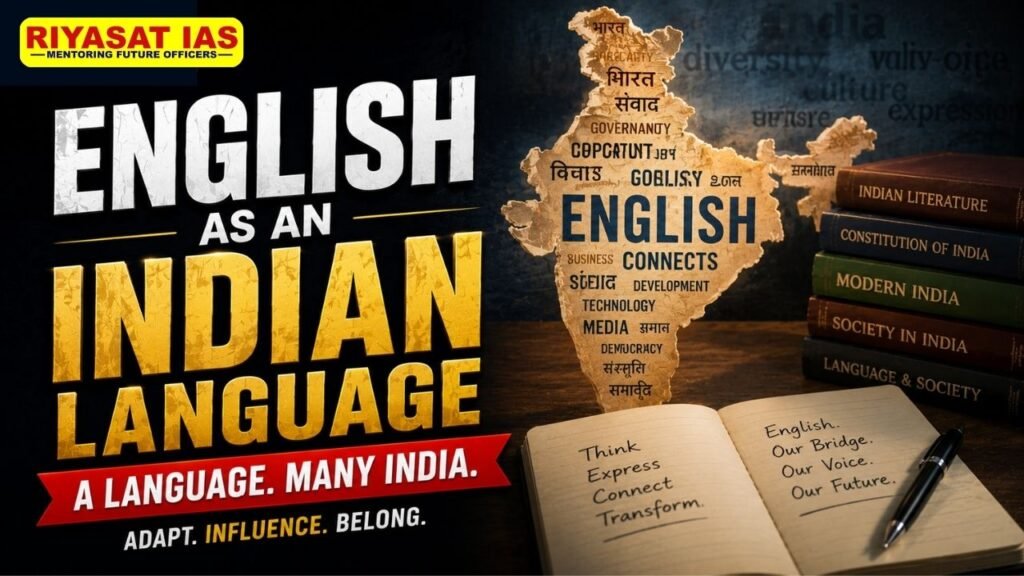
- Indianisation of English: Though English was introduced during British colonial rule, Indians have appropriated, transformed and Indianised it over the last two centuries.
A Language Transformed
- Colonial origins: English was introduced primarily for administration, commerce, missionary activity and colonial objectives.
- Indian appropriation: Languages are continually reshaped by the communities that speak them; Indians gradually transformed English into a medium of political expression, social reform and intellectual discourse.
- Raja Ram Mohan Roy: In 1823, he and his associates used English to defend the freedom of the Indian-language press in Calcutta.
- Dadabhai Naoroji: Used English to articulate the Drain Theory and expose the economic exploitation of India.
- Swami Vivekananda: His “My Plan of Campaign” lecture in Madras in 1897 demonstrated the use of English for communicating Indian ideas.
- Mahatma Gandhi: Translated Hind Swaraj into English to communicate Indian ideas to national and international audiences.
- Nationalist contribution: English therefore became an important medium for articulating Indian nationalism, social reform and cultural renaissance.
Post-Independence Recognition
- Constitutional settlement: The Constituent Assembly adopted a balanced approach by recognising Hindi as the Official Language of the Union while retaining English for official purposes.
- K.M. Munshi and N. Gopalaswami Ayyangar: Their role was significant in shaping this balanced language arrangement.
- Institutional usage: English has subsequently become an important language in academic, administrative, legislative, executive and judicial domains.
- Literary recognition: The Sahitya Akademi recognises English as one of the languages of Indian literature and confers annual awards.
- Indian Writing in English: Writers such as R.K. Narayan, Mulk Raj Anand, Amitav Ghosh and Vikram Seth have demonstrated the ability of English to authentically express Indian experiences.



Reach and Scale
- Census 2011: Nearly 129 million Indians reported English as their first, second or third language.
- Mother tongue: Nearly 2.6 lakh people reported English as their mother tongue.
- Second language: Around 83 million identified English as their second language.
- Third language: Around 46 million reported it as their third language.
- Growing functional knowledge: Scholars suggest that the number of Indians with at least functional knowledge of English may have increased substantially with the expansion of English-medium education.
- Language of aspiration: English has become an important language of aspiration and opportunity for a large section of Indian society.
Role in Education and Economy
- School education: Nearly 31,000 CBSE-affiliated schools primarily impart education through English.
- Other boards: Around 3,000 schools affiliated with boards such as CISCE also primarily use English.
- Higher education: English remains the principal medium in many premier higher educational institutions.
- Professional opportunities: English facilitates India’s engagement with the global economy, professional networks and international markets.
- Competitive advantage: India’s widespread English-language capability provides an advantage in competing with other economies and connecting with the global knowledge system.
Indianisation of English
- Raja Rao: In the Foreword to Kanthapura (1938), Raja Rao argued that India would develop its own version of English, just as other countries had developed their own varieties.
- Indian English: English in India has developed distinctive pronunciation, vocabulary, idioms and rhetorical conventions.
- Cultural adaptation: Indian English reflects Indian social realities and cultural sensibilities while remaining part of the global English family.
- Literary evidence: Writers such as V.K. Gokak and A.K. Ramanujan demonstrated that English could effectively express Indian mythology, philosophy, culture and social experiences.
Linguistic Naturalisation
- V.K. Gokak’s metaphor: In English Words, English words are portrayed as seeds that arrive from distant shores but take root in Indian soil and acquire a new life.
- A.K. Ramanujan: His works demonstrate that English can function as a natural medium for expressing Indian mythology, philosophy and devotion.
- Community determines identity: The identity of a language is shaped not merely by its historical origin, but also by the communities that use and transform it.
- Bridge language: English provides Indians with a bridge to communicate across India’s linguistic communities and with the wider world.
English and Indian Languages
- False binary: English should not be viewed as being in competition with Hindi, Tamil, Telugu, Kannada, Marathi or other Indian languages.
- Historical multilingualism: Monolingualism has never been the defining reality of Indian society.
- Complementarity: Indians can preserve their mother tongues and regional languages while using English for wider communication.
- Pan-Indian role: English can facilitate communication among people belonging to different linguistic communities.
- Need for multilingualism: Promotion of Indian languages should focus on preservation, development and wider usage, rather than opposition to English.
Way Forward
- Promote multilingualism: India should pursue a language policy that strengthens Indian languages alongside English.
- Strengthen Indian languages: Greater investment is required in translation, digital content, higher education and scientific literature in Indian languages.
- Expand English skills: English-language capabilities should continue to be developed because of their relevance to education, employment and global engagement.
- Avoid linguistic binaries: Language policy should avoid creating an artificial conflict between English and Indian languages.
- Recognise Indian English: Indian English should be understood as a language variety that has been substantially shaped by Indian society and culture.
Conclusion
English may not be an indigenous language of India in its historical origin, but two centuries of Indian usage have transformed it into an important part of modern India’s linguistic and cultural landscape. Its role in nationalism, literature, education, governance and global engagement demonstrates that languages acquire identity through their users. Therefore, the objective should not be to choose between English and Indian languages, but to build a multilingual India where English and indigenous languages complement one another.
UPSC Mains Practice Question
Q. “English may not be indigenous to India, but Indian English belongs to India.” Discuss the evolution of English in India and examine its role in promoting multilingualism, education and global engagement.





 Ravi Raaz
 Hassan Khan
 Shadab Ali