
GS-II: International Relations | International Law | Global Governance | UN System
Context
- Growing concerns: Ongoing conflicts in Ukraine and Gaza, instability in West Asia, violence against civilians and the limited effectiveness of international institutions have raised questions about the relevance of international law.
- Rules-based order: International law is based on the principle that relations between states should be governed not merely by power but by agreed rules and legal principles.
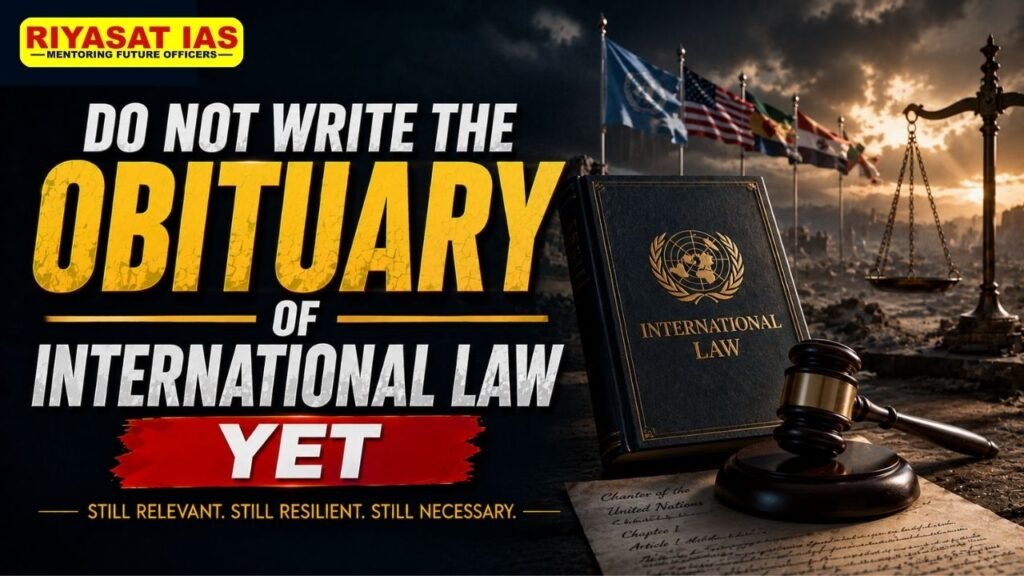
- Central dilemma: Continued wars and violations expose the limitations of the system, but they do not necessarily establish that international law has become irrelevant.
- UN position: In July 2026, UN Secretary-General António Guterres stated that international law is under pressure, but “it will prevail.”
Why International Law Is Still Relevant
- States continue to invoke law: Even states accused of violating international law generally justify their actions through concepts such as the UN Charter, sovereignty, territorial integrity, self-defence and international humanitarian law.
- Legal justification matters: The fact that states feel compelled to present their actions as legally valid demonstrates that international law continues to influence state behaviour.
- Not simply a system of sanctions: International law also provides a framework through which state conduct is assessed, disputes are addressed and cooperation is sustained.
- Compliance often remains invisible: Violations receive significant media attention, whereas everyday compliance with international rules generally goes unnoticed.
- Chayes’ argument: Scholars Abram Chayes and Antonia Handler Chayes argued that states often comply with international law because of the dynamics created within the treaty regimes to which they belong, rather than merely because of fear of sanctions.
The Quiet Power of International Law
- International aviation: Aircraft cross international borders because states comply with established international aviation rules.
- Maritime activity: Ships navigate international waters under the framework of international maritime law.
- Diplomacy: Diplomatic relations function through established legal norms and conventions.
- International trade: Global commerce depends upon thousands of international obligations and agreements.
- Travel and communication: Cross-border travel and international communications continue because states respect established rules.
- Multilateral agreements: States continue negotiating new legal frameworks despite geopolitical conflicts.
Emerging Areas of Cooperation
- High Seas Treaty: Demonstrates continued international cooperation to regulate activities beyond national jurisdiction.
- Pandemic preparedness: Global efforts toward pandemic preparedness reflect the need for collective legal commitments.
- Cybercrime: The United Nations Convention against Cybercrime demonstrates efforts to establish common international rules in emerging domains.
- Climate change: Environmental challenges require cooperation because their consequences transcend national borders.
- Cybersecurity and pandemics: These challenges cannot be effectively addressed by individual states acting alone.



Impact on Individuals
- Cross-border movement: International law becomes relevant whenever individuals cross international borders.
- Passports: Recognition of passports facilitates international mobility.
- Consular assistance: International legal frameworks provide the basis for consular protection and assistance.
- International air travel: Cross-border aviation depends upon international rules.
- Refugee protection: International legal principles provide protection to refugees and displaced persons.
- Everyday dependence: Millions of people rely on international legal arrangements without directly noticing them.
International Law and Peace
- Peace through legal commitments: Peace is often sustained through negotiations, commitments and legal arrangements.
- Peace agreements: Adversarial states frequently establish formal obligations through peace agreements and settlements.
- Ceasefire arrangements: Even temporary ceasefires create expectations regarding future conduct.
- Diplomatic understandings: States use legal and diplomatic commitments to establish predictable relations.
- India’s experience: The Indus Waters Treaty demonstrates that legal frameworks can provide a basis for continued engagement even during periods of political disagreement.
Importance for India and the Global South
- Rules-based order: International law provides developing countries an opportunity to protect their interests through negotiation rather than power alone.
- Climate challenges: Developing countries require predictable international rules to address climate change and climate finance.
- Pandemics: Global health crises require international cooperation and agreed rules.
- Economic instability: International economic challenges cannot be effectively managed through unilateral action.
- Strategic autonomy: A functioning rules-based order allows India to pursue its interests while maintaining strategic autonomy.
- Global South: International law can provide smaller and developing states with a platform to assert their interests against unequal power structures.
Structural Limitations
- Unequal power: International law has historically coexisted with unequal political and economic power structures.
- UN Security Council: The veto system and structural limitations of the Security Council constrain effective collective action.
- Selective enforcement: International law faces criticism when powerful states appear able to avoid consequences for violations.
- Weak enforcement mechanisms: Unlike domestic legal systems, international law often lacks a central authority capable of uniformly enforcing rules.
- Political realities: State behaviour continues to be influenced by national interests and geopolitical calculations.
Why Violations Do Not Mean Its Death
- No legal system guarantees perfect compliance: The existence of violations does not automatically establish that the underlying legal system is irrelevant.
- Standard of conduct: International law establishes the standards against which state behaviour can be judged.
- Adaptability: Historically, international crises have often resulted in the adaptation and development of new legal norms.
- Continuing reliance: States continue to invoke, interpret and negotiate international law even during conflicts.
- Alternative is dangerous: Abandoning international law would strengthen a world where power rather than rules determines outcomes.
Way Forward
- UNSC reform: Reform international institutions to make global governance more representative and effective.
- Strengthen compliance: Improve mechanisms for monitoring and implementing international obligations.
- Avoid selective application: International law should be applied consistently and universally.
- Strengthen multilateralism: States should continue negotiating legal frameworks for climate change, pandemics, cybercrime and emerging technologies.
- Greater Global South representation: Developing countries should have a stronger role in shaping international legal norms.
- Preserve rules-based order: India should continue supporting a fair, inclusive and rules-based international order while advocating reforms where existing structures are inadequate.
Conclusion
International law is certainly under pressure, but it is far from dead. Its importance lies not only in preventing every conflict but also in providing the rules, standards and institutions through which international conduct is assessed and cooperation is sustained. The continued reliance of states on international law demonstrates its enduring relevance. For India and the Global South, strengthening rather than abandoning the rules-based order remains essential to ensuring that might does not become the only source of international legitimacy.
UPSC Mains Practice Question
Q. “The continued violation of international law does not necessarily establish its irrelevance.” Examine the relevance and limitations of international law in contemporary global governance, with special reference to India.





 Ravi Raaz
 Hassan Khan
 Shadab Ali