
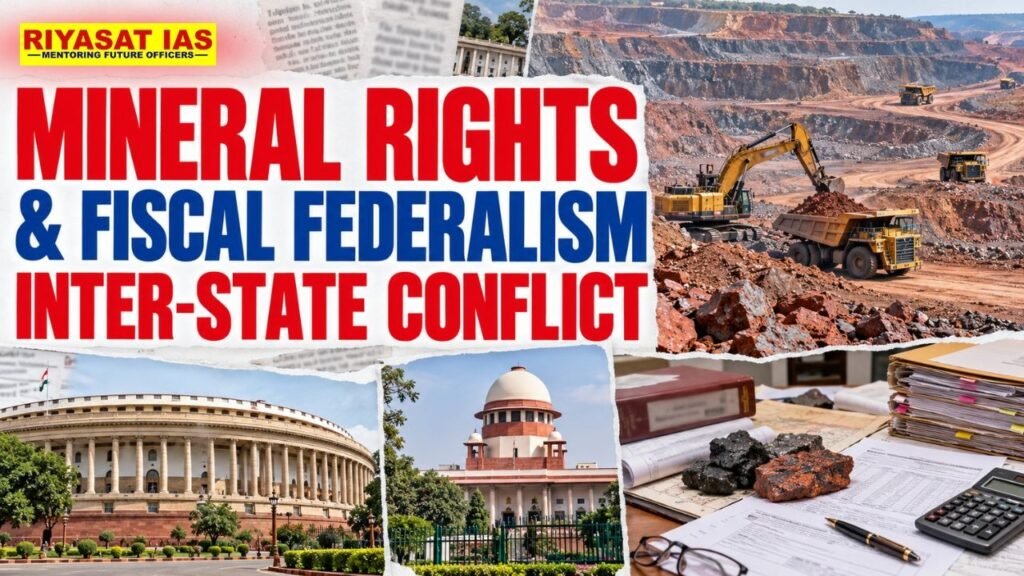
GS II Polity & Governance | Centre-State Relations | Fiscal Federalism
Mines and Minerals (Development and Regulation) Amendment Act, 2026
- Expansion of Centre’s Powers: The amended Act has given wider regulatory powers to the Centre over mining not only of mines and mineral development but also on mineral-bearing lands.
- State Taxation: It prohibits States from levying new taxes on mineral rights and mineral-bearing lands except in the manner that may be provided by the Union government.
- Past Dues: It also extinguishes mineral taxes levied by States but not wholly realized prior to the commencement of the Act.
Constitutional Division of Powers
- Entry 23. State List – Mines and minerals, but not including oilfields; Entry 54. Union List – Mining and mineral development, but not including coal, oilfields and mineral oils (emphasis added)
- Union List – Entry 54: The entry, thus, allows Parliament to have control over how much power it puts in relation to mining regulation and development of mines for purposes deemed as being in public interest.
- Taxation Powers: The Constitution further conferred powers on States to tax mineral rights and land as per entries 50 and 49 of the State List.
- Fiscal Autonomy: This recent amendment invokes the Centre’s constitutional powers to regulate mineral development, and imposes new restrictions on such taxes imposed by States. Thus, the concern spreads from regulating mining to the financial independence of States rich in minerals.
Supreme Court and Constitutional Position
- 2024 Supreme Court Stand: The amended provisions are inconsistent with the constitutional stand taken by the Supreme Court in 2024.
- Mineral Rights : It was decided by the court that even though Parliament has no power to limit such rights in interest of public, but the States can tax mineral right.
- Mineral–bearing land: Parliament is powerless to restrict the powers of the state with respect to tax on land (containing minerals) which includes in Entry 54.
- Centre’s Balancing Act: The Centre has contended that the uneven and myriad State-level taxation structure increases the price of indigenous minerals drives industries to imports and adds to the centuplicate burden on the exchequer.
- Revenue Impact: By invalidating unrecovered past dues, the law hits at the potential source of revenue for States, narrowing the prospective mineral-related revenue for some of the major mineral-bearing States.



The Fiscal Stakes
- Mineral Receipts: The ratio of mineral receipts to total non-tax revenue ranges from 85% in Jharkhand and 80% in Odisha, compared with only 48%,41% and39 % in Karnataka, Madhya Pradesh and Rajasthan respectively.
- Lower dependence: Telangana and Chhattisgarh are less dependent, accounting for 11% and 6% of their receipts from minerals as per the study.
- State-level Implications: Imposition or retention of levies on minerals has, therefore State-Level implications for Jharkhand and Odisha as it directly affects the tax base while it may have marginally less impact on Telangana and Chhattisgarh in immediate term.
- Odisha: The State is the largest producer of minerals in the country, with non-tax revenue on account of mineral resources accounting for about 70% but it could not respond as one.
- Political Reaction: The Opposition has called for a special Assembly session. The demand was, however, rejected by the BJP-led State government on the contention that the amendment would not affect Odisha’s mineral revenues.
- Even Telangana: Even Telangana, from which mineral receipts account for hardly 11% of the non-tax revenue, is joining the other non-NDA-ruled States aimed at knocking the doors of courts against the amendment.
- States in Opposition: Karnataka, Telangana, Himachal Pradesh and Kerala are preparing to fight the law in the Supreme Court by contending that the limits on State taxation of mineral rights and mineral-bearing land curtail States’ fiscal authority and do violence to federalism but Kerala has advanced an additional argument saying treating mineral-bearing land this way gives undue power to the Centre over more areas such as coastal and forest regions of a State.
- Jharkhand: Similar protests have also been voiced over the Centre’s decision on mineral royalties; Chief Minister Hemant Soren has warned that the amended Act invalidates certain uncollected past dues and cuts states’ earnings from mineral taxes, hitting social-security schemes benefiting millions.
- No challenge of its kind: In comparison, however, there has not been a similar challenge from States like Madhya Pradesh, Rajasthan or Chhattisgarh yet.
India’s Fiscal Federal Structure
- Asymmetric Federalism: The fiscal federal structure in India appears to be asymmetrical instead of purely decentralised.
- Funding and outlay: It offers greater taxation authorities to the Centre even as casting off more expenditure obligations on States in several locations.
- Centre plays a large role: Centre plays a large role in influencing both borrowing and transfers to the States; if the State needs transfers from the Centre or approval to borrow, it will need to maintain significant autonomy over crucial aspects of its financial management.
- Bone of Contention: how much financial independence do States have and how far can the Union meddle this itself becomes a bone of contention ( )
Evolving Indian Federal Dynamic
- Push and Pull: Push and pull — The Indian federal dynamic between the Union of India and States is a constant process.
- Conflicts: The conflicts between the Centre and States over legislative/executive jurisdiction, fiscal resources, administrative control and even foreign visits/engagements have emerged time-and-again in respect of:
- The GST compensation.
- Finance Commissions are given terms of reference.
- The National Education Policy.
- The Citizenship Amendment Act.
- Changes in All-India Services rules proposed.
- This amendment thus adds yet another fault line to the ongoing contest between Centre and States on legislative domain and fiscal autonomy.
UPSC Mains Practice Question
Q. The Mines and Minerals (Development and Regulation) Amendment Act 2026 has expanded the discourse beyond regulator of mines but even the financial sovereignty of States. Discuss in the context of Centre-State relations and fiscal federalism in India.
UPSC Mentorship Program: Get personalised UPSC guidance, preparation strategy, study planning, and continuous mentorship from experienced mentors.
Hindi Literature Optional: Prepare for UPSC Hindi Literature Optional with comprehensive syllabus coverage, expert guidance, and test-oriented preparation.





 Ravi Raaz
 Hassan Khan
 Shadab Ali