
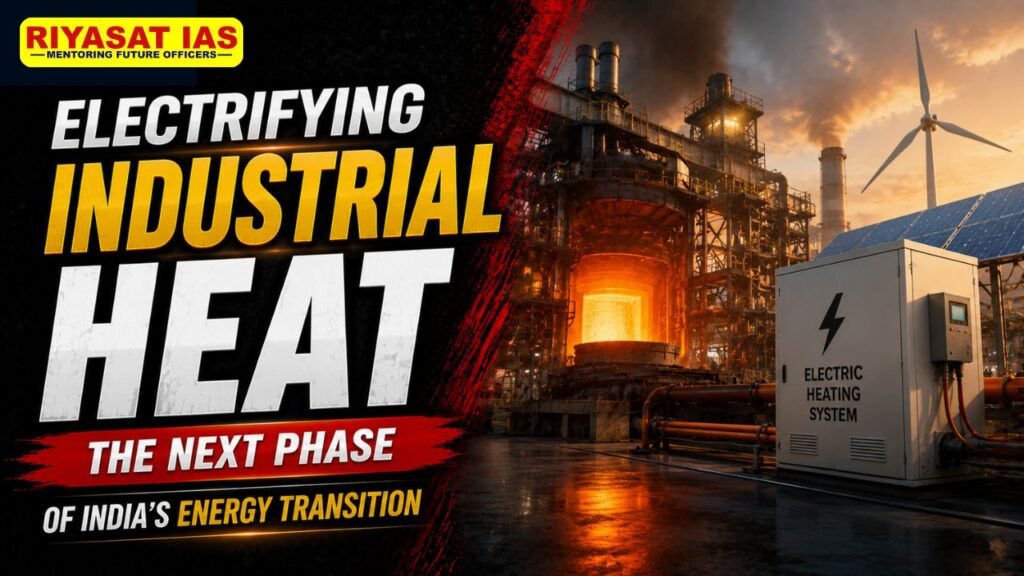
GS-III: Energy | Environment | Industrialisation | MSMEs | Renewable Energy | Decarbonisation
Context
- Renewable-powered electrification is expanding: India’s energy transition is already mainstreaming renewable-powered electrification across major demand centres.
- Major areas of electrification: Electric mobility, solar-powered irrigation and smarter appliances are increasingly replacing fossil-fuel-based systems.
- Next frontier — industrial heat: The next phase lies in electrifying industrial heat, particularly across MSMEs, to improve manufacturing competitiveness, energy security and decarbonisation.
- Solar PV as a model: India reduced solar tariffs by more than 85% over the past decade through supportive policies, innovative financing, competitive markets, institutional mandates and private investment.
- Need for a similar approach: Industrial heat electrification requires a coordinated strategy combining technology, finance, skills, infrastructure and institutional planning.
Facility-Level Engineering Assessments
- Assess thermal systems first: Most industries have limited visibility of their thermal systems beyond fuel consumption.
- Existing information gaps: Steam flows are often not metered, process temperatures remain unmonitored and waste heat streams are not quantified.
- Evaluate existing systems: Engineering assessments should examine boiler performance, operating costs, steam systems and recoverable waste heat.
- Prioritise efficiency: Where feasible, steam should be replaced with more efficient direct heating before electrification.
- Use process integration: Tools such as pinch analysis should identify internal heat-recovery opportunities before additional electricity is used.
- Cluster-level planning: Standardised process profiles can estimate thermal demand and identify electrifiable heat loads.
- District-level plans: Aggregated assessments can support industrial decarbonisation plans based on local industrial profiles, renewable resources and infrastructure readiness.
Technology-Inclusive Approach
- No one-size-fits-all solution: Industrial processes differ in temperature requirements, production schedules and thermal demand.
- Heat pumps: Suitable for low- and medium-temperature applications, particularly where waste heat can be recovered.
- Electric boilers: Provide a practical pathway for steam generation above 200°C.
- Mechanical vapour recompression: Can recover and reuse process vapour in evaporation-intensive processes.
- Thermal energy storage: Can store surplus heat generated when renewable electricity is abundant or recovered from industrial waste heat and release it when required.
- Peak-demand management: Thermal storage can improve operational flexibility and reduce peak electricity demand.



Affordable and Reliable Renewable Electricity
- Delivered electricity cost matters: Despite falling renewable generation costs, industrial users continue to face network charges, open-access provisions and transaction costs.
- Reform open access: Procedures should be streamlined and banking provisions rationalised.
- Strengthen grid infrastructure: Grid infrastructure should be improved, particularly for projects replacing fossil-fuel-based industrial heating.
- Integrate electricity and thermal planning: Renewable electricity planning should be aligned with industrial heat demand to maximise the use of renewable generation.
Evolving Financing Models
- MSME financing challenge: Industrial heat electrification requires significant engineering and investment, while many MSMEs have limited access to capital and technical expertise.
- Alternative financing: Models such as technology leasing, heat-as-a-service, Energy Service Company (ESCO) models and blended finance can reduce upfront costs and technology risks.
- Demand aggregation: Industries with similar thermal profiles can aggregate demand to reduce procurement costs and improve access to low-cost finance.
- Cluster-level investment pipelines: Facility-level assessments can be converted into cluster-level investment plans.
Skill Development and Implementation Capacity
- Existing skill gaps: MSMEs often face capability gaps that slow technology adoption and reduce efficiency.
- Need for specialised workforce: Industrial heat electrification requires engineers, technicians and operators skilled in:
- Process integration
- System design
- Installation and commissioning
- Operation and maintenance
- Digital automation and control systems
- Engineering transition: Electrification should be treated as a shop-floor engineering transition, rather than merely replacing existing equipment.
Demonstration Projects Before Large-Scale Mandates
- First-of-a-kind projects: India should establish demonstration projects across representative sectors, temperature ranges and industrial clusters.
- Reduce investment uncertainty: Demonstration projects can generate engineering evidence and validate business and financing models.
- Identify first movers: The most suitable facilities should be selected for early deployment.
- Initial focus: Brownfield units suitable for low- and medium-temperature electrification up to 250°C can be prioritised.
Common National Framework
- Coordinated framework: Industrial heat electrification requires a national framework combined with place-based implementation.
- Key elements: The framework should:
- Establish engineering standards.
- Designate institutional responsibilities.
- Facilitate demand aggregation.
- Mobilise finance.
- Support demonstration projects.
- Cluster-level implementation: District and industrial cluster plans should reflect their unique thermal profiles, electricity markets, local context and renewable energy potential.
Significance for India
- Industrial decarbonisation: Electrification can reduce fossil-fuel dependence in manufacturing.
- MSME competitiveness: Efficient industrial heat systems can improve energy efficiency and manufacturing competitiveness.
- Energy security: Greater use of renewable electricity can reduce dependence on fossil fuels.
- Emission reduction: Industrial heat electrification can contribute to lower greenhouse gas emissions.
- Future-ready industry: A coordinated transition can make India’s industrial economy more resilient and future-ready.
Conclusion
Industrial heat electrification represents the next major frontier in India’s energy transition. A combination of facility-level engineering assessments, technology diversity, affordable renewable electricity, innovative financing, skilled manpower and demonstration projects can convert electrification from an isolated technological intervention into a scalable industrial strategy.
UPSC Mains Practice Question
Q. Industrial heat electrification can become the next major frontier of India’s energy transition. Discuss the key technological, financial and institutional measures required to scale it, particularly among MSMEs.




 Ravi Raaz
 Hassan Khan
 Shadab Ali