
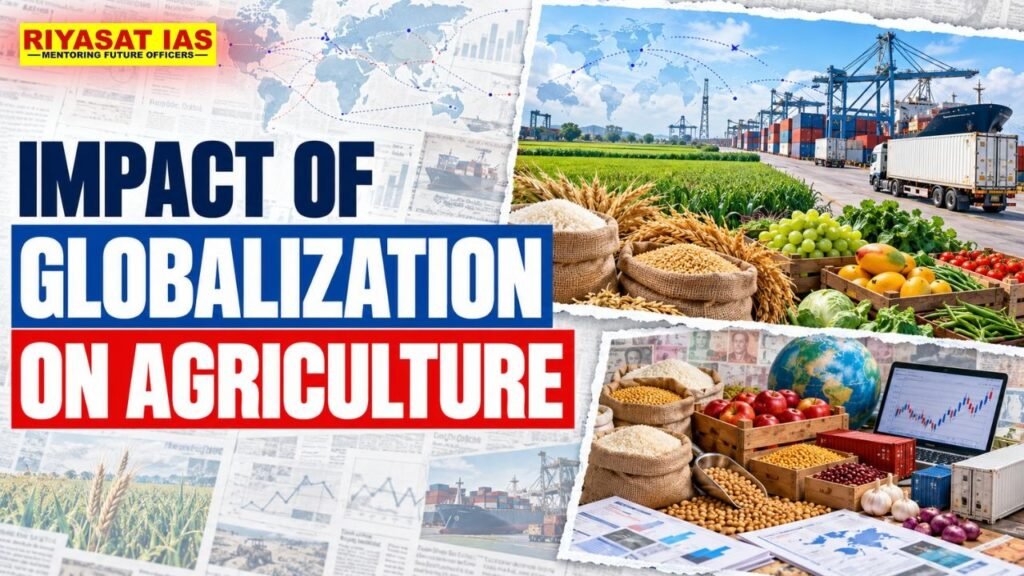
In the era of globalization, agriculture has been transformed in many ways. From the seed to the plate, agricultural products travel across the world and contribute to both local and international markets.
However, this phenomenon has both positive and negative consequences for agriculturalists and societies.
Positive Impacts of Globalization on Agriculture
Increased Market Access
- Through globalization, market accessibility increases manifold. This enables growers to sell their products to multinational companies and in distant markets where local markets may not have been viable.
- Access to international markets can provide additional buyers and may offer better prices when international market conditions are favourable.
Technological Advancement
- Due to the ease of exchange between countries, agricultural technologies and knowledge have become more accessible.
- Farmers can gain access to improved varieties, agricultural technologies, and information regarding appropriate farming practices developed in different parts of the world, subject to regulatory requirements and local suitability.
Agricultural Diversification
- With changing consumer preferences, the demand for agricultural products also changes.
- Due to the influence of domestic and international markets, farmers can diversify their production according to demand in other countries and different parts of their own country.
Increased Agricultural Trade
- Trade can create incentives for higher agricultural production by expanding the potential market for farm products.
- Through globalization, farmers can sell beyond the limits of local markets. The additional production can generate income and enable access to goods and services that may otherwise be difficult for individual farmers to afford.
Knowledge and Technology Sharing
- Problems related to agriculture are not restricted to a single country. Therefore, globalization helps in the sharing of knowledge, research, and technology between farmers, researchers, and agricultural departments across the world.
- In this way, agricultural practices that are beneficial for a particular region can be studied and adopted in other regions according to local conditions.
Increased Investment
- When markets open up, there can be an inflow of capital and investment.
- Globalization can encourage greater investment in agriculture and related sectors such as food processing, storage, logistics, and agricultural value chains.
Greater Food Choices
- Globalization enables consumers to access a wider variety of agricultural and food products from different regions and countries.
- This can increase the availability and variety of food products throughout the year.
Negative Impacts and Challenges of Globalization
Increased Competition
- The opening of international markets means that local producers compete against international producers and suppliers.
- Small-scale and marginal farmers may find it difficult to compete with larger and more highly organized producers because of differences in scale, technology, productivity, finance, and market access.
Import Dependence
- Increased imports of agricultural goods can put pressure on the domestic agricultural sector.
- Excessive dependence on imports can increase a country’s vulnerability to disruptions in international supply chains, geopolitical tensions, export restrictions, and global price shocks.
Price Volatility
- Since domestic agricultural prices can be influenced by international prices, changes in the global market can affect prices in the domestic market.
- Thus, farmers may experience income uncertainty and financial losses when prices fall sharply.



Environmental Degradation
- In order to meet international demand, agricultural production can sometimes contribute to environmental degradation.
- For example, clearing forests for farmland or excessive use of groundwater to increase production of export crops can damage the environment.
Pressure on Traditional Agriculture
- Agriculture practised in a country for hundreds of years may change due to the demands of domestic and international markets.
- This can lead to a decline in the cultivation of traditional varieties of crops and animals, potentially reducing agricultural biodiversity.
Globalization and Indian Agriculture
- Indian agriculture has experienced both positive and negative impacts of globalization.
- On the one hand, Indian agricultural products such as basmati rice, spices, marine products, tea, and fresh fruits have found wider markets across the globe. On the other hand, globalization has contributed to greater access to agricultural technology, knowledge, and international markets.
- Despite this, Indian agricultural production faces several challenges.
- A large proportion of Indian farmers operate small and marginal holdings, which can make it difficult for them to compete with large-scale and highly mechanized producers in international markets.
- Further, several aspects of Indian agriculture, particularly agricultural trade, are influenced by the rules of the World Trade Organization (WTO).
The WTO’s Agreement on Agriculture (AoA) establishes rules and commitments relating to agricultural trade, particularly in the areas of:
- Market access
- Domestic support
- Export competition
In order to benefit from globalization, Indian agriculture needs to be supported by proper infrastructure, institutions, technology, and market linkages.
Way Forward
In order to make the most of a globalized market while protecting farmers from its negative impacts, the following steps can be taken:
Infrastructure Development
- Development of cold storages, pack-houses, transportation infrastructure, and other post-harvest facilities can help reduce losses and wastage and improve access to markets.
Value Addition
- Instead of exporting low-value raw materials, farmers and agricultural value chains can increase returns through processing and value addition.
- Processed agricultural products can have greater market value and export potential.
Farmer Producer Organizations
- Farmers can unite into Farmer Producer Organisations (FPOs) in order to bargain more effectively, achieve economies of scale, improve market access, and obtain better prices for their products.
Agritech Development and Uptake
- New agricultural technologies and tools such as soil testing and Soil Health Cards, precision farming, remote sensing, and drones can be adopted to improve farm productivity and resource-use efficiency.
Climate-Smart Agriculture
To increase farm productivity while conserving natural resources such as water, farmers can adopt climate-smart practices such as:
- Micro-irrigation
- Water conservation
- Soil-health management
- Resource-efficient technologies
- Crop diversification
- Climate-resilient varieties
Insurance and Price Stabilization
- Crop insurance can protect farmers against specified production risks.
- Appropriate price-support and market-stabilization measures can help reduce the impact of sharp price fluctuations in agricultural markets.
Food Security
- A balance needs to be struck between ensuring food security for local populations and promoting exports to provide farmers with sustainable income opportunities.
- Trade policies should consider domestic availability, farmer incomes, consumer interests, and export opportunities.
Export Standards
- Producers need to meet the various standards required for exports, such as phytosanitary and food-safety standards.
- Therefore, farmers should be provided with adequate education, training, testing facilities, and information regarding these standards.
Genetic Resources
- Local genetic resources and traditional seeds need to be conserved to maintain agricultural biodiversity and ensure resilience in the face of climate change, pests, and diseases.
Conclusion
- Due to globalization, agriculture has transcended national boundaries.
- It has allowed farmers and agricultural value chains to access international markets, adopt new technologies, and diversify their products. However, it also comes with risks such as price fluctuations, competition from large-scale international producers, and environmental damage associated with unsustainable or intensive production.
- While complete separation from international markets is not desirable, a focus on building strong domestic institutions, infrastructure, market linkages, and farmer-support systems can help a country participate in the global market without jeopardizing the security and sustainability of its agriculture sector.
FAQs on Impact of Globalization on Agriculture
What is globalization in agriculture?
Globalization in agriculture is a process through which the commercial, cultural, political, and economic activities of a country become increasingly integrated with the international community.
What are the major positive impacts of globalization on agriculture?
The major positive impacts include increased market access, technological advancement, agricultural diversification, increased investment, knowledge sharing, and greater food choices.
What are the major negative impacts of globalization on agriculture?
The major negative impacts include increased competition, price volatility, import dependence, environmental degradation, and pressure on traditional agriculture.
How does globalization affect Indian farmers?
Globalization has both positive and negative impacts on Indian farmers. It has provided opportunities to participate in international markets and access new technologies. However, small-scale farmers may face greater competition and exposure to international price fluctuations.
How does globalization affect food security?
Globalization can affect food security in both ways. It can improve food availability by making it easier to import food during periods of domestic shortage. However, excessive dependence on imports can increase vulnerability to supply-chain disruptions, export restrictions, and global price shocks.
How does globalization promote agricultural technology?
The increased exchange of information, technologies, research, and agricultural practices between countries facilitates the adoption of suitable agricultural technologies in different regions.
How does globalization affect the environment?
Globalization can facilitate the spread of environmentally friendly agricultural practices and technologies. However, it can also contribute to environmental degradation when agricultural production intensifies to meet market demand without adequate resource management.
What is the role of the WTO in agricultural globalization?
The World Trade Organization (WTO) establishes rules governing international trade, while its Agreement on Agriculture (AoA) establishes rules and commitments relating specifically to agricultural trade, including market access, domestic support, and export competition.
What should India do to benefit from globalization in agriculture?
India should invest in agricultural infrastructure, food processing, cold chains, storage and transportation, encourage FPOs, promote appropriate agricultural technologies, provide training on food safety and quality standards, conserve genetic resources, and strengthen insurance and market-stabilization mechanisms against international price fluctuations.



 Ravi Raaz
 Hassan Khan
 Shadab Ali