
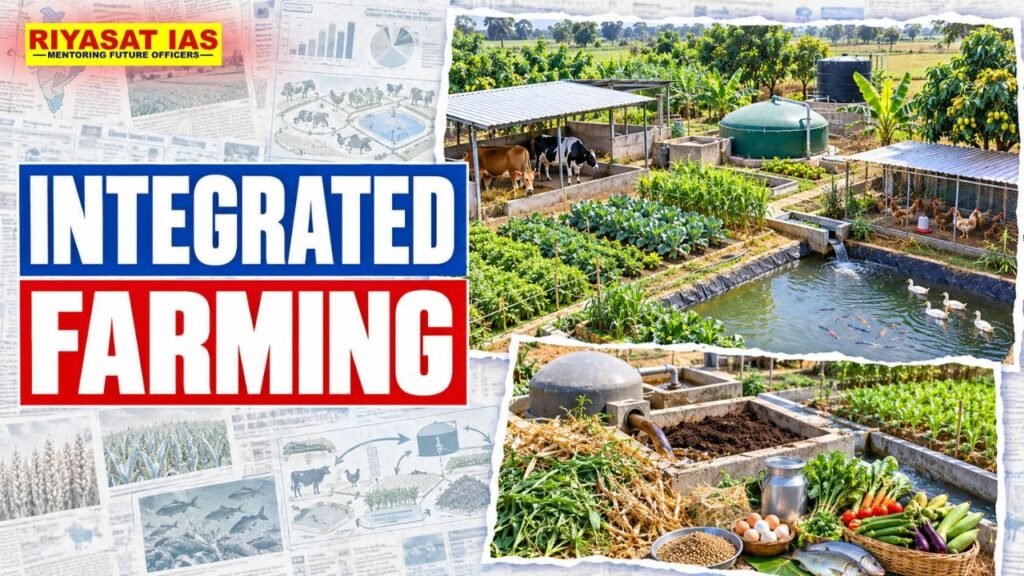
An Integrated Farming System (IFS) is a model of agriculture that views a farm as an integrated ecosystem and not as a collection of independent activities such as crop cultivation, cattle rearing, and fish farming. An IFS views crop fields, cattle sheds, and fish ponds as elements of a larger production cycle in which subsidiary activities like agroforestry, beekeeping, and mushroom cultivation are included.
- The key idea in an IFS is that the waste or by-product of one activity is used as an input in another. Crop stalks and grain chaff are used as cattle fodder; cattle dung is used to make compost or biogas; and the slurry from the biogas plant and pond silt are used as manure for crops.
- By recycling farm resources within the farm, an IFS reduces the need for expensive external inputs, makes farmers less vulnerable to price fluctuations in the market, and helps conserve natural resources like soil and water.
Features of an Integrated Farming System
Crop and Livestock Diversification
- Cultivating more than one type of crop or rearing different types of livestock is a fundamental component of the IFS model. With diversified farming, the risk of losing the entire farm income due to extreme weather conditions, pest outbreaks, or price fluctuations in the market is reduced considerably.
- A resource-rich region can make better use of its resources by choosing a combination of crops and animals that are in demand in a given region. Marginal and small farmers can also participate in diversified farming according to the resources available to them.
- While growing paddy, farmers could also rear dairy cattle and backyard poultry, keep a small freshwater fish pond, and grow trees along the boundaries for timber. Thus, even if a hailstorm destroys their standing crop, dairy, poultry, and fish farming could still provide alternative sources of income.
Resource Recycling and Efficient Utilization
The IFS model is based on the concept of recycling farm waste for the optimal use of resources.
Resource Recycling Cycle:
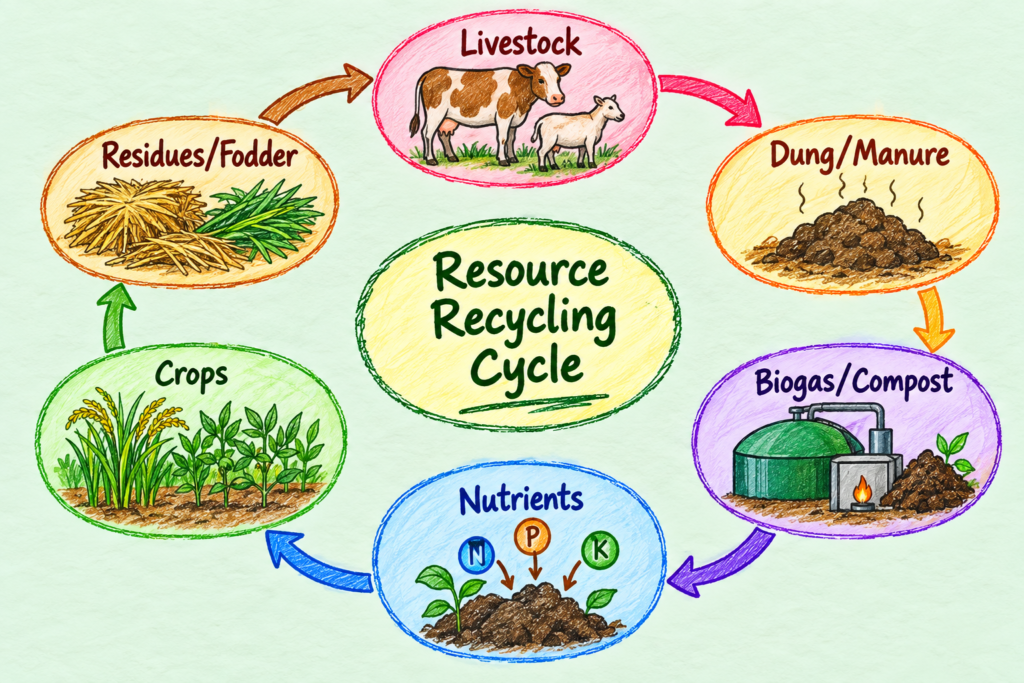
Similarly, nutrient-rich water and organic matter from different farm components can be recycled appropriately, while nutrient-rich silt from the bottom of a fish pond can be used to improve soil fertility for growing crops.
Such resource recycling not only conserves resources but also maximizes the returns from farmland, water, and labour invested.
Conservation of Natural Resources
- By focusing on the extensive use of organic matter, green manure, and tree leaves, farmers can help replenish organic carbon in the soil.
- By adopting multi-tier cropping and agroforestry, farmers can conserve topsoil and improve its water-retention capacity. Similarly, compost and farmyard manure can enrich the soil with organic matter and support healthy soil biological activity.
Control of Pests and Diseases
- Growing a single crop or livestock enterprise exposes farmers to the risk of pests and diseases specific to that crop or livestock.
- However, in an IFS model, farmers grow a variety of crops and vegetation and rear animals and birds in combinations that can support ecological pest management and biodiversity.
- Thus, IFS can help reduce a farmer’s dependence on chemical pesticides and fungicides by promoting biological and ecological approaches to pest management.
Diversified Source of Income
- The traditional farming system often follows a cyclical pattern of cash flow for a farmer—heavy expenditure on seeds, fertilizers, and pesticides at the beginning of the season and a lump-sum amount received at the end of the harvest when the crop is sold.
- The IFS model, on the other hand, can provide farmers with more regular and diversified sources of income, as farmers can sell milk, eggs, vegetables, and fish at different intervals throughout the year.
- Furthermore, a farmer can have multiple sources of income from the same farmland without depending entirely on a single crop cycle.
Challenges of Integrated Farming
Technical Complexity
- An IFS model is technically complex and requires farmers to have knowledge of diverse aspects of agriculture, such as soil management, cattle nutrition, poultry vaccination, fish farming, integrated pest management, and so on.
- Thus, without proper training in these technical areas, farmers could make mistakes that may adversely affect one or more components of their farming system.



Small and Fragmented Landholdings, Water and Labour Constraints
- Small and fragmented landholdings can constrain the adoption and scale of an IFS model, particularly where adequate water, labour, and infrastructure are unavailable.
- Furthermore, some IFS combinations require adequate availability of water and skilled labour, both of which may not be easily available to small and marginal farmers.
High Initial Capital Investment
- Though an IFS model can lower recurring expenditure through the extensive utilization of farm-generated resources, the initial capital outlay required for fencing, constructing cattle sheds, fish ponds, and micro-irrigation systems could be beyond the reach of many small and marginal farmers.
Lack of Adequate Market Access
- Since an IFS model involves the production of a variety of goods, often in relatively smaller quantities, a farmer may have to transport and sell them in multiple markets.
- This lack of economies of scale could prove to be a financial challenge.
Climate Change
- While an IFS model can help diversify climate risks, it is not totally insulated from them.
- A heatwave, for instance, could affect the dairy, fish, and crop-growing components of an IFS model at the same time.
Regulatory Formalities
- An integrated farming system may involve a variety of activities, such as dairy, poultry, fish farming, and agroforestry.
- Depending on the nature and scale of these activities, farmers may have to comply with different regulations, registrations, or other requirements.
Government Initiatives for Promoting Integrated Farming
India does not have a single uniform policy exclusively for promoting integrated farming. Instead, several government initiatives at the central and state levels support different components of integrated farming.
Rashtriya Krishi Vikas Yojana (RKVY)
- Launched in 2007–08, RKVY provides states with flexibility to design and implement agricultural and allied-sector development projects according to their priorities and agro-climatic conditions.
- The scheme can support state-specific agricultural projects and activities relevant to integrated farming, farm diversification, infrastructure, and allied agricultural activities.
- The Rainfed Area Development (RAD) component, which promotes Integrated Farming Systems in rainfed areas, has been integrated into RKVY from FY 2022 onward.
Pradhan Mantri Krishi Sinchayee Yojana (PMKSY)
- PMKSY was launched in 2015 to improve irrigation coverage and water-use efficiency in agriculture.
- Its Per Drop More Crop approach promotes efficient water use through micro-irrigation systems such as drip and sprinkler irrigation.
- Improved availability and efficient use of water can facilitate the integration of crops, livestock, horticulture, and other farm enterprises under an IFS model.
National Mission for Sustainable Agriculture (NMSA)
- The National Mission for Sustainable Agriculture (NMSA) works under the framework of the National Action Plan on Climate Change and promotes climate-resilient agriculture, soil health management, resource conservation, and sustainable agricultural practices.
- The Rainfed Area Development (RAD) component was implemented under NMSA from 2014–15 to promote integrated farming systems such as crop-livestock, crop-fishery, and agroforestry in rainfed areas.
- From FY 2022 onward, RAD has been integrated into RKVY, while continuing to support Integrated Farming Systems in rainfed regions.
National Livestock Mission (NLM)
- The National Livestock Mission (NLM) supports livestock and poultry entrepreneurship, breed improvement, feed and fodder development, and related infrastructure.
- These activities can complement an Integrated Farming System by strengthening its livestock, poultry, and fodder components.
Krishi Vigyan Kendras (KVKs)
- The Krishi Vigyan Kendras (KVKs) are Farm Science Centres that promote agricultural technologies at the local level through technology assessment, demonstrations, and capacity development.
- KVKs also demonstrate location-specific integrated farming models according to the agro-climatic conditions of different regions and provide training to farmers in areas such as integrated pest management, livestock management, farm ponds, and compost production.
Way Forward for Integrated Farming
Research and Development
- Agricultural research institutions and universities should promote greater research on integrated ecological and farming systems, alongside research on individual agricultural commodities.
- Research could focus on developing cost-effective recycling methods and zero-waste bio-digesters suitable for different agro-ecological regions of the country.
Awareness and Farmer Training
- States could promote awareness about integrated farming systems and provide training to farmers in these techniques.
- To this end, KVKs could provide farmers with exposure visits to model farms before they make major capital investments in integrated farming.
- Practical workshops and field demonstrations can complement classroom-based training.
Public-Private Partnership
- The government needs to encourage public-private partnerships to develop processing equipment and technologies suitable for small-scale farmers.
- There is a need to develop affordable and compact systems like feed mills, cold storage, and solar dryers.
- The government could also facilitate market and buyback linkages for processed farm products.
Market Linkages
- The government should encourage the formation and strengthening of Farmer Producer Organisations (FPOs) among integrated farmers so that they can aggregate their produce, bargain for better prices, and sell their products in bulk.
- FPOs could also facilitate direct marketing and reduce dependence on multiple intermediaries.
ICT and Technology
Farmers need to be encouraged and equipped with technological tools to monitor and manage their farming systems.
Such tools include:
- Mobile-based diagnostic tools
- Weather forecast apps
- Mandi price discovery tools
- Tele-consultation services
Importance of Integrated Farming System for Indian Agriculture
| Focus Area | Core Contribution |
| Income Stability | Provides farmers with more regular and diversified sources of income through dairy, poultry, crops, fisheries, and other enterprises. |
| Risk Management | Reduces dependence on a single enterprise by spreading risk across different farm activities. |
| Resource Optimization | Ensures that crop residues, manure, and other farm by-products are put to productive use. |
| Soil Health | Improves soil quality through regular application of compost, farmyard manure, and recycled organic matter. |
| Gainful Employment | Can provide farm households with employment opportunities throughout the year. |
| Nutrition Security | Can supply farm families with nutritious food items, including pulses, seasonal vegetables, fresh milk, fish, and eggs. |
| Ecological Health | Can reduce dependence on chemical inputs and support biodiversity and natural-resource conservation. |
| Climate Resilience | Builds resilience by diversifying farm enterprises and integrating water conservation, tree cover, and other sustainable practices. |
| Economic Circularity | Reduces dependence on purchased inputs by recycling crop residues, manure, fodder, and other farm resources. |
Conclusion
- An IFS model replaces the conventional linearity of agricultural production with circularity.
- It can reduce the burden of expenditure by converting crop residues into cattle fodder and manure into compost or biogas. At the same time, it reduces risk by diversifying farm enterprises rather than depending entirely on a single crop.
- The success of an IFS model depends on coordinated efforts by farmers, research institutions, extension agencies, markets, and policymakers. By facilitating credit availability, farmer training, processing infrastructure, market linkages, and FPOs, Integrated Farming Systems can provide a more sustainable pathway for improving farm income, resource efficiency, and agricultural resilience.
FAQs on Integrated Farming
What is integrated farming?
Integrated farming is a farming strategy in which different activities, such as crop cultivation, dairy, fish farming, agroforestry, poultry, and beekeeping, are combined so that the by-product of one activity can be used as an input in another.
What is the main principle of integrated farming?
The main principle of integrated farming is resource recycling and biological synergy. In other words, integrated farming seeks to capture and recycle farm waste to reduce dependence on expensive external inputs.
How does integrated farming increase farmers’ income?
Integrated farming can provide more regular and diversified sources of income while reducing expenditure on external inputs by recycling farm resources.
How does integrated farming help the environment?
Integrated farming can increase organic matter in the soil, reduce dependence on chemical inputs, conserve water through appropriate water-management practices, recycle biomass through composting and biogas, and support biodiversity.
What are the major challenges of integrated farming?
The major challenges of integrated farming include technical complexity, initial investment requirements, small and fragmented landholdings, water and labour constraints, inadequate market access, and the need for specialized skills.
Which government programmes support integrated farming?
Different components of integrated farming are supported through programmes such as RKVY, Rainfed Area Development (RAD), PMKSY, NMSA, National Livestock Mission, and the extension and demonstration activities of KVKs.
What is the difference between mixed farming and integrated farming?
While mixed farming refers to the combination of crop cultivation and livestock farming on the same farm, integrated farming involves deliberately linking different farm enterprises so that the output or by-product of one enterprise becomes an input for another, improving resource-use efficiency.


 Ravi Raaz
 Hassan Khan
 Shadab Ali