
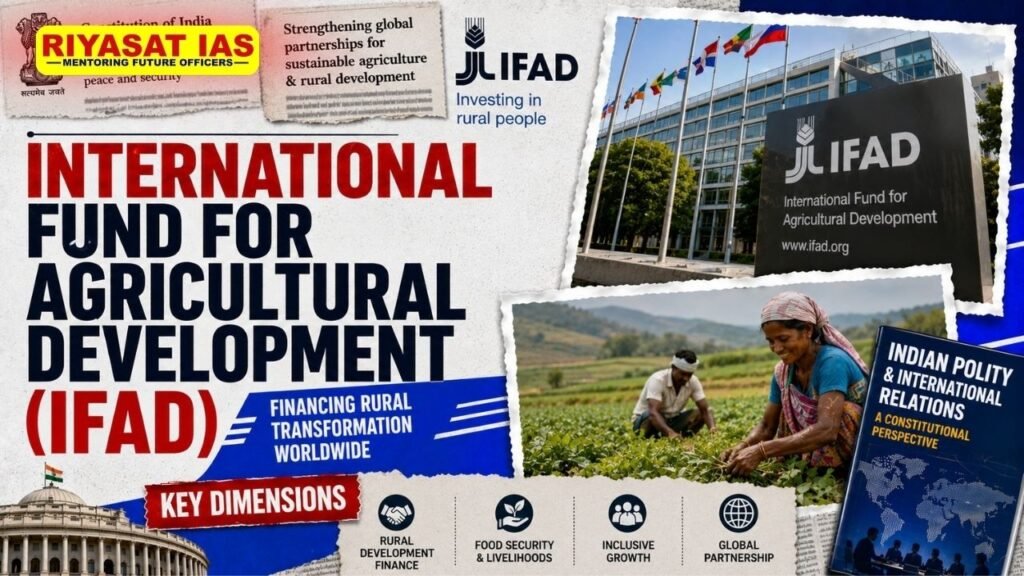
About IFAD
The International Fund for Agricultural Development (IFAD) is a specialised agency of the United Nations and an international financial institution dedicated exclusively to reducing rural poverty and hunger and improving the livelihoods of rural populations, particularly small-scale farmers and vulnerable rural communities.
It was created in response to the global food crisis of the early 1970s and was established as an international financial institution through the Agreement Establishing IFAD, which was adopted in Rome on 13 June 1976 and entered into force on 30 November 1977. Its headquarters are in Rome, Italy.
IFAD primarily provides loans, grants, technical assistance and development finance for rural development, agricultural transformation, food security and climate resilience. Unlike many development institutions, its work is focused specifically on rural people and agricultural development.
Key Facts
o Established: 1977.
o Founding agreement: Agreement Establishing in 1976.
o Headquarters: Rome, Italy.
o Nature: UN specialised agency and international financial institution.
o Current membership: 180 Member States.
o Primary focus: Rural poverty, hunger, food security, smallholder agriculture and rural transformation.
o Governing bodies: Governing Council and Executive Board.
Membership of IFAD
· IFAD currently has 180 Member States representing countries from different regions and income groups. Membership is open to any State that is a member of the United Nations, a UN specialised agency or the International Atomic Energy Agency.
· For governance and voting purposes, Member States are grouped into three lists:
· List A mainly consists of high-income contributor countries that contribute resources to IFAD and are generally not eligible for IFAD financing.



· List B consists primarily of contributing developing countries, including several OPEC members, some of which can also receive IFAD financing and services.
· List C primarily consists of developing countries that are eligible to receive financing and services while also contributing to the Fund. List C is further divided into C1, C2 and C3 according to geographical regions.
· A distinctive feature of IFAD’s governance is that one-third of the votes created is allocated to List C countries as membership votes, helping strengthen the representation of developing countries.
Key Legal Instruments and Institutional Ties
The principal legal foundation is the Agreement Establishing the International Fund for Agricultural Development, adopted on 13 June 1976 and brought into force on 30 November 1977. The Agreement defines IFAD’s objectives, membership, governance, resources and decision-making arrangements.
· The By-Laws for the Conduct of the Business of IFAD supplement the Agreement and establish procedural rules for the functioning of its governing bodies.
· IFAD also operates under Financial Regulations and General Conditions for Agricultural Development Financing, which provide the framework for its financial operations and development financing.
Relationship with the UN System
It works closely with the Food and Agriculture Organization (FAO) and other UN organisations, international financial institutions, governments, NGOs and development agencies.
This cooperation is explicitly recognised in Article 8 of the Agreement Establishing IFAD, which calls for close cooperation with FAO and other organisations involved in agricultural development.
IFAD and Sustainable Development
· IFAD’s work directly supports several Sustainable Development Goals, particularly SDG 1 (No Poverty), SDG 2 (Zero Hunger), SDG 5 (Gender Equality), SDG 8 (Decent Work and Economic Growth), SDG 10 (Reduced Inequalities), SDG 13 (Climate Action) and SDG 15 (Life on Land).
· Its central contribution lies in connecting rural development with poverty reduction, food security, climate resilience and inclusive economic growth.
· In 2026, IFAD launched consultations for its 14th replenishment (IFAD14), highlighting the importance of rural transformation for food security, economic growth, employment and stability amid geopolitical fragmentation and increasing pressure on global food systems.
India and IFADs
· India became a member of IFAD on 28 March 1977, shortly before the Fund formally began operations.
· India’s engagement with this is particularly relevant to smallholder agriculture, rural livelihoods, agricultural value chains, climate resilience, women’s empowerment and rural financial inclusion.
· IFAD’s approach complements India’s development priorities relating to agricultural productivity, rural employment, farmer incomes, food security and climate-resilient agriculture.
FAQs
1. What is IFAD?
It is a UN specialised agency and international financial institution focused on reducing rural poverty, hunger and vulnerability through agricultural and rural development finance.
2. When was IFAD established?
The Agreement Establishing IFAD was adopted in 1976 and entered into force on 30 November 1977, marking the establishment of the Fund.
3. How many members does they have?
IFAD currently has 180 Member States.
4. Where is IFAD headquartered?
IFAD is headquartered in Rome, Italy, which is also an important global centre for UN food and agriculture institutions.
5. What makes IFAD different from FAO?
FAO primarily provides knowledge, standards, technical assistance and policy support, whereas IFAD is an international financial institution that provides development finance for rural and agricultural development.





 Ravi Raaz
 Hassan Khan
 Shadab Ali