
Participatory Notes (P-Notes): Participatory Notes, or P-Notes, are financial instruments that allow overseas investors to get exposure to Indian securities without directly registering as a Foreign Portfolio Investor (FPI). They are issued by eligible registered FPIs and are commonly referred to as Offshore Derivative Instruments (ODIs).
In simple words: An overseas investor can gain economic exposure to Indian shares or other eligible securities through a registered FPI instead of investing directly as an FPI.
Underlying Securities: P-Notes can be linked to eligible Indian securities such as equities, government securities and corporate bonds, subject to the applicable SEBI rules.
How Do Participatory Notes Work?
The basic idea behind P-Notes is quite simple. The overseas investor does not directly buy the Indian security as an FPI. Instead, an eligible registered FPI issues an ODI that gives the investor economic exposure to the underlying security.
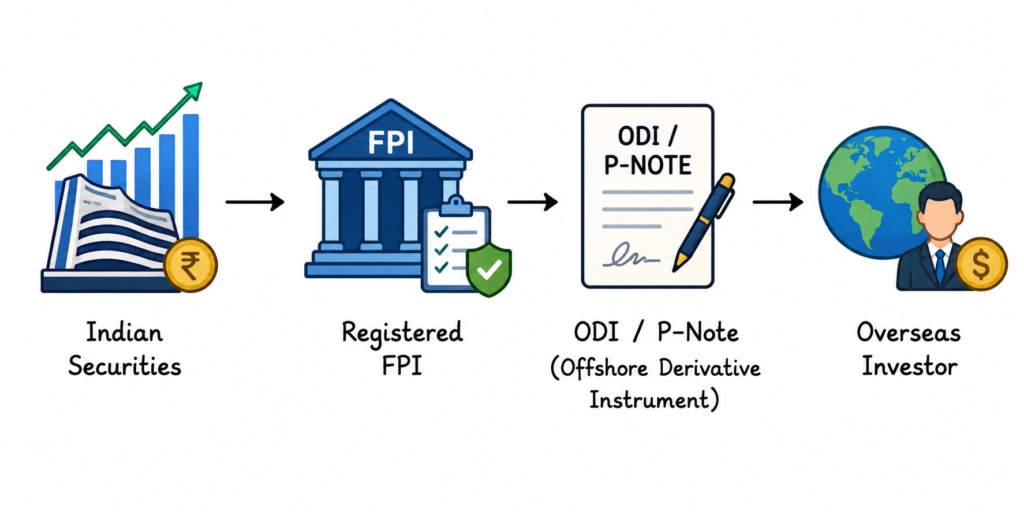
Role of FPI: The registered FPI holds the underlying securities and issues the ODI to the overseas investor according to the applicable regulatory requirements.
Role of Investor: The overseas investor receives the economic benefits associated with the underlying investment, according to the terms of the ODI.
Who Issues P-Notes?
Registered FPIs: P-Notes are issued by eligible registered Foreign Portfolio Investors under SEBI’s regulatory framework.
Overseas Investors: The investor receiving the ODI obtains exposure to the Indian securities market without becoming a direct FPI.
SEBI Oversight: The FPI issuing the ODI must comply with SEBI’s applicable registration, reporting, disclosure and due-diligence requirements.
Why Do Investors Use P-Notes?
Indirect Access to Indian Markets: P-Notes give overseas investors a way to obtain exposure to Indian securities without holding direct FPI registration.



Investment Convenience: For eligible investors, investing through an ODI can provide an alternative route to participate in the Indian securities market.
Exposure to Indian Assets: Investors can gain economic exposure to Indian equities and other eligible securities through the underlying assets of the ODI.
Are P-Notes Regulated by SEBI?
SEBI Regulation: Yes. P-Notes are not outside the regulatory system. They operate under SEBI’s framework for Offshore Derivative Instruments and Foreign Portfolio Investors.
Current Regulatory Framework: SEBI has introduced additional requirements around ODI issuance, reporting and transparency over the years. The framework has become more structured to ensure better monitoring of offshore investment.
Separate ODI Registration: Under the current framework, an FPI issuing ODIs generally requires a separate registration for ODI issuance, subject to applicable exceptions.
Underlying Asset Rules: Current rules also place restrictions on the underlying assets and require compliance with prescribed hedging conditions.
Investor Due Diligence: ODI-issuing FPIs are required to follow applicable requirements relating to investor identification, documentation and reporting.
Why Has SEBI Strengthened P-Note Regulations?
Greater Transparency: SEBI has progressively strengthened disclosure and reporting requirements to get a clearer picture of offshore investment flows.
Preventing Regulatory Arbitrage: Regulatory changes have aimed to reduce situations where investors could obtain similar economic exposure through different structures while facing significantly different regulatory requirements.
Better Monitoring: Stronger reporting and compliance requirements make it easier for regulators to monitor ODI activity and identify potential risks.
What Factors Affect P-Note Investment?
P-Note activity does not move in isolation. It is influenced by the same broader factors that affect international investment flows.
Global Interest Rates: When interest rates rise in major economies, investors may find those markets more attractive, potentially reducing flows towards emerging markets.
Inflation: Changes in inflation expectations can influence interest rates, investment decisions and global risk appetite.
Indian Market Valuations: If Indian shares and other assets appear attractive relative to their expected returns, foreign investors may increase their exposure.
Currency Movements: Changes in the value of the rupee can affect the returns that overseas investors receive after converting their investment back into their home currency.
Global Risk Appetite: During periods of uncertainty, investors often become more cautious about emerging markets. When confidence improves, investment flows can recover.
P-Notes vs Direct FPI Investment
| P-Notes vs Direct FPI Investment | Column 1 | Column 2 |
| Feature | P-Notes / ODIs | Direct FPI Investment |
| Investor | Overseas ODI subscriber | Registered FPI |
| Investment Route | Through an ODI | Direct investment |
| Issuer | Eligible registered FPI | Investor itself |
| Indian Market Exposure | Indirect | Direct |
| SEBI Framework | Applicable | Applicable |
Frequently Asked Questions (FAQs)
What are P-Notes?
P-Notes are Offshore Derivative Instruments issued by eligible registered FPIs to provide overseas investors with exposure to Indian securities.
Who issues P-Notes?
Eligible registered Foreign Portfolio Investors issue P-Notes/ODIs.
Are P-Notes and ODIs the same?
P-Notes is the commonly used term, while Offshore Derivative Instruments (ODIs) is the terminology used in the current SEBI framework.
Why are P-Notes used?
They provide overseas investors with indirect economic exposure to Indian securities without direct FPI registration.
Are P-Notes regulated by SEBI?
Yes. P-Notes operate under SEBI’s regulatory and reporting framework.
Can P-Notes be issued against derivatives?
Under the current framework, FPIs cannot issue ODIs with derivatives as the reference or underlying asset.
What affects P-Note investment?
Global interest rates, inflation, currency movements, Indian market valuations and foreign investor sentiment can affect P-Note activity.
Are P-Notes still relevant in 2026?
Yes. P-Notes/ODIs remain part of India’s foreign investment framework, while SEBI continues to monitor and regulate their use.




 Ravi Raaz
 Hassan Khan
 Shadab Ali